

K Y Duration
A couple has finally found the right moment. The room is comfortable, the lubricant is nearby, and a delay spray was applied earlier. Then the lubricant starts feeling tacky, the spray seems either too subtle or too strong, and one partner wonders whether adding more will restore the experience. That confusion is common because delay sprays and lubricants solve different problems.
K-Y Duration belongs to the first category. It's a lidocaine-based male genital desensitizing spray intended to temporarily reduce sensation and help prolong the time until ejaculation. A standard lubricant, by contrast, reduces friction. Understanding that difference makes product timing, reapplication, cleanup, and partner safety much easier to manage.
Table of Contents
- Understanding Intimacy Product Longevity
- How Long K-Y Duration and Delay Sprays Last
- Duration of Common Lubricant Types
- Factors That Affect Reapplication and Layering
- Safety Context and Contraindications
- Building Your Intimacy Product Strategy
Understanding Intimacy Product Longevity
The spray was applied, the lubricant is within reach, and the first few minutes feel comfortable. Later, the lubricant becomes tacky while sensation still seems reduced. Adding more of either product may sound reasonable, yet the two products respond to different problems. Reapplication works best when you identify whether friction or sensitivity has changed.
A lubricant modifies the contact surface between skin, fingers, toys, or other materials. Its useful life depends on friction, moisture, the formula's base, and whether it remains on the skin or absorbs. A delay spray works through an active ingredient, so its effect depends more on absorption, the amount used, individual sensitivity, and whether residue stays on the intended area.
Layering can complicate both results and safety. If a man applies a delay spray and immediately covers the area with a generous amount of lubricant, the lubricant may spread the active ingredient, remove some during movement, or carry residue toward a partner. If reduced sensation is then mistaken for spray failure, another application may create excessive numbness instead of better control.
Practical distinction: Lubricant manages friction. A delay spray manages sensation. Reapplying one does not automatically replace reapplying the other.
Why the difference matters
A standard lubricant may seem to stop working because it dries, absorbs, becomes tacky, or shifts away from the areas experiencing the most friction. This is a change in the mechanical barrier, not a loss of a numbing effect. A small amount of compatible lubricant may restore comfort, provided the product has not caused irritation and the new layer does not spread unwanted residue.
K-Y Duration serves a different purpose. The product page describes it as a temporary aid for prolonging time until ejaculation and helping prevent premature ejaculation through desensitization. The K-Y Duration product information identifies lidocaine as the spray's active ingredient.
That difference sets practical expectations. Someone seeking smoother movement may need lubricant rather than more numbing product. Someone seeking reduced genital sensitivity may consider a delay spray, but should treat it as a targeted product, not a general lubricant. Extra product can also affect a partner if it transfers through direct contact or shared lubricant.
Longevity is more than a clock
No single duration applies to every person or sexual situation. Friction intensity, washing, sweating, skin condition, the amount applied, and another product can all change the experience. The useful question is whether the effect remains comfortable and appropriately localized, rather than how much time has passed.
Start conservatively, allow the product time to work, and assess sensation before adding anything. Keep transfer in mind, especially if a partner may contact the treated area. This approach lowers the chance of irritation, unwanted partner numbness, or stopping to wash away excess residue.
How Long K-Y Duration and Delay Sprays Last
A couple may start with a delay spray for greater control, then discover that the practical question is not how many minutes the sensation changes. They also need to know when the effect feels comfortable, whether another application is appropriate, and how to prevent the product from reaching a partner.
K-Y Duration is sold as a 0.16 fl oz bottle marketed in a 36-spray format. Its label sets a defined application range and a daily limit, so it should be used as directed instead of reapplied casually whenever sensation changes. A delay spray is a measured product, not an ordinary topical that can be layered without checking how much has already been used.
Lidocaine makes the effect dose-sensitive. More spray can create stronger numbness, but stronger numbness may reduce pleasure, make pressure and friction harder to judge, and increase the chance of residue transferring during direct contact. Reapplication can therefore work like turning down a dimmer switch. A small adjustment may help, while too much can make useful feedback difficult to detect.
What the available evidence suggests
Healthline's coverage reports 13,173 global Amazon ratings with an average of 4 out of 5 stars, and summarizes research in which time to orgasm rose from under 7 minutes to over 11 minutes, an increase of more than 4 minutes. The same coverage describes the product's 3-to-10-spray range, an SRP of $24.99, and its 36-spray bottle format. These details provide context, not a guaranteed result for every user. Healthline's coverage of K-Y Duration
The research summary reflects an average change under particular conditions. Baseline sensitivity, anxiety, relationship context, erectile response, and application technique can all affect the experience. Consumer ratings indicate that people used and reviewed the product, but they cannot show that every person experienced the same duration, comfort, or level of control.
A spray's useful effect also has no universal countdown. Washing, sweating, skin condition, the amount applied, and contact with another product may change how long the altered sensation remains noticeable. The better measure is whether the effect stays comfortable and localized.
Delay spray versus lubricant duration
A delay spray and a lubricant solve different problems. Lubricant duration describes how long a formula maintains glide under particular friction, moisture, and material conditions. Delay-spray duration describes how long reduced sensation remains helpful. One product may need reapplication to restore glide, while adding more spray may create excessive numbness instead.
Apply the spray within its labeled limits and allow it time to settle before substantial contact. If sensation feels excessive, uncomfortable, or widespread, stop rather than adding another layer. Wiping or washing away residue may be more appropriate, especially when a partner's skin or oral contact is possible.
For a broader explanation, see this guide to duration spray for men. It is also useful to keep the categories separate: a delay spray is not a lubricant, and adding lubricant does not restore a desensitizing effect.
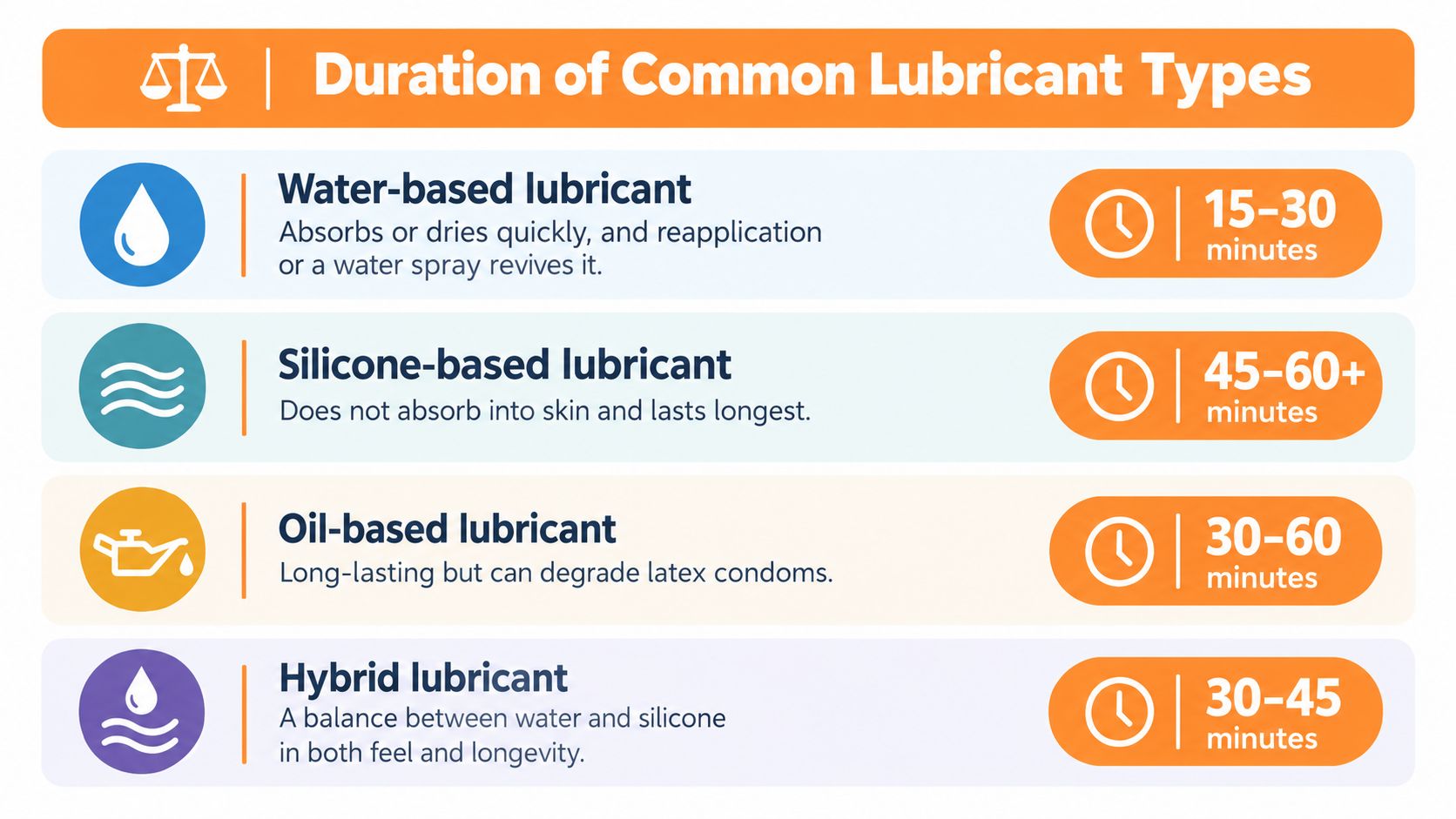
Duration of Common Lubricant Types
Lubricants differ mainly in how they interact with skin, moisture, friction, and the materials involved. The practical question isn't which base lasts longest in the abstract. It's which base remains comfortable for the activity and can be safely used with the relevant condom, toy, or body area.
Water-based formulas
Water-based lubricant usually offers an easy starting point because it rinses away readily and feels light. Its main longevity limitation is that it can absorb into skin or dry during extended friction. A person may need to reapply when the surface begins to feel tacky rather than waiting until discomfort develops.
A small amount of water can sometimes restore the glide of a water-based formula, but that doesn't mean every product behaves identically. Ingredients vary, and adding water can change texture. The person using it should follow the product label and treat increasing stickiness as a signal to pause, assess, and reapply compatible lubricant if needed.
Silicone-based formulas
Silicone-based lubricant generally remains on the surface instead of absorbing quickly, so it can provide longer-lasting glide during activities involving sustained friction or water exposure. That persistence can be helpful, but it also makes cleanup more deliberate and increases the importance of checking compatibility with toys and other materials.
A person should inspect the toy manufacturer's guidance before combining silicone lubricant with a toy. A formula that feels durable on skin may not be appropriate for every material. The product's label and the toy's care instructions should control the decision.
Oil-based formulas
Oil-based lubricant can remain slick for a long time and may suit some forms of external massage or intimacy. Its material compatibility requires special attention, particularly where latex condoms are involved. Oil can compromise latex, so a person using latex protection should choose a compatible alternative rather than relying on feel alone.
The same caution applies to cleanup. Oil can remain on skin and surfaces longer than water-based products, which may increase the chance of transfer if a delay spray has also been used. Washing hands and exposed skin before moving from one activity to another helps reduce unintended spread.
Hybrid formulas
Hybrid lubricants combine characteristics of more than one base. They may offer a middle ground between the lighter feel of water-based products and the persistence associated with silicone, but the exact balance depends on the formulation.
The comparison below is more useful than a universal promise about duration:
| Lubricant type | Typical practical behavior | Reapplication reality |
|---|---|---|
| Water-based | Light, washable, more likely to dry or absorb | Often needs refreshing during sustained friction |
| Silicone-based | Persistent surface glide | May need less frequent refreshing, but requires material checks |
| Oil-based | Long-lasting slickness | Requires careful condom and cleanup planning |
| Hybrid | Middle-ground feel and persistence | Reapplication depends heavily on the formula and activity |
A lubricant can be reapplied when friction returns. A lidocaine spray shouldn't be treated the same way. Reapplication of the spray requires attention to the product's maximum application and daily limits, plus the possibility that the active ingredient has already transferred or absorbed.
Factors That Affect Reapplication and Layering
Layering works best when each product has a defined job. The delay spray belongs on the intended genital area, while the lubricant belongs on surfaces where friction reduction is needed. Applying both at once makes it harder to tell which product is causing a change in sensation or texture.
A practical sequence looks like this:
- Apply sparingly. The product directions provide the governing limits. Starting with the minimum amount that may be effective gives the person a chance to assess sensation without committing to excessive numbness.
- Allow time for the spray to settle. Immediate rubbing, washing, or covering with lubricant can move the active ingredient away from the intended area. The exact waiting period should come from the product label, because the available product information doesn't establish one universal onset time.
- Remove excess residue if the label advises it. This step matters for partner protection. A delay spray that remains on the surface can transfer through hands, genital contact, or oral contact.
- Add compatible lubricant only where needed. A person can target the areas experiencing friction instead of coating the entire genital region. This reduces unnecessary mixing and helps preserve a clearer separation between sensation control and glide.
- Reassess before adding anything else. If sensation is already reduced, another spray isn't a sensible response to lubricant dryness. The better response is to address friction with compatible lubricant or pause.
Heat, sweating, vigorous friction, and repeated washing can all change how products feel. Skin chemistry also varies. A person with sensitive or easily irritated skin may experience discomfort sooner, while another person may notice a broader spread of numbness when too much product is used.
Layering rule: Let the active product settle before adding lubricant, and treat lubricant dryness as a friction problem rather than proof that more lidocaine is needed.
Condom use adds another decision point. Product-specific guidance should be checked before combining a delay spray with condoms, because retail and product listings identify K-Y Duration as not compatible with condoms. Readers exploring barrier-based approaches can review this discussion of condoms and delay ejaculation, but product labeling remains the controlling source for compatibility.
Reapplication should stop when burning, itching, rash, worsening irritation, or unwanted numbness appears. Washing the area and avoiding further use is more appropriate than trying to balance the reaction with another product.
Safety Context and Contraindications
The assumption that more numbing produces more endurance sounds logical, but it ignores the experience of both partners. Excessive desensitization can reduce pleasure, make physical feedback less clear, and increase the likelihood of transfer. The useful target is the minimum effective amount, not the maximum permitted amount.
Partner transfer is a real bedroom issue
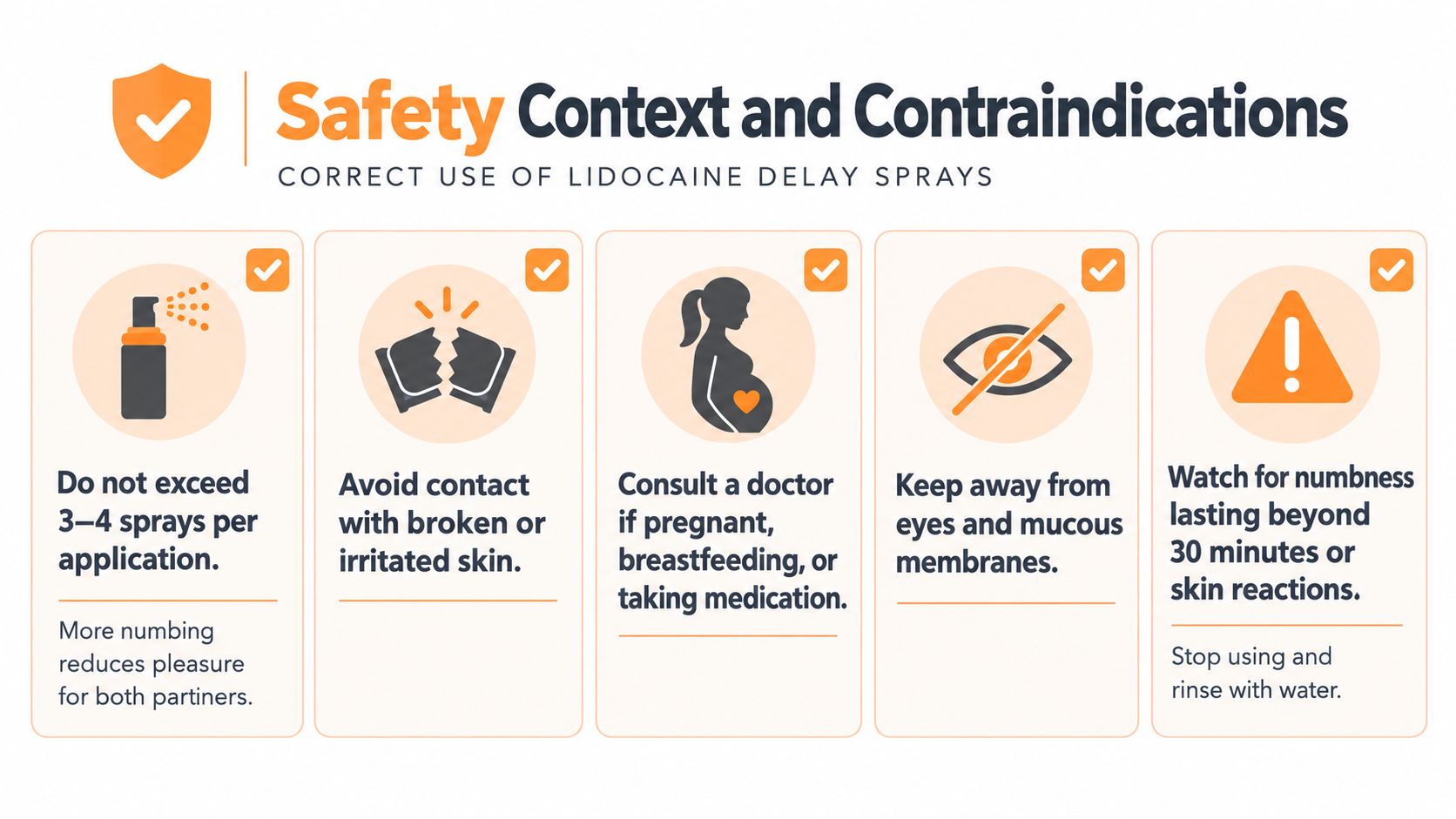
A spray residue can move through hands, genital contact, shared towels, or oral sex. A partner may experience unwanted numbness or irritation if the active ingredient reaches the mouth or sensitive tissue. The product should not contact the mouth, and a person should avoid sexual activity that creates oral exposure while residue remains.
Transfer can also happen after the original application seems forgotten. Washing hands and removing excess residue are simple ways to reduce that risk. Communication matters too. A partner deserves to know that a desensitizing product was used before contact begins.
Skin and health conditions change the decision
K-Y Duration and comparable lidocaine sprays shouldn't be applied to broken, inflamed, or irritated skin. Damaged skin can react differently, and a person may experience more discomfort when an active ingredient enters compromised tissue. Use should stop if irritation develops.
Product and retail guidance also calls for medical advice in certain circumstances, including when a partner is pregnant or when the user has liver or kidney problems. The K-Y Duration safety information gathers practical warnings concerning condom compatibility, oral contact, broken skin, and health conditions.
The same care applies to erectile concerns. Heavy numbing may make it harder to interpret physical feedback and can complicate an existing difficulty maintaining arousal. A person managing erection concerns or taking medication should discuss the product with a qualified clinician rather than increasing the spray amount independently.
The image URL above contains a typo relative to the mandatory asset URL? Need exact provided: Let's check user: b2b87bdb-911e-4ce2-bace-4220af82a779/k-y-duration-medical-safety.jpg. I wrote wrong b7591? Need correct in final. Continue.
A person should also check whether a lubricant is compatible with the chosen condom or toy. Material damage, product transfer, and skin irritation are separate risks, so solving one doesn't solve the others.
Numbing isn't a substitute for evaluation
Persistent ejaculation concerns, pain, recurrent irritation, or sudden changes in sexual function deserve professional evaluation. A topical product may alter sensation temporarily, but it doesn't explain why a symptom occurs. A clinician can help determine whether behavioral techniques, relationship support, medication review, or another approach is more appropriate.
Building Your Intimacy Product Strategy
You are preparing for intimacy and want more control, but the right product depends on the problem you are solving. A delay spray reduces sensation when used within its label directions. A lubricant reduces friction and may need refreshing as movement, time, or moisture changes. If both are involved, treat them as separate tools. Applying more of each can increase residue, transfer, and irritation rather than improve the experience.
Use this checklist before and during intimacy:
- Identify the goal: Decide whether the priority is sensation, friction, or both.
- Check compatibility: Read the spray, condom, toy, and lubricant labels before combining products.
- Start conservatively: Use the minimum effective amount and follow the product's application and daily limits.
- Control transfer: Allow the spray to settle, remove excess residue when appropriate, and avoid oral contact with active product.
- Choose the lubricant base: Match water, silicone, oil, or hybrid formulas to the activity and materials involved.
- Communicate early: Tell your partner when a desensitizing product is being used. They should mention unwanted numbness or irritation promptly.
- Stop when the body objects: Burning, rash, persistent numbness, or discomfort means washing off the product and discontinuing use.
A delay spray is closer to a timed sensation-control layer than to a lubricant reservoir. Reapplication should follow the label, not the return of impatience or friction. Lubricant can often be refreshed when dryness or drag returns, but adding more numbing spray may increase partner transfer and make useful physical feedback harder to notice.
Breathing and pacing can support an endurance plan without adding another topical layer. Breathing techniques for premature ejaculation are one non-topical option to consider alongside communication and professional guidance.
For men evaluating daily wellness supplements, SEMEX is described as a daily formula focused on semen volume, taste, and broader male wellness support. Its listed ingredients include zinc, L-arginine, sunflower lecithin, bromelain, maca root, Panax ginseng, ashwagandha, tongkat ali, saw palmetto, and horny goat weed. It is a dietary supplement, not a replacement for a delay spray or medical care.
The practical rule is simple: match the product to the job, then monitor what happens after application. Product longevity depends on controlled use, enough time for a spray to settle, careful reapplication, and clear partner communication.
The FDA requires the following disclaimer for applicable dietary supplement structure and function claims:
These statements have not been evaluated by the Food and Drug Administration. This product is not intended to diagnose, treat, cure, or prevent any disease.
Readers comparing delay sprays, lubricants, and daily men's wellness support can review SEMEX's ingredient-focused formula and product details. A careful routine and label-based selection can make intimacy more comfortable and predictable.