

Is Sunflower Lecithin Bad for You? a Review
Is sunflower lecithin bad for you, or can the actual problem be an excessive dose or an untested product? That question exposes a gap in much of the conventional advice. Sunflower lecithin has a generally favorable safety profile under intended food-use conditions, yet individual tolerance, supplement quantity, and product purity still deserve careful attention.
The most useful answer isn't a simple yes or no. Regulatory reviews and human safety data support reasonable use, while reports of digestive discomfort and concerns about trace contaminants show why “natural” doesn't automatically mean every product or every amount will suit every person.
Table of Contents
- Understanding Sunflower Lecithin and Why You Might Be Taking It
- The Regulatory Safety Profile of Sunflower Lecithin
- Clinical Evidence and Real-World Safety Data
- The Dose and Quality Concerns Most Articles Miss
- Allergies, Interactions, and Who Should Exercise Caution
- How to Choose Quality Sunflower Lecithin Supplements
Understanding Sunflower Lecithin and Why You Might Be Taking It
A man may notice sunflower lecithin on a supplement label, add it to an existing stack, and then wonder whether a food-derived ingredient can create problems. The confusion grows when lecithin appears in powders, capsules, and men's wellness formulas, sometimes alongside several other ingredients. Understanding what the ingredient is makes the safety question much easier to assess.
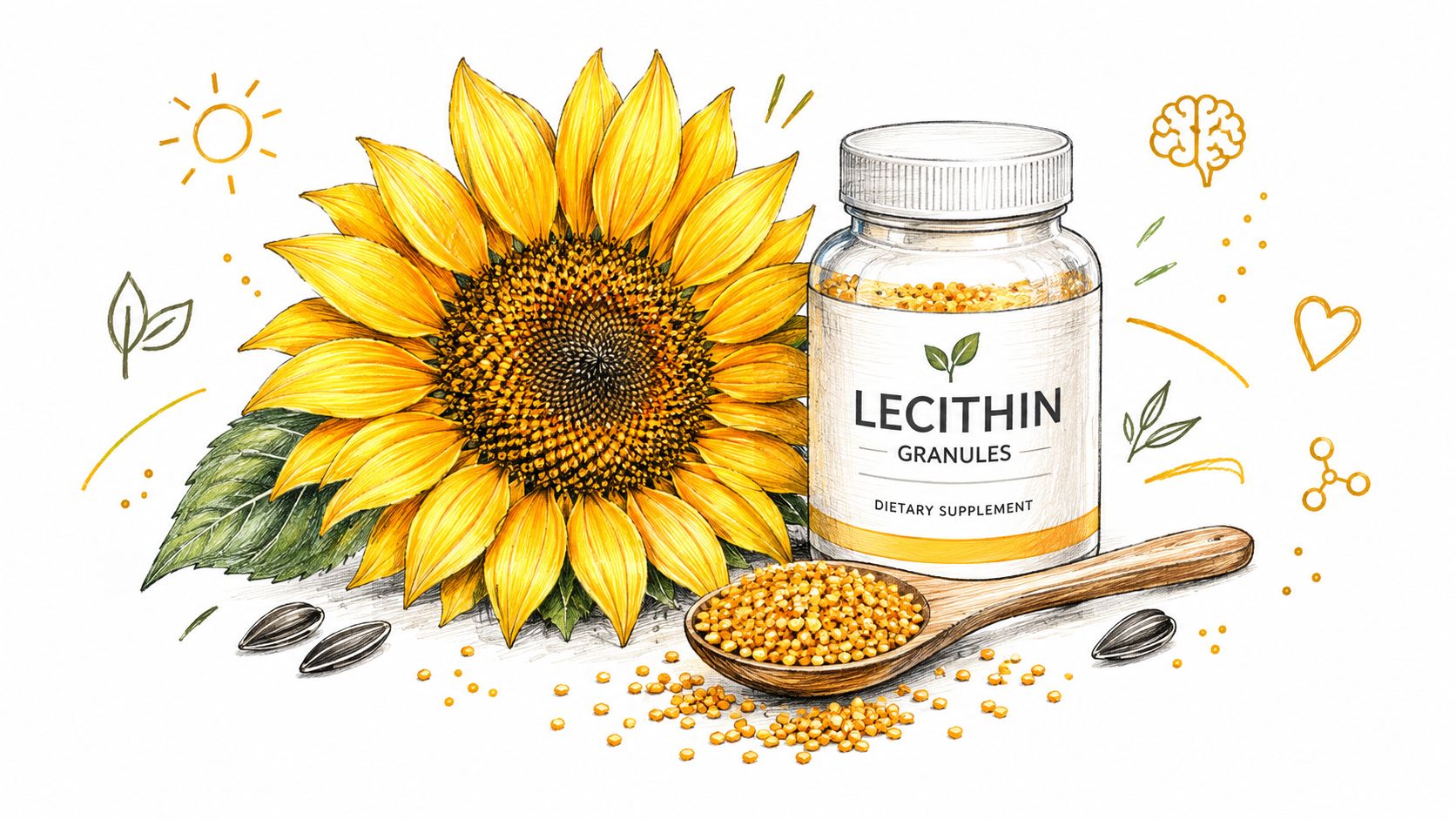
Sunflower lecithin is derived from sunflower seeds and contains phospholipids, including phosphatidylcholine. These compounds form part of cell membranes and help the body handle fats. Lecithin also acts as an emulsifier, which means it helps substances that normally resist mixing work together more evenly.
A simple kitchen comparison is salad dressing. Oil and water separate unless an emulsifier helps distribute them. In the body, phospholipids can serve a related molecular role, supporting the movement and handling of fat-based compounds. That doesn't make lecithin a medicine, and it doesn't establish that every supplement claim is valid, but it explains why manufacturers use the ingredient.
Why sunflower lecithin appears in supplements
Sunflower lecithin is often chosen as a plant-derived alternative to soy lecithin. Buyers may also look for it because they prefer non-GMO ingredients or want to avoid soy-based formulations. Those preferences concern sourcing and formulation, not proof that sunflower lecithin produces a particular health outcome.
In men's wellness products, the ingredient may be included as a phospholipid source in formulas designed to support semen volume or overall reproductive wellness. Readers evaluating that use can find a focused explanation of what sunflower lecithin is, while keeping the distinction clear between an ingredient's nutritional role and a product making a disease claim.
The practical takeaway is straightforward. Lecithin is a food ingredient with a functional role in mixing and transporting fats, not a substance that should be judged solely by its marketing context. The next questions are how regulators evaluate it, how people tolerate it, and whether a particular product is clean and accurately labeled.
The Regulatory Safety Profile of Sunflower Lecithin
The strongest mainstream safety signal comes from the U.S. Food and Drug Administration's GRAS process. GRAS means “generally recognized as safe” for specified intended uses. It doesn't mean that every dose, delivery form, or person has identical tolerance.
The FDA issued “no questions” letters for multiple sunflower lecithin GRAS notices, including GRN 939 on March 3, 2021, and GRN 1267 on February 17, 2026. In the GRN 1267 response, the agency noted that the notifier cited acute, repeated-dose, reproductive, and developmental toxicity studies with no treatment-related adverse effects. The same response stated that lecithin and related compounds were non-mutagenic and non-genotoxic. These details appear in the FDA GRAS notice record for sunflower lecithin.
What GRAS status means in practice
A GRAS conclusion applies to defined uses and conditions. For sunflower lecithin in the United States, intended uses include roles such as an emulsifier and dispersing agent at levels not exceeding current good manufacturing practice. That wording describes a manufacturing-limit concept, not a single universal maximum supplement dose for every consumer.
This distinction matters because a regulatory finding supports safety under intended use, but it doesn't guarantee that a large amount in a concentrated supplement will feel comfortable. It also doesn't rule out sensitivity to an ingredient, an additive, or contamination in a specific batch.
Practical rule: Regulatory support answers whether the ingredient has a recognized safety basis under specified conditions. It doesn't replace label reading or individual judgment.
The safety picture is therefore stronger than a one-off approval and narrower than a blanket endorsement. Repeated scientific evaluation supports a generally low concern for intended food use, while consumers still need to assess quantity, formulation, and personal circumstances. Readers comparing manufacturing standards can also review what cGMP certification means before choosing a supplement.
Clinical Evidence and Real-World Safety Data
Regulatory review provides an important foundation, but consumers also want to know how people tolerate sunflower lecithin in actual use. The available evidence points away from broad systemic toxicity at typical exposures and toward a more practical concern: whether a particular person experiences digestive or other short-term symptoms.
A recent peer-reviewed clinical report described oral sunflower lecithin at a daily dose of 4,800 mg, with no patient-reported adverse effects in that study. The report also noted that manufacturer guidance and prior studies used that daily amount. This is useful concrete information, but it shouldn't be treated as a universal recommendation or proof that every person will tolerate the same quantity. The findings are available in the peer-reviewed clinical report on oral sunflower lecithin.
What the safety evidence does and doesn't show
The FDA's review of published human trials involving lecithin and phospholipids reported no treatment-related effects in the data examined. The agency's broader toxicology review also found no treatment-related adverse effects across the evaluated acute, repeated-dose, reproductive, and developmental studies, as described in the FDA safety review of sunflower lecithin.
That evidence supports a useful distinction:
- Systemic toxicity: The reviewed evidence doesn't indicate a broad toxicity signal at intended exposures.
- Individual intolerance: A person can still react with nausea, diarrhea, stomach pain, or increased salivation.
- Dose response: Larger intakes may increase the chance of short-term digestive discomfort.
- Product differences: A clean, accurately labeled ingredient isn't equivalent to an opaque or poorly tested formulation.
Independent review material describes adverse reactions as uncommon, while identifying gastrointestinal symptoms and, with large intakes, effects such as sweating, increased salivation, or anorexia. The GRN 939 safety documentation provides context for the distinction between intended use and excessive intake.
For a healthy adult following a product label, the evidence is reassuring. A person who develops persistent symptoms shouldn't continue just because the ingredient is generally considered safe. “Generally safe” describes a population-level safety position, not an obligation for an individual to tolerate a supplement.
The Dose and Quality Concerns Most Articles Miss
The dose-quality paradox explains why two apparently conflicting statements can both be true. Sunflower lecithin can have an excellent safety profile when sourced well and used as directed, while an extreme intake or poorly verified product can create a legitimate concern.
Many articles stop after saying that lecithin is safe. That skips the question consumers really face: how much is in the daily serving, how many other lecithin or choline products are being used, and whether the manufacturer has tested the finished product. A person who adds powder to food, takes capsules, and uses a blend containing phospholipids may unintentionally stack sources.
Dose is a tolerance question
A higher amount isn't automatically more useful. Large intakes of lecithin have been associated with short-term gastrointestinal distress, and reports also describe sweating, increased salivation, or anorexia. These effects don't establish that sunflower lecithin is broadly toxic, but they do show why “more” can become counterproductive.
A sensible review of a supplement stack includes:
- Serving size: Check the amount of sunflower lecithin per serving and the number of servings taken each day.
- Ingredient overlap: Look for lecithin, phosphatidylcholine, or other choline-containing products elsewhere in the routine.
- Gradual introduction: Starting conservatively allows a user to notice tolerance before adding complexity.
- Symptom response: New nausea, diarrhea, stomach pain, or unusual salivation is a reason to pause and reassess.
Dose matters more than the marketing mood around an ingredient. A familiar food ingredient still deserves measured use when concentrated in a supplement.
Quality changes the risk conversation
The other overlooked issue is purity. Public reporting and product documentation indicate that trace heavy metals can occur in some sunflower lecithin lots, while regulatory reviews and food-safety assessments have found no major concern under intended uses. That doesn't make testing optional. It means the relevant question shifts from “is lecithin toxic?” to “has this specific product been verified?”
A purchaser should seek evidence of testing for heavy metals, microbes, and adulterants, preferably from an independent laboratory. A label that lists sunflower lecithin but gives no meaningful sourcing or testing information leaves important questions unanswered. The FDA GRAS notice for sunflower lecithin supports the ingredient's intended-use safety, but it cannot certify the quality of every product sold under that ingredient name.
Men comparing products can use this sunflower lecithin dosage guide as a starting point for label questions, not as a reason to exceed the manufacturer's directions.
Allergies, Interactions, and Who Should Exercise Caution
Sunflower lecithin is generally well tolerated, but “generally” leaves room for personal circumstances. A person with a known sunflower seed allergy should discuss supplementation with a healthcare professional before trying it, particularly if the product contains other botanical or flavoring ingredients.
Medication use also changes the decision. Lecithin contains phosphatidylcholine, and anyone taking blood thinners or medicines affected by platelet function should ask a pharmacist or prescribing clinician about possible interactions rather than assuming a food-derived ingredient is automatically irrelevant. People with liver conditions or medicines metabolized by the liver should use the same cautious approach.
Pregnancy and breastfeeding deserve professional guidance because supplement decisions depend on the individual's diet, medical history, medicines, and the specific product. Caution in these situations isn't a statement that sunflower lecithin has demonstrated harm. It reflects the need for personalized advice when safety data and nutritional needs may differ.
| Population | Reason for Caution | Recommended Action |
|---|---|---|
| People with sunflower seed allergies | The source ingredient may be relevant to an individual's sensitivity | Discuss the product with a healthcare professional before use |
| People taking blood thinners | Phosphatidylcholine and the full formulation may warrant interaction review | Ask a pharmacist or prescribing clinician |
| Pregnant people | Supplement needs and safety decisions require individualized assessment | Consult an obstetric clinician or midwife |
| Breastfeeding people | The infant, maternal health, medicines, and product composition all matter | Speak with a doctor, pharmacist, or lactation professional |
| People with liver conditions | Health status and medication metabolism can affect supplement choices | Obtain medical guidance before starting |
| People using multiple choline or lecithin products | Stacking can increase total intake and the chance of intolerance | Review the full supplement list with a professional |
Urgent symptoms such as breathing difficulty, facial swelling, or severe persistent gastrointestinal distress require prompt medical attention. For less severe symptoms, stopping the new product and reviewing the label is a sensible first step.
How to Choose Quality Sunflower Lecithin Supplements
A quality decision begins with the finished product, not just the ingredient name. “Sunflower lecithin” tells a buyer what is included, but it doesn't by itself show how the raw material was sourced, whether contaminants were screened, or whether the final capsules match the label.
A clear label should identify the serving size, the amount of sunflower lecithin, other active ingredients, and non-active additives. Transparent sourcing is useful, but independent verification provides stronger reassurance than attractive packaging or a low price.
A practical buying checklist
Look for third-party testing. Testing should address heavy metals, microbes, and adulterants. A responsible manufacturer should be able to explain whether testing covers the raw ingredient, the finished formula, or both.
Read the full formula. A product containing sunflower lecithin alongside herbs, minerals, amino acids, or enzymes needs evaluation as a complete formulation. Ingredient purity matters, but interactions and total intake also depend on everything in the capsule.
Check the dosage instructions. Clear directions make it easier to avoid accidental stacking. A label that relies on vague “as needed” language gives the consumer less control over exposure.
Inspect the additives. Fillers, colors, sweeteners, and flavor systems aren't automatically harmful, but unnecessary ingredients make it harder to identify the cause of a reaction. Simpler formulas can make troubleshooting easier.
Treat certifications as supporting evidence. cGMP registration, batch documentation, and independent certificates can add confidence. None should be treated as a substitute for reading the ingredient panel or asking questions about testing.
How to introduce a product
A person starting sunflower lecithin can avoid changing several supplements at once. Introducing one product at a time, following its label, and observing digestive tolerance makes it easier to identify what works and what doesn't.
Price alone can't verify quality. A low-cost product may offer good testing, while an expensive product may provide little meaningful documentation. The useful comparison is between transparent evidence and unsupported marketing.
For men considering a formula that includes sunflower lecithin, SEMEX is a daily supplement combining that ingredient with zinc, L-arginine, bromelain, maca root, Panax ginseng, ashwagandha, Tongkat Ali, saw palmetto, and horny goat weed; its product information states that the formula is vegan, non-GMO, made in the United States in a cGMP-registered facility, and third-party tested by Eurofins for microbials, heavy metals, and adulterants. Those details give buyers specific quality questions to ask, while the usual label and tolerance checks still apply.
For most healthy adults, the evidence supports a balanced conclusion. Sunflower lecithin isn't generally considered bad for you when used as intended, but excessive intake, personal sensitivity, and weak quality controls can change the practical risk. The safest choice is an accurately labeled, independently tested product used according to directions.
SEMEX offers a men's wellness formula that includes sunflower lecithin alongside zinc, L-arginine, bromelain, and additional botanical ingredients for daily nutritional support. Readers who want to compare its labeling and testing information can visit SEMEX and review the product details before deciding whether it fits their routine.
These statements have not been evaluated by the Food and Drug Administration. This product is not intended to diagnose, treat, cure, or prevent any disease.