

How to Take Tongkat Ali the Smart Way
Most tongkat ali advice starts with the wrong question: “How many milligrams should be taken?” A larger number on a bottle doesn't automatically mean a stronger or more useful product. A standardized water-based extract at a modest dose can be quite different from a large serving of unverified root powder, because the label may reflect bulk material rather than a consistent amount of active plant compounds.
The smarter question is how to take tongkat ali in a way that prioritizes extract quality, studied dosing, consistent timing, and sensible monitoring. Human research has used tongkat ali at 100–600 mg per day, while the most practical evidence-supported range for a standardized extract is generally 200–400 mg daily. A systematic review summary of tongkat ali research describes repeated use of standardized extracts over several weeks, not occasional megadosing.
Table of Contents
- Why Most Tongkat Ali Advice Misses the Point
- The Dosing Range With Research Behind It
- When to Take It for the Best Results
- How to Cycle Tongkat Ali Without Overdoing It
- What to Watch For Once You Start Taking It
- Why Product Quality Matters More Than the Dose on the Label
- Your Quick-Reference Tongkat Ali Checklist
Why Most Tongkat Ali Advice Misses the Point
The popular assumption is simple: more milligrams must produce better results. It fails because milligrams describe quantity, not necessarily extract quality. A capsule containing a standardized water extract is not equivalent to one containing plain root powder, even if both display a number on the label.
Product quality should come before dose escalation. Look for the plant part used, the extraction method, and clear standardization markers. These details show what you are buying more reliably than a large number beside an unspecified “tongkat ali” blend.
Human studies have examined commercial water extracts at daily doses ranging from 100 to 600 mg, with positive findings reported across periods from two weeks to 12 weeks, and some studies continuing for six months. The clinical evidence review hosted by Caldic summarizes this pattern and reports commercial water-extract use in seven of nine studies.
The label number isn't the active dose
Plain root powder may require a larger serving because it has not been concentrated like a standardized extract. A larger serving therefore does not automatically mean greater potency. It means the products cannot be compared by milligrams alone.
Comparing 200 mg of standardized extract with 1,000 mg of unspecified powder means comparing different materials. Ask whether the product uses water-based extraction, identifies meaningful standardization markers, and undergoes consistent batch testing.
Practical rule: A transparent 200 mg extract gives you a better basis for judging a product than a vague formula with a much larger milligram claim.
The same principle applies to tolerability. Increasing the amount may bring more restlessness, gastrointestinal discomfort, itching, or insomnia without a matching benefit. Choose a clearly identified extract, take it consistently, and allow enough time to judge your response. Quality and consistency come before dose escalation.
The Dosing Range With Research Behind It
For most adult men, start with 200 mg per day of a standardized water-based extract, taken consistently with food. If tolerance is good and the response remains insufficient, increase the total daily amount toward 300–400 mg. The systematic review summary identifies 200–400 mg daily as a recurring range for energy, athletic performance, libido, and mood support, generally after at least two to four weeks of use.
Human studies have examined a broader range, from 100 to 600 mg per day. That does not make the upper end a sensible starting point. A review in Molecules describes typical recommendations of 50–200 mg daily for a water-extracted root standardized to 22% eurypeptides, while noting that 200–400 mg daily is commonly recommended for men. The different ranges reflect differences in extract specifications, so milligrams alone cannot determine strength.
A practical starting protocol
Begin with 200 mg once daily with a meal and keep the amount steady long enough to assess sleep, mood, energy, libido, and general tolerance. Changing the dose every few days makes the response difficult to judge. Users who react strongly to stimulating supplements can start at the lower end of the human-study range. Anyone taking medication or using hormone-related products should consult a healthcare professional before starting.
The table below keeps the decision centered on extract quality and evidence, not aggressive escalation.
| Daily Dose | Standardization | Best For | Evidence Strength |
|---|---|---|---|
| 100–200 mg | Clearly identified extract with stated standardization | Conservative starting protocol | Appears in human research and review summaries, but response can vary |
| 200–400 mg | Standardized water-based extract | General male wellness, libido, mood, and training support | Most consistent practical range in human studies |
| 400–600 mg | Standardized extract only, with careful monitoring | Higher end of studied protocols | Present in clinical evidence, but not a reason to assume more is better |
For readers comparing tongkat ali dosage for libido, match the intended goal to the product's actual extract strength. A higher label number does not make up for undisclosed standardization. Product identity comes first, then dose.
When to Take It for the Best Results
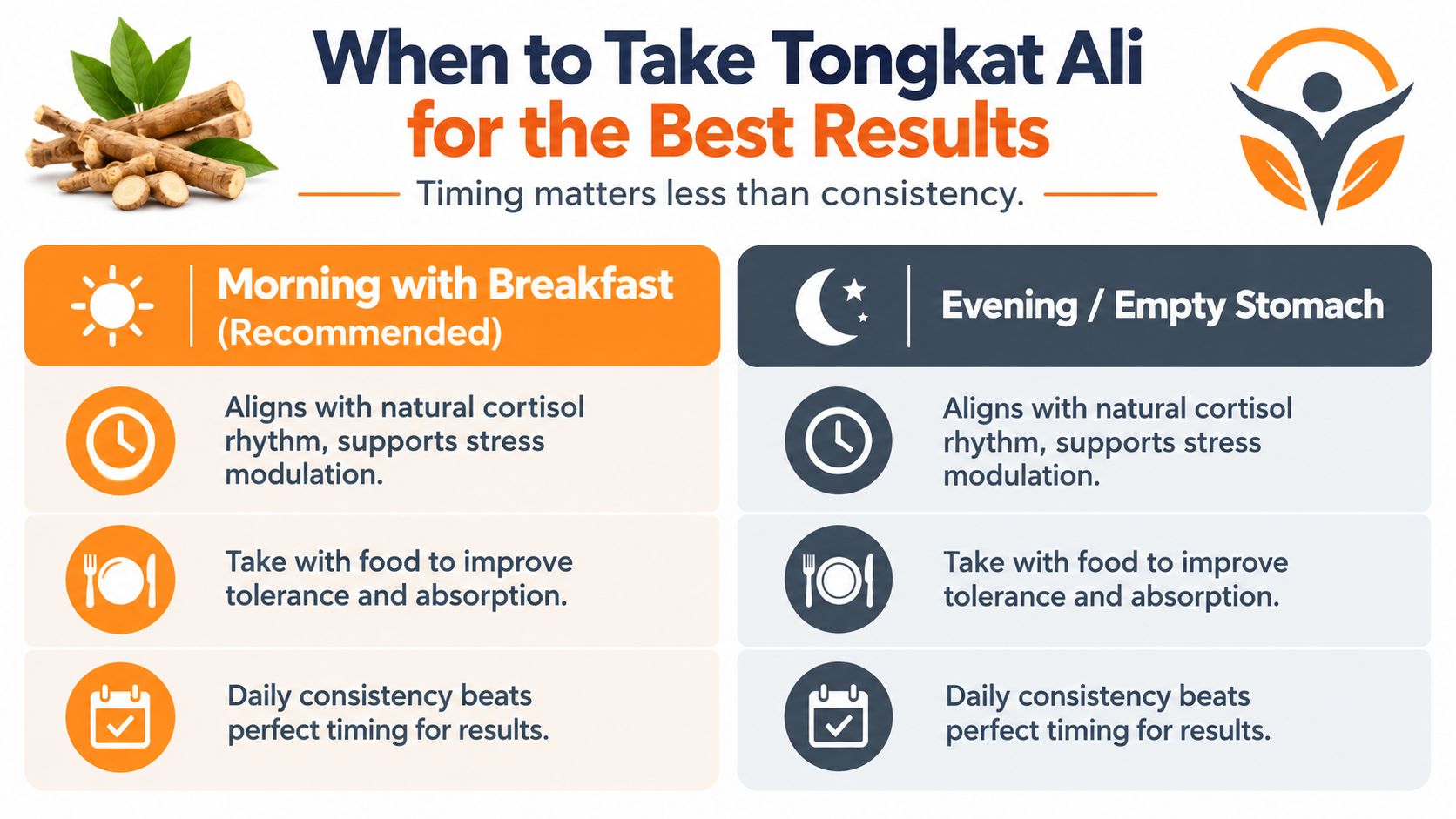
Breakfast is the best default, but the clock matters less than consistency. Take tongkat ali with breakfast or another early meal. Food usually improves tolerance, particularly if taking supplements on an empty stomach causes discomfort. An early routine also makes it easier to notice whether the extract feels stimulating during the day.
Morning dosing suits users focused on mood, stress handling, and daytime energy. Human research has examined tongkat ali in stress and exercise settings, but it does not establish that one precise hour delivers better long-term results. The practical advantage is simple: attaching the dose to a regular meal makes daily use easier to repeat.
Morning, training, or split dosing
For general daily use, take the serving in the morning. Training-focused users can take it earlier in the day before exercise, but do not use tongkat ali like a fast-acting pre-workout. Its relevant effects depend on consistent use over time, not an immediate surge in sensation.
At the higher end of the practical range, splitting the serving can make the routine more comfortable. 200 mg in the morning and another 200 mg earlier in the afternoon keeps the daily total at 400 mg without requiring one large serving. If restlessness appears, move the second dose earlier or return to one lower daily dose.
Sleep is the deciding factor. Late-day dosing has little upside if it makes sleep lighter or harder.
Timing rule: Take it early, take it with food if that improves comfort, and avoid late-day use if sleep becomes lighter or more difficult.
Anyone asking how long tongkat ali takes to work should assess the protocol over several consistent weeks rather than judging the first dose. A wired feeling is not evidence of a meaningful hormonal response. Product quality and standardization also matter more than forcing a later dose or chasing a higher milligram number.
How to Cycle Tongkat Ali Without Overdoing It
Cycling will not fix a poor-quality tongkat ali product. Use breaks as a review point, not as a way to justify taking an unstandardized extract year-round. The goal is to confirm that the supplement provides a useful, tolerable response before continuing.
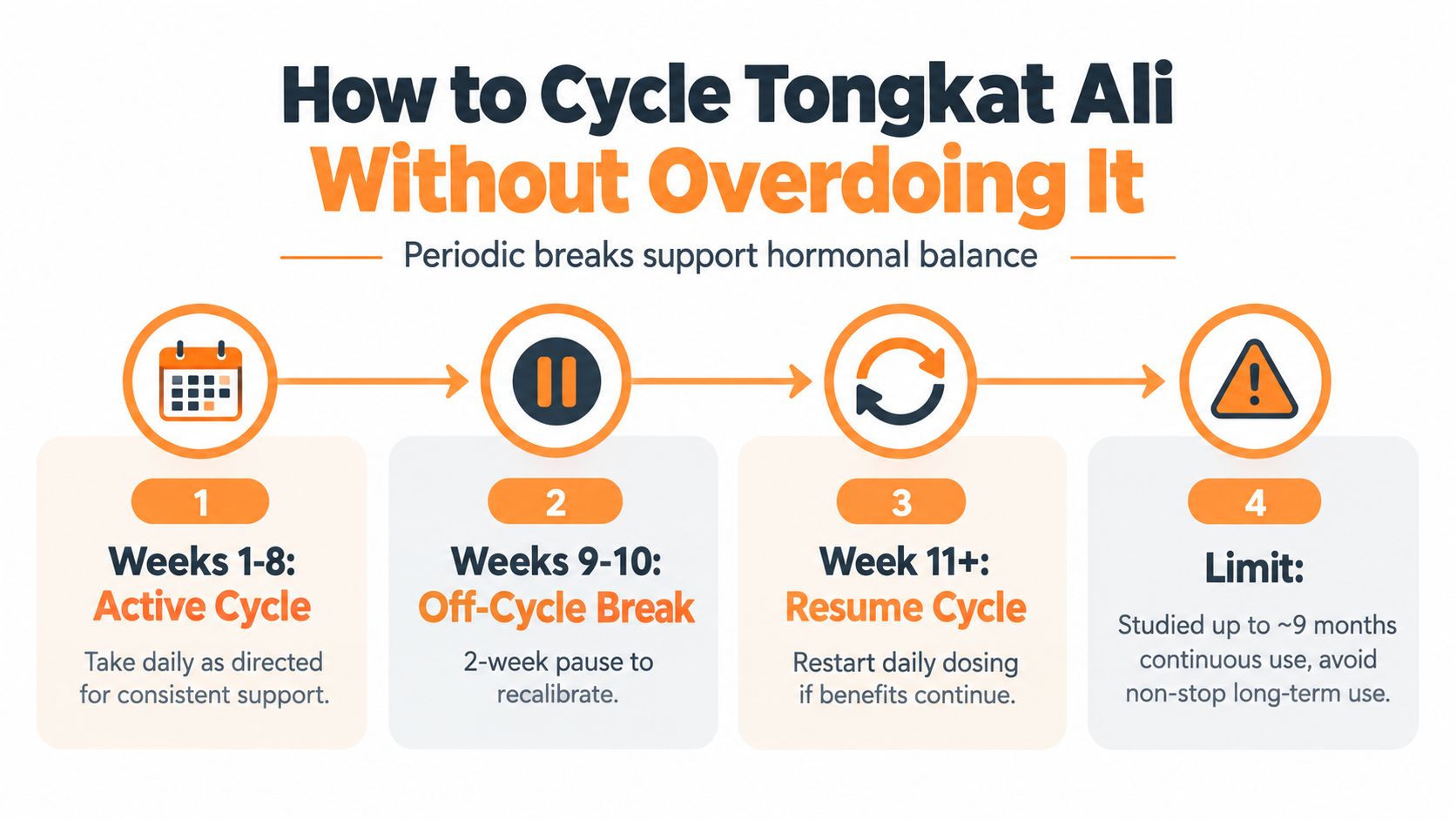
Human studies have included continuous use lasting six months. Safety beyond roughly nine months of uninterrupted use remains insufficiently established. Short-term human trials have generally tolerated 200–400 mg daily, but the extract's quality and standardization still matter more than selecting the largest number on the label.
Two workable approaches
For daily users who want regular breaks, a five-days-on, two-days-off schedule is simple. Treat it as a practical routine, not a proven requirement for effectiveness. A more structured option is eight to 12 weeks on, followed by four weeks off. That break creates a clear opportunity to judge whether the benefits remain meaningful without supplementation.
Choose the conservative option if you are over 40, take medication, or combine tongkat ali with supplements that affect hormonal pathways. Users taking it mainly around training can choose a shorter exposure period. The same rule applies in every case: stop early if insomnia, agitation, unusual mood changes, or other concerning symptoms appear.
Use this decision rule:
- Continue the planned cycle if sleep, mood, energy, and libido stay stable and the response feels useful.
- Reduce the dose if mild activation or stomach discomfort follows a serving increase.
- Stop early if symptoms persist, become pronounced, or feel unusual.
- Reassess the product if a consistent trial at a studied dose produces no meaningful response.
A cycle should force a review of the product, dose, and symptoms. It should not become an excuse to ignore testing, labeling, or tolerability.
What to Watch For Once You Start Taking It
Track your response instead of trusting memory. Tongkat ali can produce subtle changes, and a brief stimulating sensation does not prove better daily function. Record the same signals for at least two weeks so you can judge whether the product, dose, and timing suit you.
Log morning energy, sleep quality, time needed to fall asleep, mood stability, libido, training recovery, and resting heart rate. A useful response should look sustainable: steadier daytime energy, better stress tolerance, stable libido, or easier recovery. Feeling constantly overstimulated is a warning, not a success marker.
Signals worth recording
| Signal | Positive Response | Warning Sign |
|---|---|---|
| Sleep | Easier sleep and stable rest | Insomnia or noticeably lighter sleep |
| Mood | More stable motivation and stress tolerance | Agitation, irritability, or unusual flatness |
| Energy | Consistent daytime alertness | Feeling wired, tense, or overstimulated |
| Libido | Gradual, stable improvement | Uncomfortable or erratic changes |
| Training | Better perceived recovery | Restlessness that interferes with sessions |
| Resting heart rate | No concerning change | A persistent elevation after starting |
If warning signs appear soon after you begin, adjust dose and timing first. Someone taking 400 mg who develops restlessness may do better with 200 mg, especially with the lower serving taken alongside breakfast. Stop the product and seek professional advice if symptoms persist, become severe, or feel unusual. Do not keep experimenting through a clear adverse reaction.
Give the protocol a fair test. Changing several variables at once ruins the feedback. Starting tongkat ali alongside multiple stimulating herbs, a new pre-workout, and a major training increase makes it impossible to identify what caused sleep or mood changes. Use one product, keep the dose stable, and maintain a short daily record. That record will also show whether a standardized extract is producing a steady benefit or whether the label's milligram figure is masking an inconsistent product.
Why Product Quality Matters More Than the Dose on the Label
The biggest mistake in tongkat ali buying is treating the capsule's milligram number as proof of strength. The better question is, “How many milligrams of what, verified by whom?” A standardized water extract gives you a clearer comparison than a generic root-powder label. Look for the plant material, extraction method, and relevant standardization markers, not a dramatic serving size.
The National Center for Biotechnology Information dosage overview distinguishes standardized root-extract protocols from the much larger capsule amounts often promoted online. Those larger numbers do not represent the core human evidence base. A high serving of raw or poorly defined material can look impressive while revealing little about its active content.
What a stronger label should show
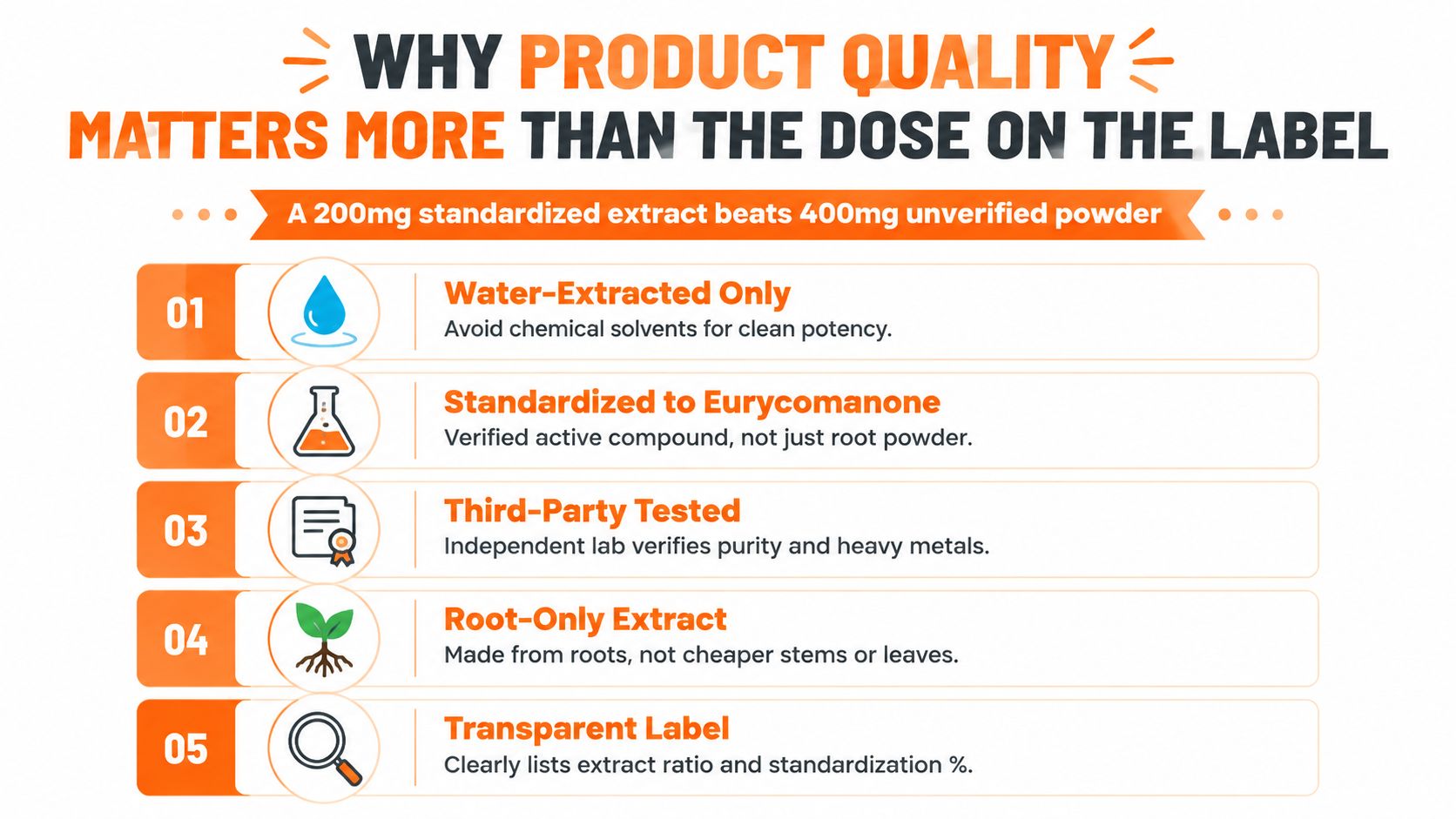
Start with a standardized, water-based root extract. The label should state an extract ratio or identify a marker such as eurycomanone or glycopeptide content. Extract ratio alone does not guarantee consistency, so use it alongside a declared bioactive marker and batch information.
Testing matters as much as labeling. The safety review at Examine raises concerns about adulteration and contaminants, and notes that the European Food Safety Authority concluded that safety has not been established under any condition of use. Increasing the dose of an unverified product is a poor response to an uncertain label.
Before you buy, require clear answers to these questions:
- Plant material: Does the product identify root extract rather than unspecified plant material?
- Extraction method: Does it state that the extract is water-based?
- Standardization: Does it provide a meaningful marker and batch-level information?
- Testing: Is there a current Certificate of Analysis covering heavy metals and adulterants?
- Transparency: Does the manufacturer identify who performed the testing and what was examined?
Use SEMEX's supplement testing resource to understand what independent verification should cover. A credible certificate beats a louder milligram claim.
Your Quick-Reference Tongkat Ali Checklist
Treat the label as a starting point, not proof of quality. Before opening a bottle, changing your dose, or reordering, run through this checklist. A larger milligram figure does not compensate for an unidentified extract or weak testing.
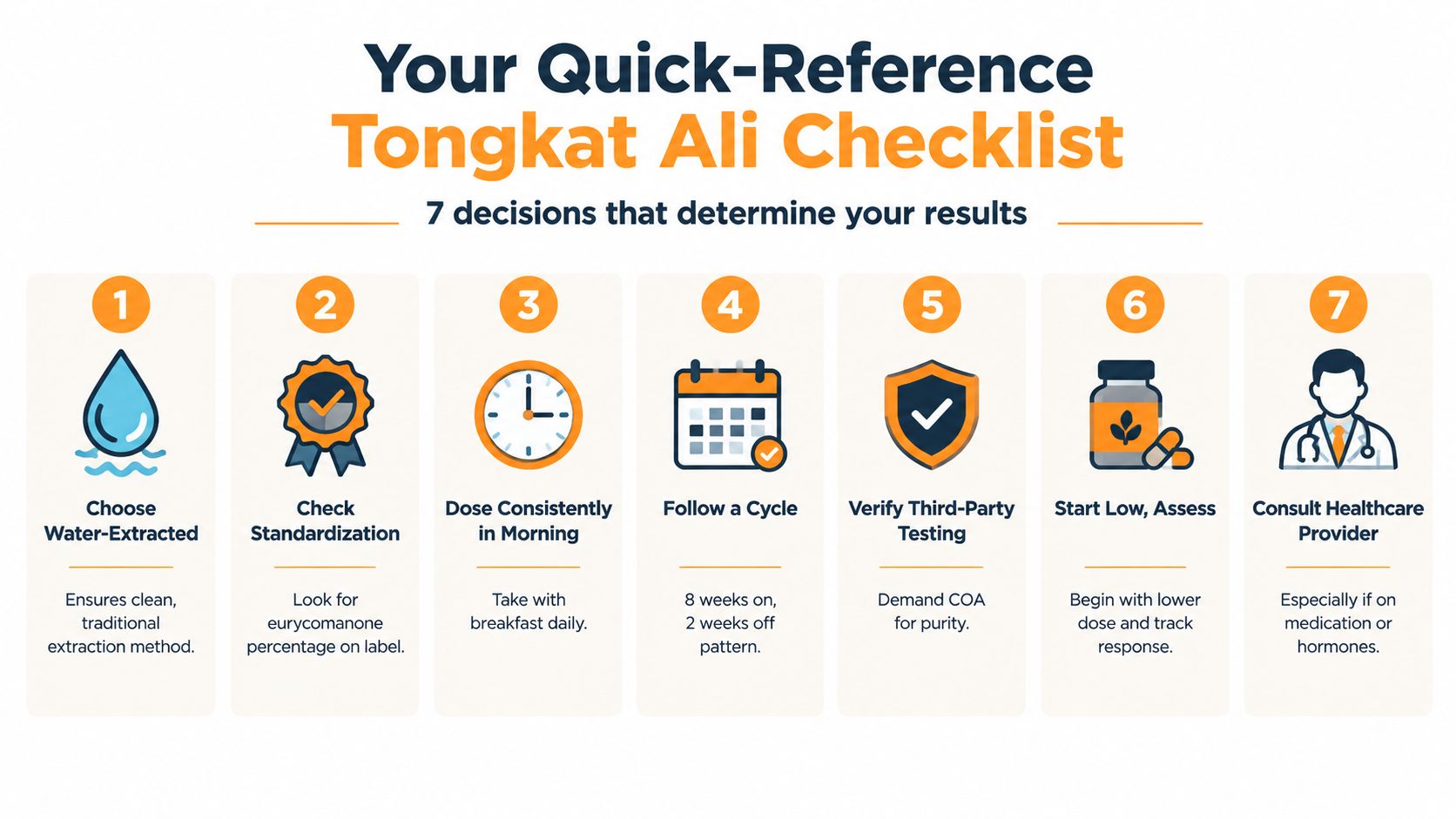
- Choose a water-extracted product that clearly identifies standardized root extract. Avoid products described only as generic powder.
- Read the standardization details. Look for verified eurycomanone or glycopeptide content, because extract weight alone does not show potency.
- Start at 200 mg daily with food. Keep the timing and serving consistent while you monitor tolerance. Changing several variables at once makes the result harder to judge.
- Consider 300–400 mg only when appropriate. Use the higher range only after the initial protocol is well tolerated and a consistent assessment shows an insufficient response. More extract is not automatically better, especially when the product's identity and testing are unclear.
- Take it in the morning for general use. If exercise is the main goal, use an earlier training-day schedule. Avoid late dosing when it interferes with sleep.
- Plan a cycle instead of taking it automatically all year. A practical approach is eight to 12 weeks on, followed by a break. Cycling does not replace product testing, careful dosing, or symptom monitoring.
- Check third-party testing before each purchase. Require a current Certificate of Analysis covering purity, heavy metals, and adulteration. If the seller cannot provide meaningful documentation, choose another product.
The rule is straightforward: consistent use of a properly characterized extract beats chasing a larger milligram number. Warning signs call for a lower dose or a stop, not for pushing through in pursuit of a stronger effect.
SEMEX includes tongkat ali in a broader men's wellness formula and gives a daily serving instruction of three capsules with water, preferably with a meal. Men comparing ingredient-focused options can visit SEMEX to review the formula, testing information, and product details against their own quality and dosing criteria.
These statements have not been evaluated by the Food and Drug Administration. This product is not intended to diagnose, treat, cure, or prevent any disease.