

How to Ejaculate Twice: Practical Strategies and Science
Most advice about how to ejaculate twice starts in the wrong place. It promises a secret technique, a supplement, or a perfect sequence of stimulation, while skipping the main biological limit: after orgasm, many men temporarily lose erection and orgasmic responsiveness. A second ejaculation may be possible, but it isn't a switch you can reliably force.
The more useful approach is to understand your recovery window, pace the first orgasm, rebuild arousal gradually, and treat comfort and communication as part of the experience. You may regain interest before your body is ready to ejaculate again, and a smaller second release is normal rather than proof that something is wrong.
Table of Contents
- Why the Refractory Period Sets the Practical Ceiling
- Pacing and Recovery After the First Release
- Edging and Arousal Control Before the Finish
- Pelvic Floor Training for Stronger Orgasms
- Recovery Variables You Actually Control
- Partner Communication and Shared Expectations
- Safety Signals and a Realistic Takeaway
Why the Refractory Period Sets the Practical Ceiling
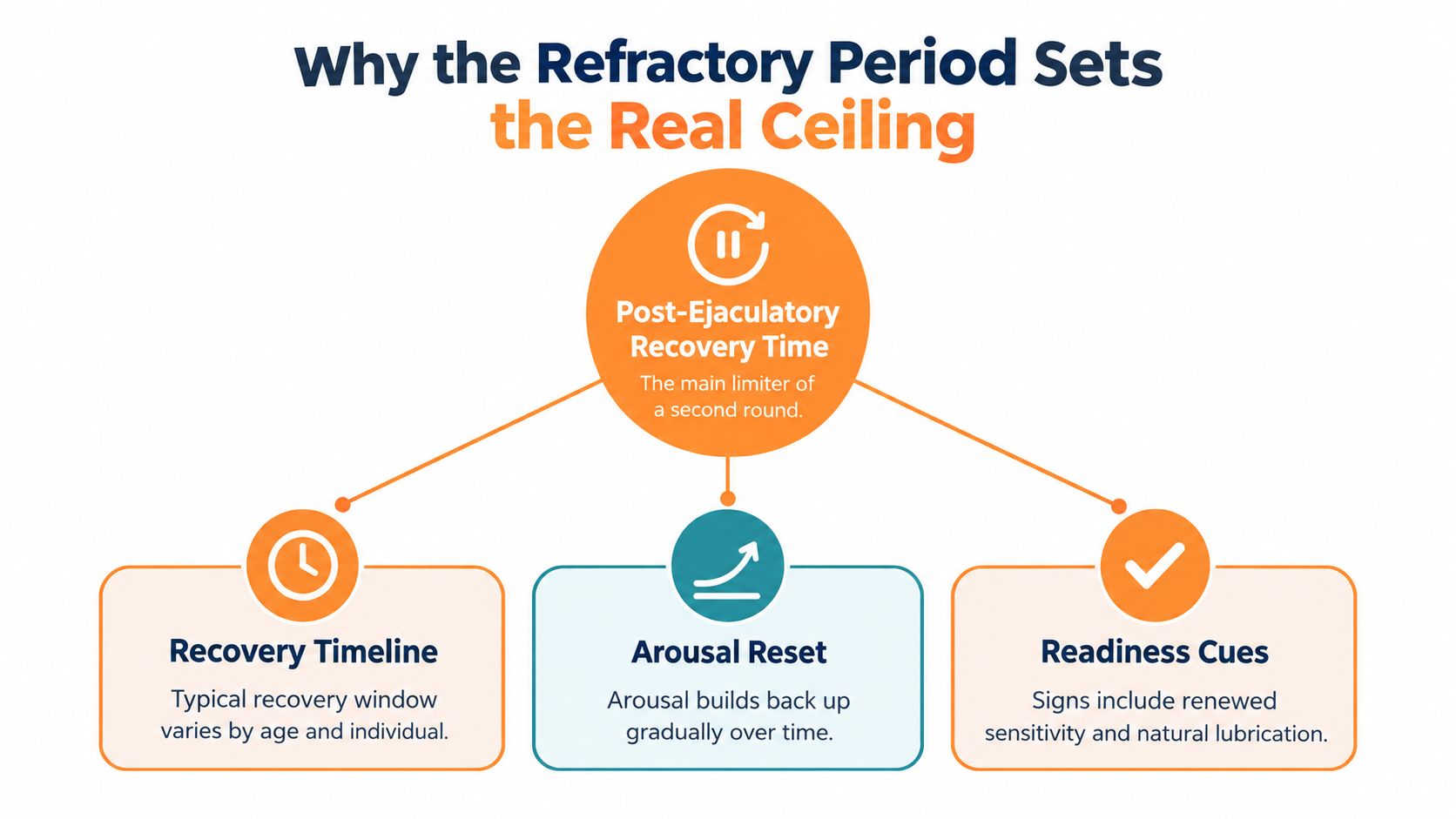
The post-ejaculatory refractory period is the temporary interval after orgasm when sexual arousal, erection, and ejaculation may be difficult or impossible. It sets the practical ceiling for a second round more often than technique does. Some men become responsive again quickly, while others need much longer, and the same man may have different recovery times on different days.
Age, stress, sleep, health, medication, arousal, and the context of sex can all shape the experience. Arousal and erection also recover on separate tracks. You might feel mentally interested while your erection remains unreliable, or regain an erection without enough sensitivity and readiness to ejaculate again.
A 2024 study of 274 men shows how wide the variation can be. Among men without premature ejaculation who reported multiple intercourse sessions, the average interval between attempts was about 221 minutes, while the premature-ejaculation group averaged about 59 minutes. These are observational averages, not targets, and they do not predict what will happen in your bedroom. The findings are reported in the Journal of Sexual Medicine study on repeated intercourse.
Read your body instead of chasing a clock
Published estimates of the male refractory period range from roughly 30 minutes to 24 hours, with age often associated with longer recovery and no single universal timetable supported by research, as summarized by Medical News Today's explanation of refractory periods. That range is too broad for a universal bedroom schedule.
Renewed sensitivity, a natural return of erection, genuine desire, and comfortable touch are more useful cues than elapsed time. If the penis feels tender, stimulation feels irritating, or your erection keeps disappearing, your body may still be in recovery.
Practical rule: A second orgasm is possible for some men, not mandatory for everyone, and not a reliable test of sexual capacity.
For a closer look at what can affect recovery, see this guide to shortening the refractory period. The central point stays simple. No technique can guarantee that your physiology will be ready on demand.
Pacing and Recovery After the First Release
The first few minutes after ejaculation often decide whether a second attempt feels workable or awkward. Stop direct stimulation when you finish, let your breathing settle, and give the arousal drop room to happen. A pause lets the nervous system move out of the heightened state that follows orgasm.
You can still stay close during that pause if it suits both of you. Kissing, conversation, gentle touch, or other non-genital contact can keep the mood connected without asking for an immediate erection. Slow breathing, especially a longer exhale, helps lower the pressure to perform right away.

Let readiness return gradually
Erection recovery is not the same thing as ejaculation readiness. A man may feel firm enough for penetration while still being nowhere near another orgasm, or he may feel mentally turned on before his body is ready again. Pushing harder to prove otherwise usually brings discomfort and frustration.
When sensation starts to return, restart gently. Use more lubrication than you think you need, switch positions if pressure feels off, and begin with broad, light touch before moving back toward stronger friction. If the area feels sharp, sore, or overly sensitive, pause again. Pain is a signal to change pace, not a test to pass.
Recovery time varies widely from one man to another. Some men are ready sooner, others need much longer, and the useful cue is the body in front of you, not a borrowed timetable. A practical guide to performance and recovery is to watch for returning comfort, desire, and responsiveness, then let those signals set the pace.
A realistic pacing protocol looks like this:
- After orgasm: Stop direct stimulation and breathe normally.
- During the pause: Stay connected through kissing, touch, or conversation if that feels good.
- As arousal returns: Reintroduce stimulation gradually and use lubrication.
- At any discomfort: Stop or change the activity rather than pushing through it.
- If the second attempt doesn't happen: Keep the session pleasurable without turning the outcome into a verdict.
Your own pattern matters more than a number found online. If the first release leaves you relaxed, sensitive, and interested again, the next phase may go well. If it leaves you flat or tender, a slower reset is the smarter move.
Edging and Arousal Control Before the Finish
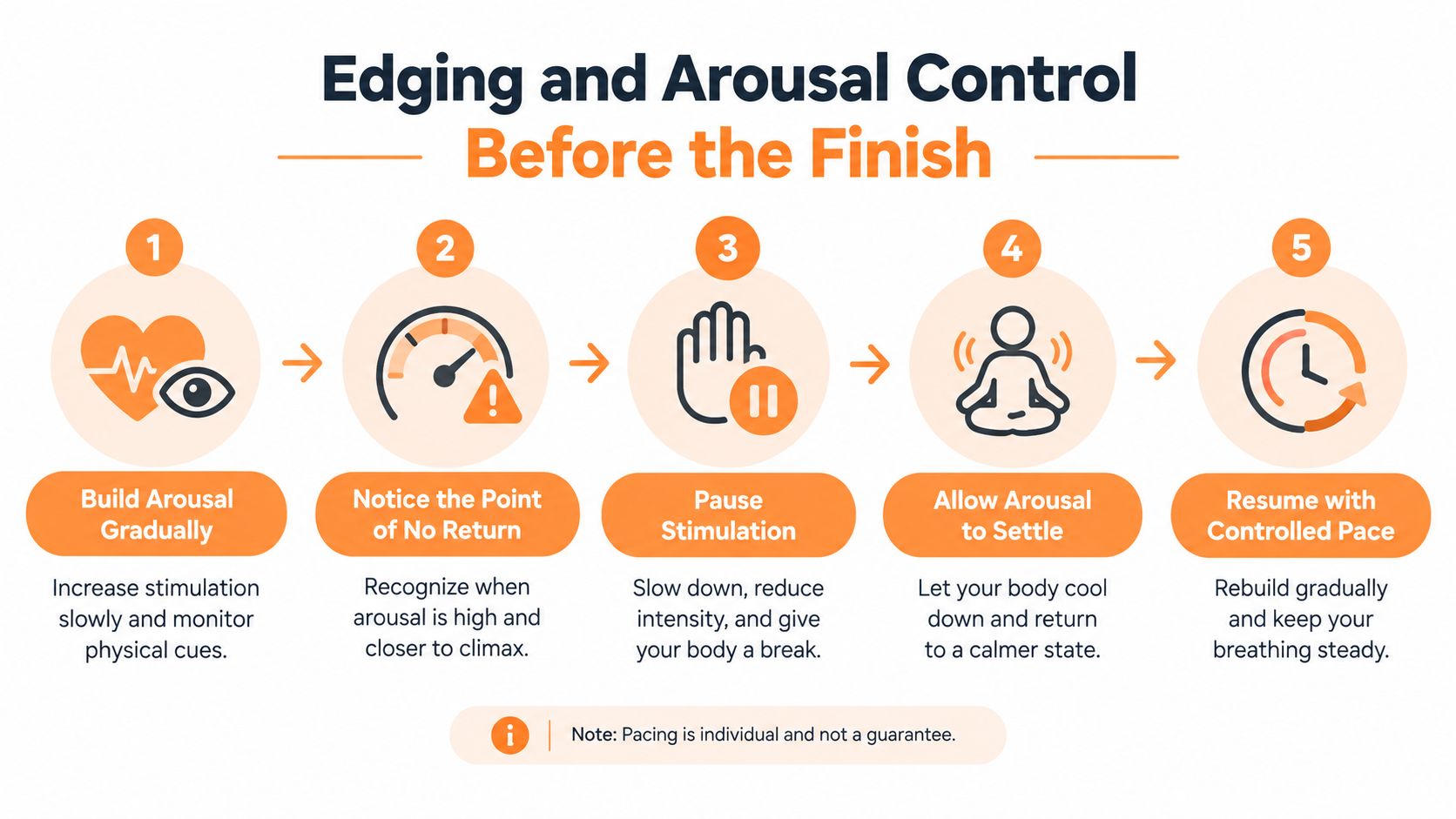
Edging can help some men manage the first orgasm more deliberately. The basic pattern is to build arousal toward a high point, notice the signs that ejaculation is becoming difficult to stop, pause or reduce stimulation, let the intensity settle, and then resume at a controlled pace.
This doesn't eliminate the refractory period. It may, however, prevent the first climax from becoming so intense that the rest of the session feels physically demanding. Some men also prefer holding a comfortable plateau because it leaves more energy and interest for what follows.
Pay attention to tightening in the pelvic floor, rapid breathing, involuntary thrusting, and the feeling that ejaculation is becoming inevitable. When those cues appear, slow down rather than waiting until control has completely disappeared. A longer exhale and relaxed abdomen can help you avoid turning the entire body rigid.
Avoid turning control into clenching
Edging isn't endless squeezing. Repeatedly clenching the pelvic floor, abdomen, and glutes can increase tension and make ejaculation control harder for some men. The aim is awareness and modulation, not a contest between your muscles and the reflex.
Solo practice makes it easier to identify your cues. With a partner, explain what “slower” or “pause” means before the session becomes intense. A hand signal or simple phrase can prevent one person from assuming that reduced stimulation means rejection.
A 2009 review in the Journal of Sexual Medicine found that evidence about the refractory period was remarkably limited and noted that the commonly repeated belief that recovery lengthens with age lacked published supporting data. That makes personal observation more useful than rigid claims, as discussed in the review of the refractory period.
If you enjoy controlled teasing, keep the goal flexible. Teasing and denial can be part of a pleasurable session, but edging won't guarantee two ejaculations, and it shouldn't continue once the experience becomes painful or stressful.
Pelvic Floor Training for Stronger Orgasms
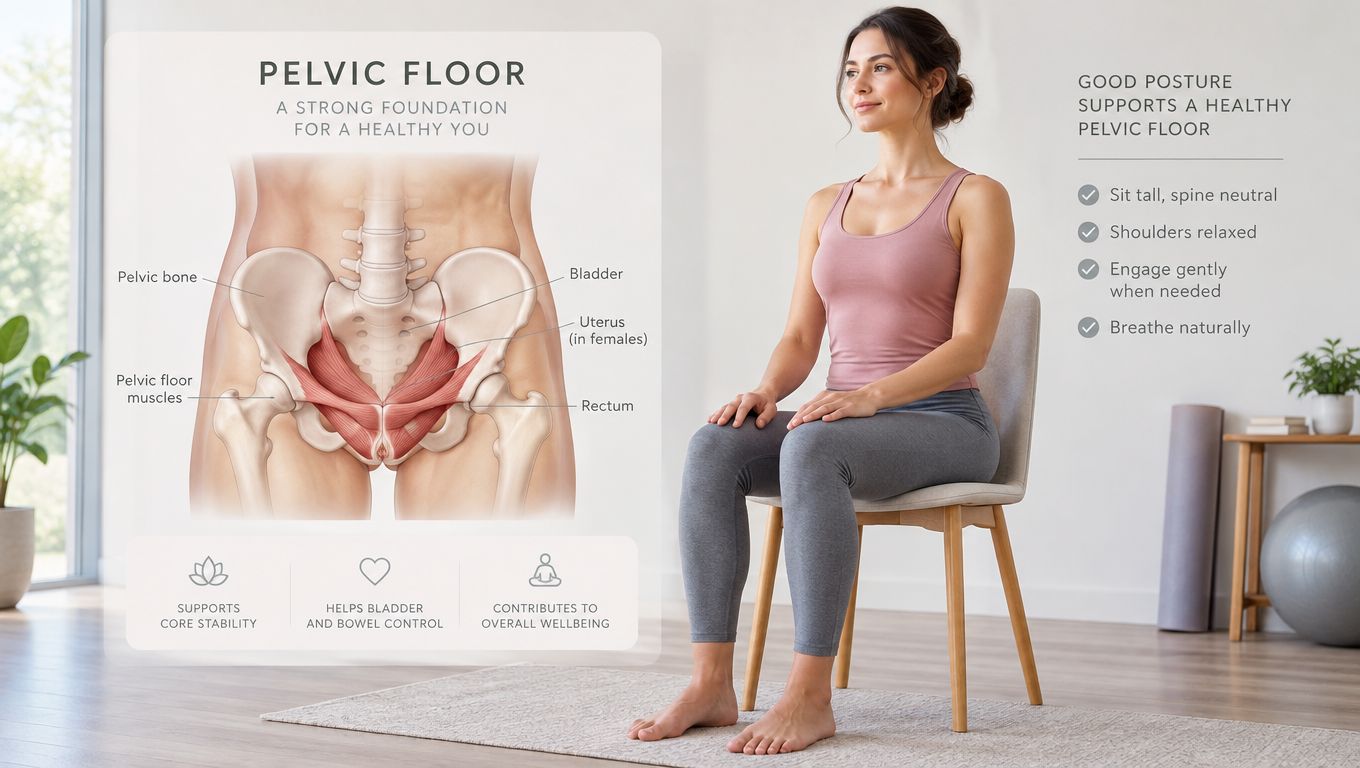
The pelvic floor contributes to the contractions involved in ejaculation, but stronger isn't always better. Some men need more coordination and endurance, while others already carry too much tension. Treat training as a gradual skill rather than a demand to clench harder during sex.
To identify the relevant muscles, imagine briefly stopping urine flow. Use that only as an identification exercise, not as a habit during urination. The muscles you feel lifting inward include the bulbocavernosus and ischiocavernosus, which are involved in ejaculatory contractions.
Build control with release as well as contraction
A simple routine can include short, comfortable holds followed by complete relaxation, longer endurance holds, and a few quick contractions. Keep your breathing easy and avoid recruiting the glutes, thighs, or abdominal muscles. Three nonconsecutive training days each week gives you regular practice without making every day a test.
Progress should be judged by coordination and comfort. Research summarized across multiple pelvic floor reviews links consistent training of the bulbocavernosus and ischiocavernosus muscles with stronger ejaculatory contractions and improved orgasmic intensity, although results depend heavily on starting baseline, as described in this review of pelvic floor exercise research.
Relaxation matters: A pelvic floor that never releases can create more control problems, not fewer.
Don't expect a training routine to erase the refractory period. It may support contraction quality and orgasmic sensation, but recovery after ejaculation remains a separate physiological process. During sex, endless Kegel-style clenching can also increase tension and work against the relaxed arousal needed for a second attempt.
If you notice pelvic pain, urinary symptoms, painful ejaculation, or a persistent feeling of tightness, weakness may not be the issue. A pelvic floor physiotherapist can help distinguish poor coordination from excessive tension. The Kegel exercise guide for men can provide a starting point, but discomfort is a reason to seek individualized advice.
Recovery Variables You Actually Control
Bedroom technique matters, but your baseline state matters too. Poor sleep, heavy stress, dehydration, alcohol, and general fatigue can make arousal less responsive and recovery feel longer. These factors don't create a predictable timetable, yet they can influence whether your body has the energy and blood flow needed for another round.
Recent ejaculation frequency also affects what the second release looks like. A shorter interval generally leaves less time for the reproductive tract to replenish seminal fluid and sperm stores. That changes semen volume, not necessarily pleasure, orgasm intensity, fertility, testosterone, or sexual health.
| Factor | Typical effect on refractory window | Why it matters |
|---|---|---|
| Sleep and fatigue | May make recovery feel slower | A tired body often has less available energy for renewed arousal |
| Stress | May narrow sexual responsiveness | Worry can keep attention focused on performance rather than sensation |
| Alcohol | Can interfere with arousal and erection quality | It may reduce reliable physical feedback during a second attempt |
| Hydration and comfort | Support a more comfortable session | Dryness, friction, and physical discomfort can end the attempt early |
| Recent ejaculation | Often changes the next semen sample | The second release commonly contains less fluid after a short interval |
| General conditioning | Supports cardiovascular and sexual function | Blood flow and stamina influence the experience, without guaranteeing two orgasms |
What semen volume can and can't tell you
A clinical review summarized research in which first-ejaculation semen volume averaged 2.9 mL, while the second averaged 1.1 mL, a reduction of approximately 62%. Those figures describe a research pattern, not a guaranteed result for every man or every encounter, and they come from the clinical review of repeated ejaculation and semen measurements.
The same distinction matters when considering ingredients. Zinc plays a role in normal male reproductive function, while L-arginine supports nitric oxide production and blood flow. These are structure and function points about individual ingredients, not evidence that a supplement removes the refractory period or guarantees a second ejaculation.
If you compare products, SEMEX is a dietary supplement formulated around ingredients including zinc and L-arginine. It should be evaluated as a wellness option, not as a way to override normal post-ejaculatory recovery. No supplement has an established direct method for eliminating that recovery window.
Partner Communication and Shared Expectations
A second ejaculation works better as a shared possibility than as a solo performance target. Tell your partner that your body may need a pause, and make clear that reduced stimulation isn't a sign of lost attraction. That conversation removes the pressure to perform immediately.
Simple language helps:
- For a pause: “I'm still interested, but I need a little recovery time.”
- For a gradual restart: “Could we begin gently and see how my body responds?”
- For a mismatch: “I may not finish again, but I'd like to keep enjoying this together.”
- For comfort: “That feels too sensitive right now. Let's switch to something softer.”
Your partner's arousal curve may not match yours. They may want continued touch while you need space, or they may be ready for a second round before you are. Negotiating those differences protects pleasure on both sides and prevents a normal physiological pause from becoming an emotional misunderstanding.
The most useful goal is more enjoyable time together, not “I must finish twice.” That shift lowers performance anxiety, leaves room for other forms of pleasure, and makes it easier to stop without disappointment when your body doesn't recover quickly.
If your partner needs stimulation you can't provide after ejaculation, be honest rather than promising a result you can't control. Hands, oral sex, toys, conversation, or ending warmly can all be valid choices when both people agree.
Safety Signals and a Realistic Takeaway
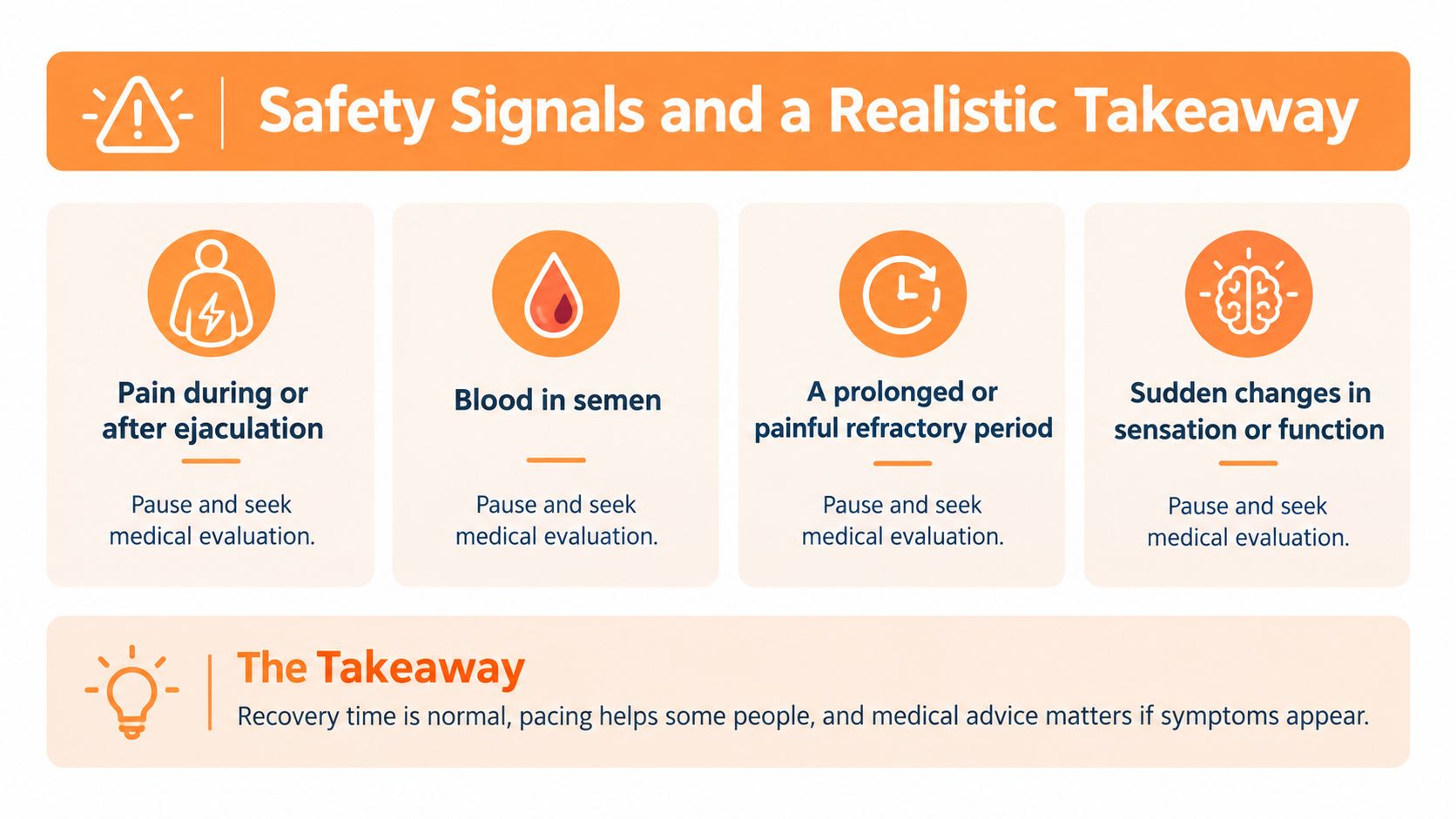
Experimentation should remain comfortable. Stop if stimulation causes pain, burning, sharp sensitivity, or soreness that doesn't settle. Blood in semen, a sudden inability to ejaculate, a persistent change in recovery, or a prolonged and painful erection deserves medical attention rather than another technique.
Seek prompt medical evaluation for a prolonged erection lasting more than two hours, especially if it is painful. Medical advice also matters when ejaculation becomes suddenly difficult, when erectile function changes persist, or when pain repeatedly follows orgasm.
A smaller second release is expected for many men. A 2022 systematic review found that 17 of 18 studies examining short-interval repeated ejaculation reported lower semen volume in the second sample. Among normozoospermic men, the review reported a standardized mean difference of −1.16, with a 95% confidence interval of −1.44 to −0.88 and p < 0.00001, as detailed in the systematic review of repeated ejaculation. This describes semen volume, not masculinity, pleasure, fertility, or orgasm quality.
The realistic path is straightforward:
- Understand that the refractory period is the main biological limit.
- Pace the first climax rather than chasing maximum intensity.
- Use edging as an awareness tool, not a guarantee.
- Train the pelvic floor with equal attention to relaxation.
- Support sleep, stress management, comfort, and general health.
- Communicate clearly with your partner.
- Stop when pain or concerning symptoms appear.
A second ejaculation is achievable for some men in some sessions. It can add novelty and pleasure, but it isn't a benchmark of sexual health, virility, or relationship quality. Ingredients such as zinc and L-arginine support normal reproductive function at the ingredient level, but they aren't treatments for any condition and don't remove normal recovery physiology.
These statements have not been evaluated by the Food and Drug Administration. This product is not intended to diagnose, treat, cure, or prevent any disease.
If you want to explore a daily men's wellness supplement alongside realistic pacing and recovery habits, visit SEMEX to review its ingredient-focused formula. Use it as part of a broader approach to sexual wellness, not as a promise that your body will ejaculate twice on demand.