

How to Do Reverse Kegels Men Guide
A man may be sitting at his desk, jaw tight, abdomen braced, and perineum subtly clenched without realizing it. Later, during sex or while trying to urinate, that same tension can feel like poor control, pressure, or an inability to fully let go. Searching for how to do reverse Kegels as a man usually starts with that frustration, but the solution isn't a harder push. It's learning to recognize and release the pelvic floor.
A reverse Kegel is a deliberate pelvic-floor relaxation exercise. Instead of squeezing and lifting, the muscles soften, lengthen, and gently “drop” with the breath. The position matters because a man can only improve the movement if he can feel it.
Table of Contents
- Understanding Pelvic Floor Relaxation
- Choosing the Right Position for Body Awareness
- Mastering the Breathing and Release Cues
- Building a Measurable Practice Routine
- Common Execution Errors and How to Fix Them
- Integrating Relaxation into Overall Male Vitality
Understanding Pelvic Floor Relaxation
The male pelvic floor forms a muscular base beneath the bladder, bowel, and reproductive structures. It helps coordinate urination, bowel function, erections, ejaculation, and postural support. Standard Kegels train contraction, but contraction is only one part of useful pelvic-floor control. A muscle that can tighten but cannot release efficiently may remain guarded during sitting, exercise, urination, or sexual activity.
A reverse Kegel is the opposite of a conventional Kegel. The aim is to let the pelvic floor drop downward and outward, not to force it down. Modern male pelvic-floor guidance describes the movement as a subtle release paired with relaxed abdominal breathing and, for some men, a mild bearing-down sensation that never becomes straining. The male pelvic-pain guidance from DynamicHealth emphasizes this distinction and places relaxation alongside controlled strengthening.
The physical target
The muscles sit inside a bowl-shaped region between the pubic bone at the front and the tailbone at the back. During a regular Kegel, that base lifts and narrows. During a reverse Kegel, the base lengthens and widens slightly. The sensation may resemble the beginning of urination or passing gas, but it should remain quiet and controlled.
A useful mental reference is the muscle used to stop urine flow, but reverse Kegels shouldn't be practiced while urinating. Stopping the stream can help identify the area once, yet repeated interruption may interfere with normal bladder emptying.
Practical rule: A correct reverse Kegel feels like less effort, not more effort.
The first objective isn't sexual performance. It's body awareness. A man should notice whether his perineum softens, whether his lower belly expands, and whether his glutes, thighs, and abdominal wall remain relatively quiet. The Kegel exercise guide for men can provide useful context for balancing contraction work with relaxation, but the release phase deserves equal attention.
Choosing the Right Position for Body Awareness
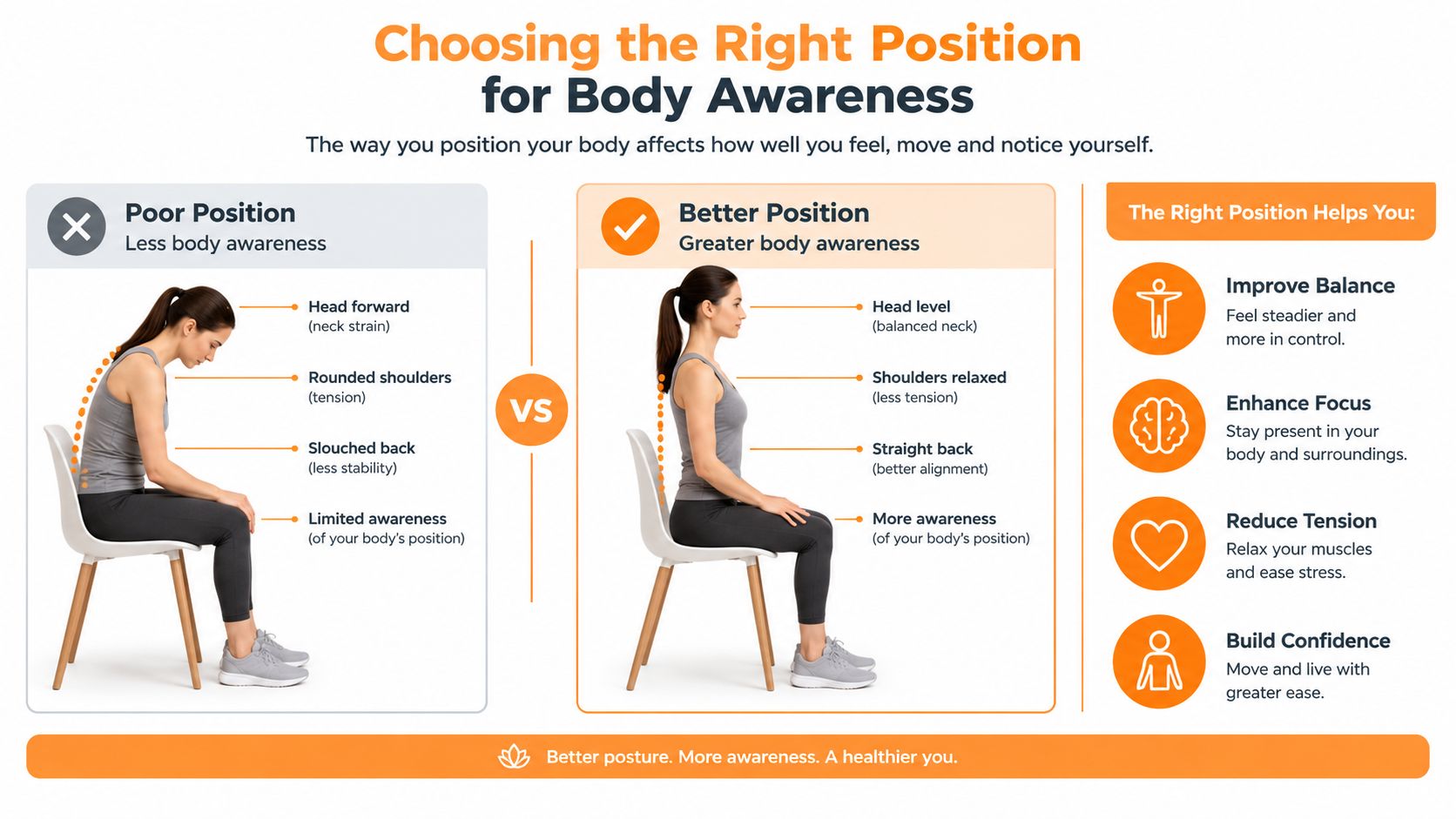
Position changes the feedback a man receives from gravity, the chair, and the surrounding muscles. No single setup works perfectly for everyone, so the practical approach is to begin where the pelvic drop is easiest to detect and then transfer the skill into more demanding positions.
Lying down
Lying on the back with the knees bent and feet supported is often the clearest starting point. The floor supports the spine, the hips don't need to stabilize the body, and gravity places less demand on the pelvic floor. This makes it easier to notice a softening around the perineum instead of automatically recruiting the glutes or lower abdominals.
The trade-off is that the position may feel too passive. A man who can release while lying down may still brace when standing, walking, lifting, or becoming sexually aroused. Lying down is therefore a learning position, not necessarily the final test.
Sitting
Sitting on a firm, supportive chair offers valuable tactile feedback. With the feet planted and the spine upright, the perineum can soften into the seat. That contact gives the nervous system a reference point, making a subtle downward release easier to recognize.
Slouching changes the result. Collapsing the chest or tucking the pelvis can create pressure and make the man mistake posture for pelvic-floor movement. The chair should support awareness, not encourage passive collapse.
Standing
Standing is the most functional position because daily activities and sexual movement happen upright. It also demands more control from the abdomen, hips, and spine, so beginners often compensate without noticing. A man should progress to standing only when he can release without pushing, holding his breath, or tightening his buttocks.
A practical progression is lying down first, sitting second, and standing third, while returning to the easier position whenever the sensation becomes unclear. The best position is the one that produces a quiet pelvic drop with minimal effort.
Mastering the Breathing and Release Cues
Breathing creates the rhythm, but it doesn't replace the release. A reverse Kegel should feel like a breath-led lengthening rather than a deliberate shove. Deep abdominal breathing, free diaphragm movement, and a relaxed abdomen support the local release pattern described in the NIH and PMC review on male pelvic-floor relaxation.
Begin in the position that offers the clearest feedback. Place one hand over the lower belly and keep the other over the upper chest. Breathe in through the nose and allow the lower hand to rise while the chest remains comparatively quiet. The abdomen shouldn't be pushed outward aggressively. It should expand because the diaphragm is moving naturally.
The inhale
On the inhale, allow the pelvic floor to move outward and downward. The perineum may feel as though it is becoming heavier against the chair or floor. Some men notice a widening between the sitting bones, while others feel only a faint softening behind the scrotum.
The jaw matters because facial tension often travels with general bracing. Let the tongue rest, unclench the teeth, and soften the abdomen. The glutes and inner thighs should remain relaxed.
The release
A subtle bearing-down image can help, but it must stay gentle. Think of opening space at the base of the pelvis, not trying to force a bowel movement. If the belly hardens, the face tightens, or pressure builds sharply, the movement has become a push.
During the exhale, keep the release easy and return toward neutral without squeezing. A slow breathing pattern can be useful. Some male pelvic-floor programs use cycles of approximately 7 seconds in and 11 seconds out, repeated 10 times, while others use 30 to 60 second relaxation holds. Those formats are options for controlled practice, not targets that should override comfort, as described by Advanced Urology's pelvic-floor therapy guide for men.
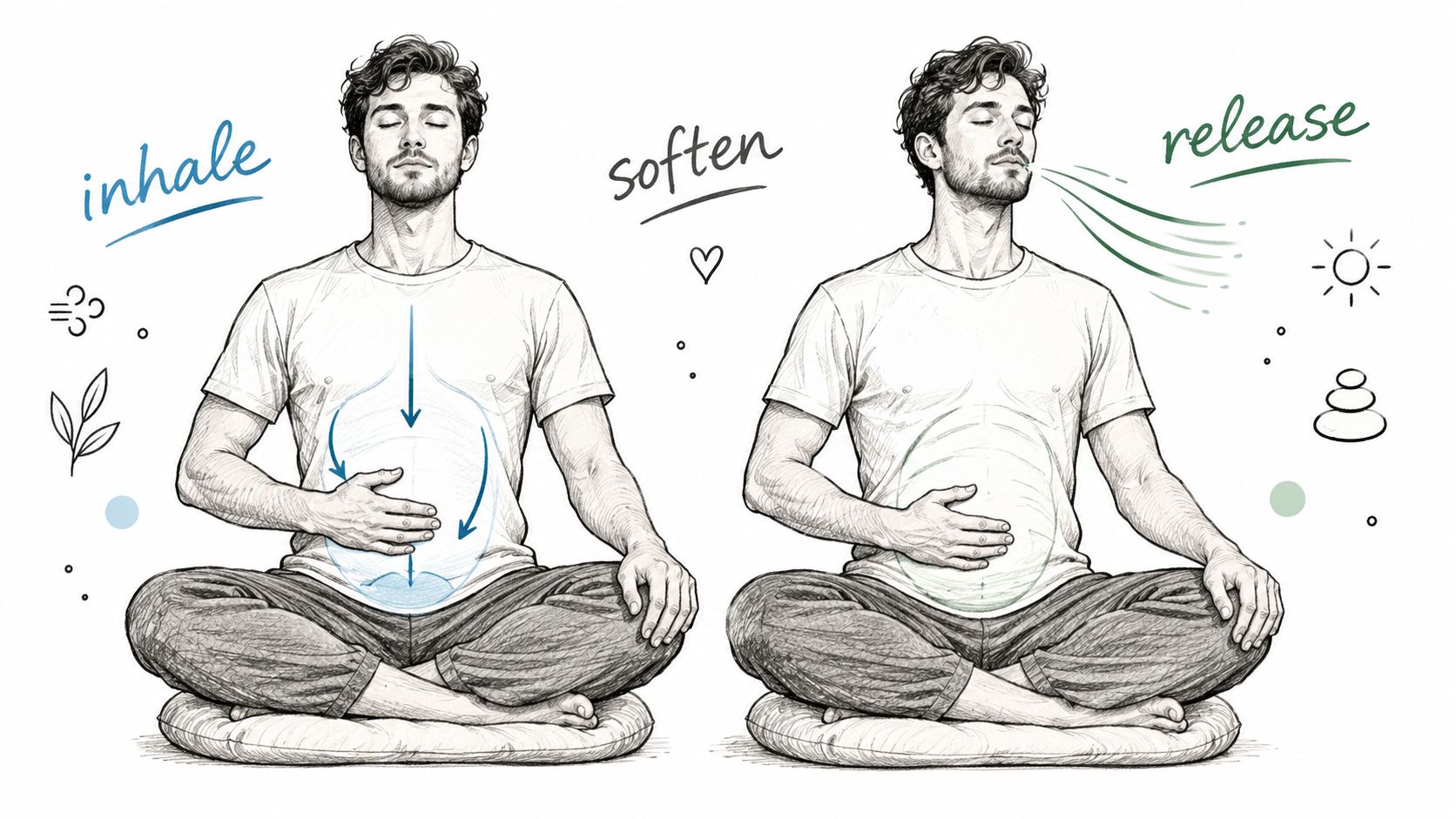
A man who wants additional breath-focused context can review these breathing techniques for male sexual control, but the core test remains simple: the breath should make the pelvic floor softer, not more pressurized.
Building a Measurable Practice Routine
Pelvic-floor practice becomes easier to evaluate when the dose is clear. Randomly pushing through repetitions can teach the wrong pattern, while a modest routine makes it easier to notice whether relaxation is becoming more accessible.
Physiotherapy guidance commonly uses 2 to 3 daily sessions, 5 to 10 repetitions, and breathing drills lasting 10 cycles or relaxation holds of 30 to 60 seconds, according to the NHS pelvic-floor exercise guidance for men. Reverse Kegels should sit within a balanced program, not replace all strengthening work when a clinician has identified weakness.
Reverse Kegel Progression Framework
| Week | Hold Duration | Reps Per Session | Daily Sessions |
|---|---|---|---|
| 1 | 2–3 seconds | 8–10 | 1 |
| 2 | 2–3 seconds | 8–10 | 2 |
| 3 | 30–60 seconds of relaxed breathing | 10 cycles | 2 |
| 4 | 30–60 seconds of relaxed breathing | 10 cycles | 2–3 |
The table is a practical progression, not a rule that every man must follow. The first stage prioritizes recognition. The second adds frequency without increasing force. The third and fourth stages emphasize sustained softness and breathing control.
A national continence framework provides a broader strengthening comparison, beginning with 3-second contractions, progressing toward 5 to 8 seconds, using 3 to 5 repetitions per set, and eventually working toward 8 to 10 squeezes per set and 3 sets per day. That contrast matters. A complete pelvic-floor routine pairs controlled activation with equally deliberate relaxation.
Quality check: If the final repetition feels like straining, the session has already gone too far.
Practice can be done after waking, during a quiet seated break, or before bed. The useful measure is not intensity. It's whether the man can find the release faster, breathe without bracing, and return to neutral smoothly.
Common Execution Errors and How to Fix Them
The biggest mistake is assuming that a stronger downward sensation means a better reverse Kegel. It doesn't. Forceful bearing down raises abdominal pressure and can cause the pelvic floor to guard rather than relax.
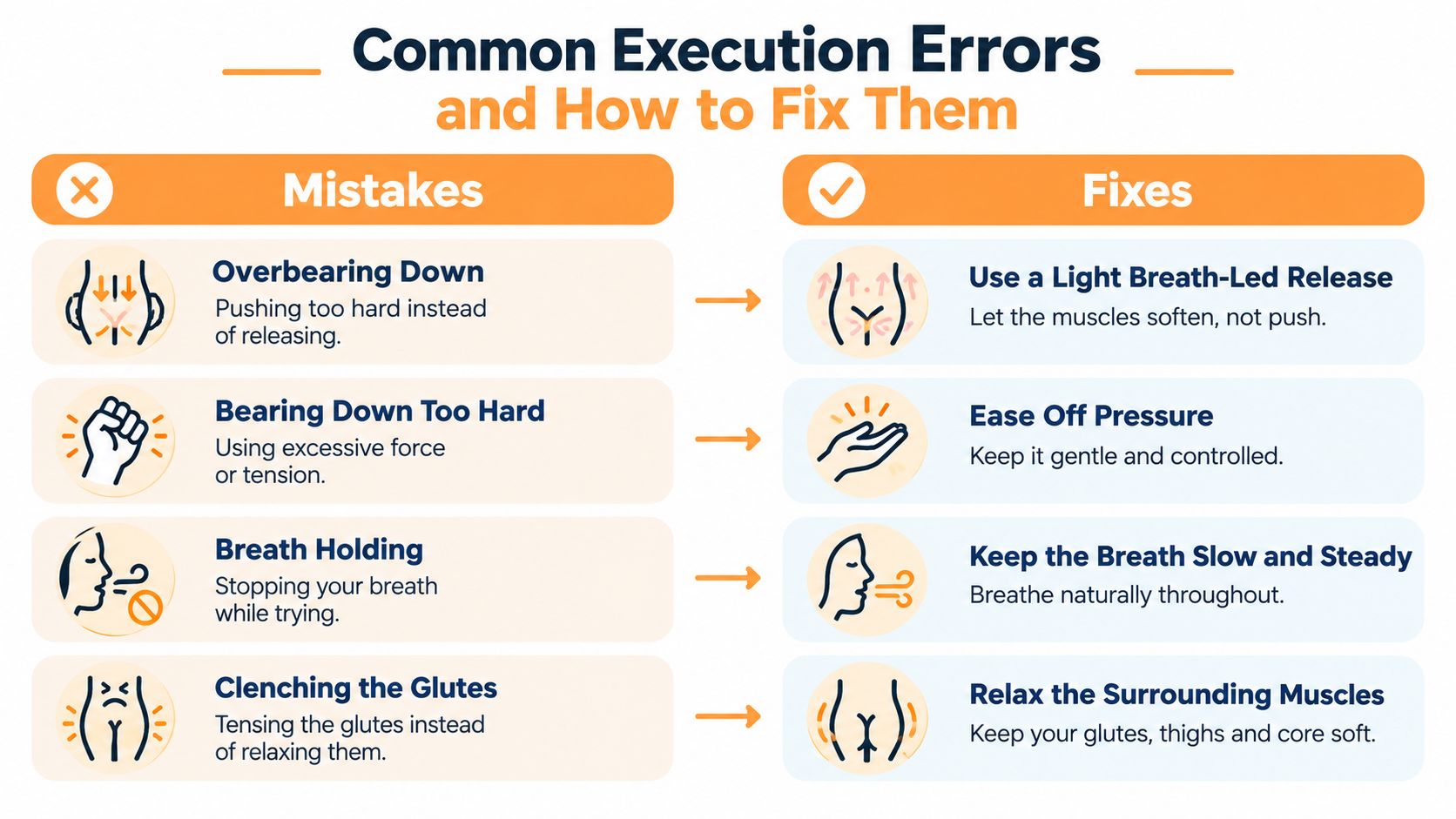
Overbearing down
A man may push as if trying to empty the bowel. The abdomen becomes firm, the face tightens, and the perineum may recoil. The correction is to reduce the effort until only a breath-linked softening remains.
Chest-dominant breathing
Raising the chest while keeping the belly rigid limits the movement that supports pelvic-floor release. Place a hand on the lower abdomen and make the inhale quieter. The belly should expand naturally, while the shoulders stay relaxed.
Moving the pelvis or spine
Rocking the pelvis, arching the back, or shifting the hips can create the illusion of movement. The pelvic floor should change tone without visible motion. A chair or floor provides useful feedback because it exposes large movements that shouldn't be necessary.
Clenching nearby muscles
Glutes, inner thighs, and abdominal muscles often join the exercise when a man concentrates too intensely. Loosen the buttocks, keep the feet heavy, and imagine the perineum melting into the support beneath it.
Holding the breath
Breath holding removes the rhythm that helps the muscles release. If the inhale or exhale becomes forced, stop, return to ordinary breathing, and restart with less range.
The reverse Kegel isn't a push with better branding. It's a controlled reduction in tension.
Pain, persistent urinary symptoms, difficulty starting the stream, or worsening discomfort deserves professional assessment from a urologist or pelvic-floor physical therapist. A gentle exercise shouldn't be used to override symptoms that remain unexplained.
Integrating Relaxation into Overall Male Vitality
Pelvic-floor control works best as part of a wider male-wellness routine. Sleep, physical activity, stress management, comfortable breathing, and appropriate medical care all influence how easily a man can stop bracing. Reverse Kegels add a specific skill, the ability to move from tension to release without losing awareness.
The practical sequence is straightforward. A man learns the drop lying down, confirms it while sitting, and then practices it standing without shifting the spine or tightening the hips. Over time, that awareness can support more deliberate control during everyday movement and sexual activity, although it shouldn't be described as a guaranteed treatment for any sexual or urinary condition.
Nutritional support may also be considered separately from exercise. SEMEX is a daily supplement formulated around semen-volume and taste-focused ingredients, including Zinc, L-Arginine, Sunflower Lecithin, and Bromelain, alongside a men's wellness blend. It doesn't replace pelvic-floor training, clinical evaluation, or healthy habits.
The male vitality support guide can sit alongside a broader routine, but consistency remains the useful principle. The man who practices gently, tracks body awareness, and stops forcing the movement is more likely to build a reliable release pattern than the man who chases intensity.
These statements have not been evaluated by the Food and Drug Administration. This product is not intended to diagnose, treat, cure, or prevent any disease.
SEMEX offers a daily supplement built around semen-volume and taste-focused ingredients, making it a separate nutritional option to consider alongside breath-led pelvic-floor practice. Visit SEMEX to review the product information and decide whether it fits the reader's broader men's wellness routine.