

How to Bust Bigger Nuts: A Real-World Guide
Most advice on how to bust bigger nuts is backwards. Men chase random pills, more ejaculations, or some miracle trick, then ignore the stuff that changes semen volume, timing, hydration, and nutrient status. Bigger volume is real, but it's not the same thing as better fertility, better sperm quality, or a better outcome in bed.
Table of Contents
- What Bigger Volume Really Means
- Lifestyle Habits That Move the Needle
- Timing, Frequency, and the Abstinence Question
- Zinc and L-Arginine Under the Microscope
- The Men's Wellness Herb Lineup
- Choosing a Supplement Without Getting Burned
- Realistic Timelines and What to Expect
What Bigger Volume Really Means
More volume does not automatically mean better fertility. Semen is a mix of fluids from several glands, and the amount you see is only one part of the picture. A WHO reference framework summary places the lower fifth-percentile semen volume at 1.4 mL with a 95% CI of 1.3 to 1.5 mL, the median at 3.0 mL, and the 90th percentile at 5.5 mL based on data from about 3,500 fertile men.
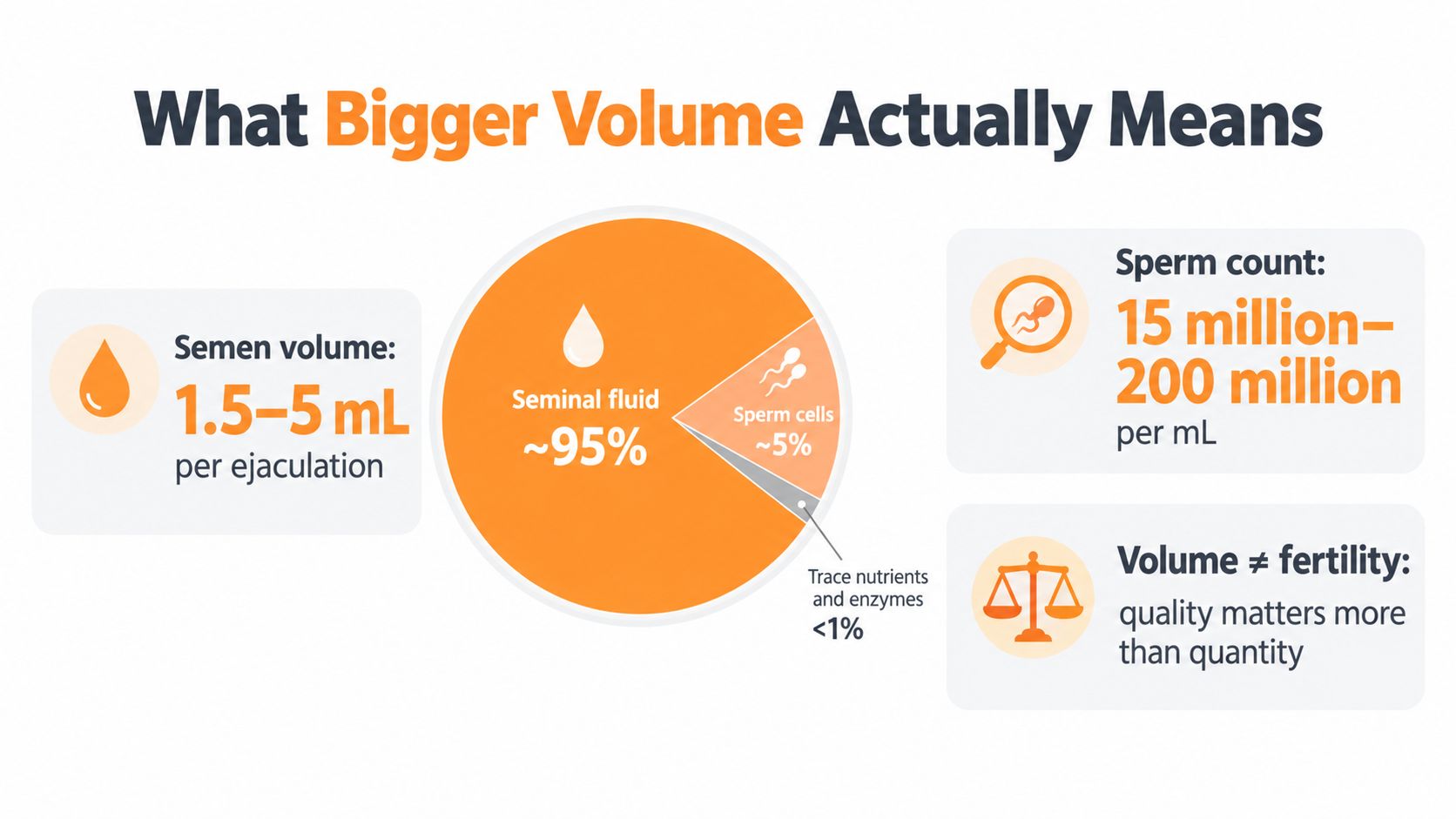
The number you see is not the whole story
A guy can have a bigger-looking load and still have weak sperm movement, poor morphology, or low total sperm number. That is why semen volume should be treated as a cosmetic and confidence metric first, not a fertility score. The same WHO framework lists lower reference limits for 39 million sperm per ejaculate, 42% total motility, 30% progressive motility, and 4% normal morphology, which is the reason volume alone is the wrong lens.
Practical rule: stop judging yourself by eyeball volume alone. If the goal is a bigger-looking ejaculation, focus on the levers that change fluid output. If the goal is conception, sperm count and motility matter just as much, and often more.
Visible load size changes with timing, hydration, collection method, and normal variation. It does not tell you much about reproductive health by itself. If you want a useful benchmark, use volume as a reference point, not a verdict.
For a plain-English breakdown of semen volume, see this guide on sperm volume.
Lifestyle Habits That Move the Needle
If you want bigger volume, build the base first. Supplements can support the routine, but they don't replace it. The men who get the best results are the ones who keep hydration, sleep, food, training, and ejaculation timing steady instead of bouncing all over the place.
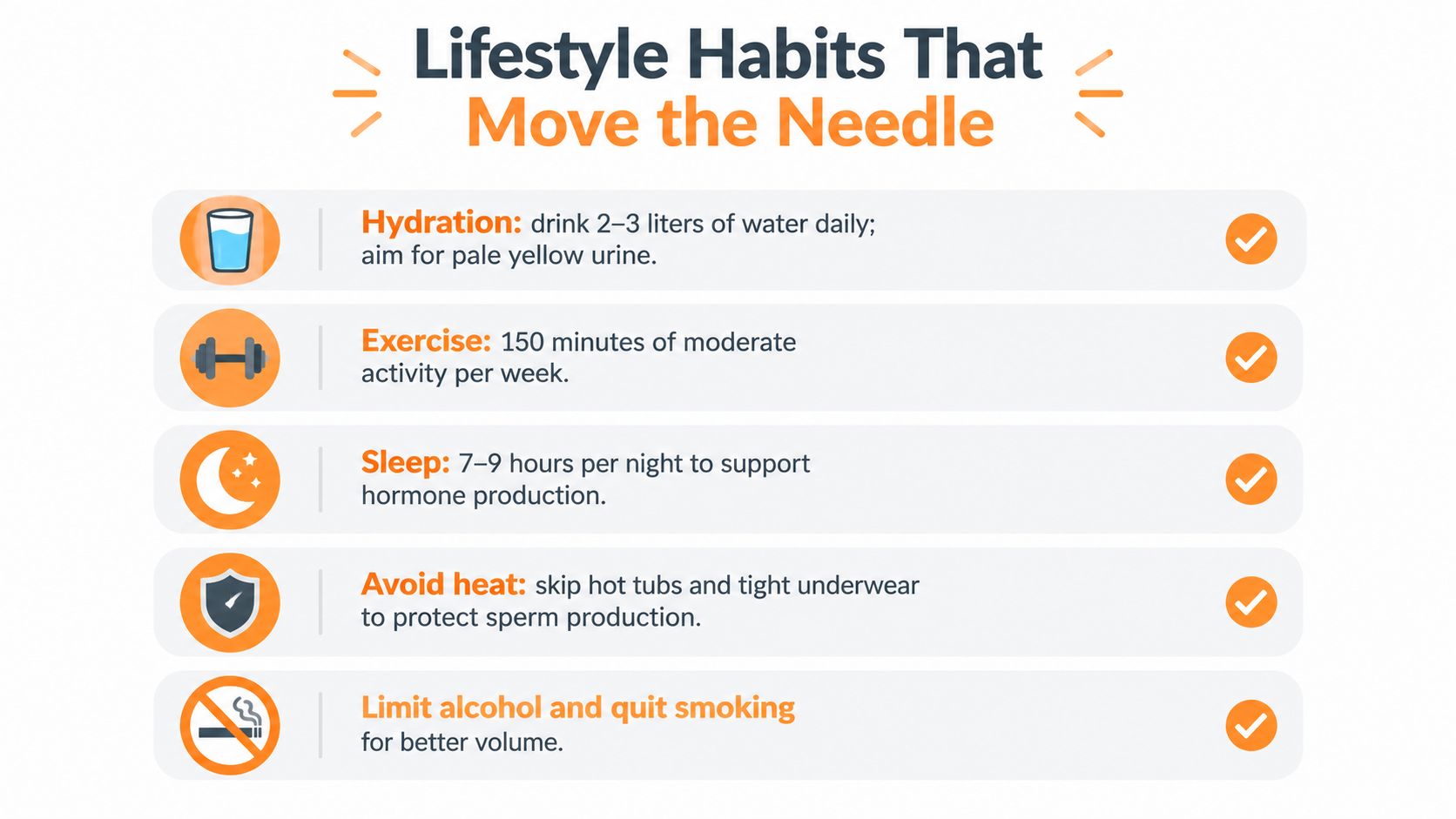
Start with fluid, food, and recovery
Hydration is the first easy win. If you're under-drinking, semen looks thinner and smaller because there's less fluid available to work with. Keep water intake consistent across the week, not just on the day you want a bigger result, and use urine color as a simple check, pale yellow usually means you're in the right zone.
Sleep matters because testosterone and recovery don't run well on short nights. Keep your schedule boring and regular. The guy who sleeps like trash, drinks heavily, and trains erratically is usually fighting uphill before he even thinks about supplements.
Train your body, but don't overdo it
Moderate exercise helps circulation, stress control, and overall reproductive health. Pelvic-floor work can also help men feel more control during ejaculation, which matters if you care about intensity as well as volume. Hard cardio and resistance training are fine, but chronic overtraining, poor recovery, and constant heat exposure can work against you.
Zinc is a good example of why nutrition quality matters. In a controlled depletion study, men dropped from 10.4 mg to 1.4 mg of daily zinc and saw semen volume fall from 3.30 mL to 2.24 mL, while serum testosterone fell about 19% (controlled zinc-depletion study). That doesn't mean loading up on zinc will make every guy bigger. It does mean inadequate intake can show up in semen-related parameters.
Simple rule: don't chase one supplement while living like your body's in a deficit. Food, sleep, hydration, and training consistency are the base layer.
If you want a focused routine for raising volume, this practical guide to improving ejaculation volume lays out the basics in plain language.
Timing, Frequency, and the Abstinence Question
Men usually ask one practical thing: how long should they wait? Timing changes the result more than people admit. If you want a temporarily larger-looking ejaculation, abstinence matters, but stretching the gap too far is not a smart default.
| Abstinence Interval | Volume Effect | Motility Effect | Best For |
|---|---|---|---|
| 1 day | Usually lower than a longer window | Can stay fresher | Routine sex, frequent ejaculation |
| 2 to 3 days | Strong balance of volume and freshness | Better balance for sperm freshness | Most men, most of the time |
| 5 to 7 days | Often higher single-ejaculation volume | Freshness can drop | Planned high-volume encounter |
Clinical semen collection commonly uses a 2 to 7 day abstinence window, and the 2 to 3 day range gives a solid mix of volume and freshness (WHO-based collection guidance).
Frequency doesn't magically grow the tank
Frequent ejaculation does not train the body to make more volume. A clinical dataset found that men reporting 2 to 3 ejaculations per week had semen volume of 2.92 ± 1.56 mL, versus 2.91 ± 1.54 mL in men reporting fewer than one per week, which is the same. The higher-frequency group did show better sperm motility, so frequency affects quality more than volume (clinical dataset summary).
That is where a lot of locker-room advice goes sideways. If conception is the goal, a steadier rhythm makes sense. If you want a bigger visible load for a planned encounter, give yourself a few days off, not weeks.
Best practical rule: keep ejaculation every 2 to 3 days for freshness, then use about 2 to 3 days of abstinence before a planned high-volume encounter.
Keep the rest of the setup steady if you want to judge the result clearly. Hydration, sleep, alcohol, and collection method all change what you see. One sloppy day can make a good routine look useless when timing was the real issue.
Zinc and L-Arginine Under the Microscope
Zinc gets sold like a magic semen booster. It is not. Zinc still matters because normal male reproductive function depends on it, but more zinc does not automatically mean more visible ejaculate.

What zinc can and can't prove
The cleanest read on zinc is simple. Adequate zinc status matters, deficiency can hurt reproductive parameters, and supplementation may help some semen markers in some contexts. A zinc meta-analysis reported links between zinc supplementation and higher semen volume, motility, and normal morphology, but it did not show uniform improvement across every sperm outcome.
Then the harder reality check landed. An NIH-supported trial of 2,370 couples gave men 30 mg zinc plus 5 mg folic acid or placebo for six months. Live birth was 34% in the supplement group and 35% in placebo, with no meaningful difference in sperm count, motility, or morphology (NIH trial summary).
That is the right frame. Zinc supports normal reproductive biology, and deficiency correction can matter. It does not guarantee a bigger load, and it is not fertility treatment in a bottle.
Where L-arginine fits
L-arginine plays a different role. It is a biochemical precursor to nitric oxide, and nitric oxide supports penile blood flow and erection physiology (L-arginine and nitric oxide). That makes it relevant for sexual function support when circulation is part of the problem.
A clinical study of high-dose oral L-arginine reported subjective sexual-function improvement in men with organic erectile dysfunction and reduced nitric oxide production. The effect was specific, not universal. Do not turn that into a blanket promise.
If you are reading labels, keep the logic straight. Zinc supports normal reproductive function, L-arginine supports nitric-oxide availability, and neither one justifies fantasy claims. For a straighter breakdown of zinc's role, this zinc and ejaculation guide covers the practical angle without the hype.
The Men's Wellness Herb Lineup
Herbs get marketed hard in men's formulas because they sound natural and feel safer than “chemical” ingredients. That does not make them useless, it just means you need to separate tradition from human evidence. Some ingredients are mostly about libido or energy, while others are sold on reputation.
What the herbs are really for
Maca root shows up because men want more desire and drive, not because it is a proven semen-volume monster. Panax ginseng is usually positioned around energy and circulation. Ashwagandha gets pulled into stress support, and tongkat ali is often sold for libido and vitality.
Saw palmetto sits in a different lane. It is more often discussed for prostate and urinary support than for ejaculate volume. Horny goat weed gets attention because the name sells itself, but that is not the same thing as strong human evidence.
What deserves real attention
L-arginine has the clearest physiological role in this group. It supports nitric-oxide production, which is one reason it gets used in sexual-function formulas. The honest claim is blood-flow-related support, not an automatic volume jump.
Bromelain is where a lot of product copy drifts into fantasy. Published studies do not establish a reliable human clinical effect for semen taste, and there is no solid dose-response work here that lets a label make a trustworthy promise. Do not let marketing sell you a flavor claim it cannot prove.
Sunflower lecithin appears in these formulas too, but ingredient inclusion is not the same as outcome proof. A decent formula can support a broader routine, but it will not override hydration, abstinence timing, or nutrient status.
If you want the simplest filter, ask one question for every herb, what human outcome is being measured? Libido, erection quality, stress, circulation, or something else. If the answer stays vague, the marketing is doing the heavy lifting.
Choosing a Supplement Without Getting Burned
Most supplement mistakes come from bad product filtering, not bad intentions. Guys buy whatever has the loudest label, then wonder why the bottle doesn't match the promise. The fix is simple, but you've got to be strict.
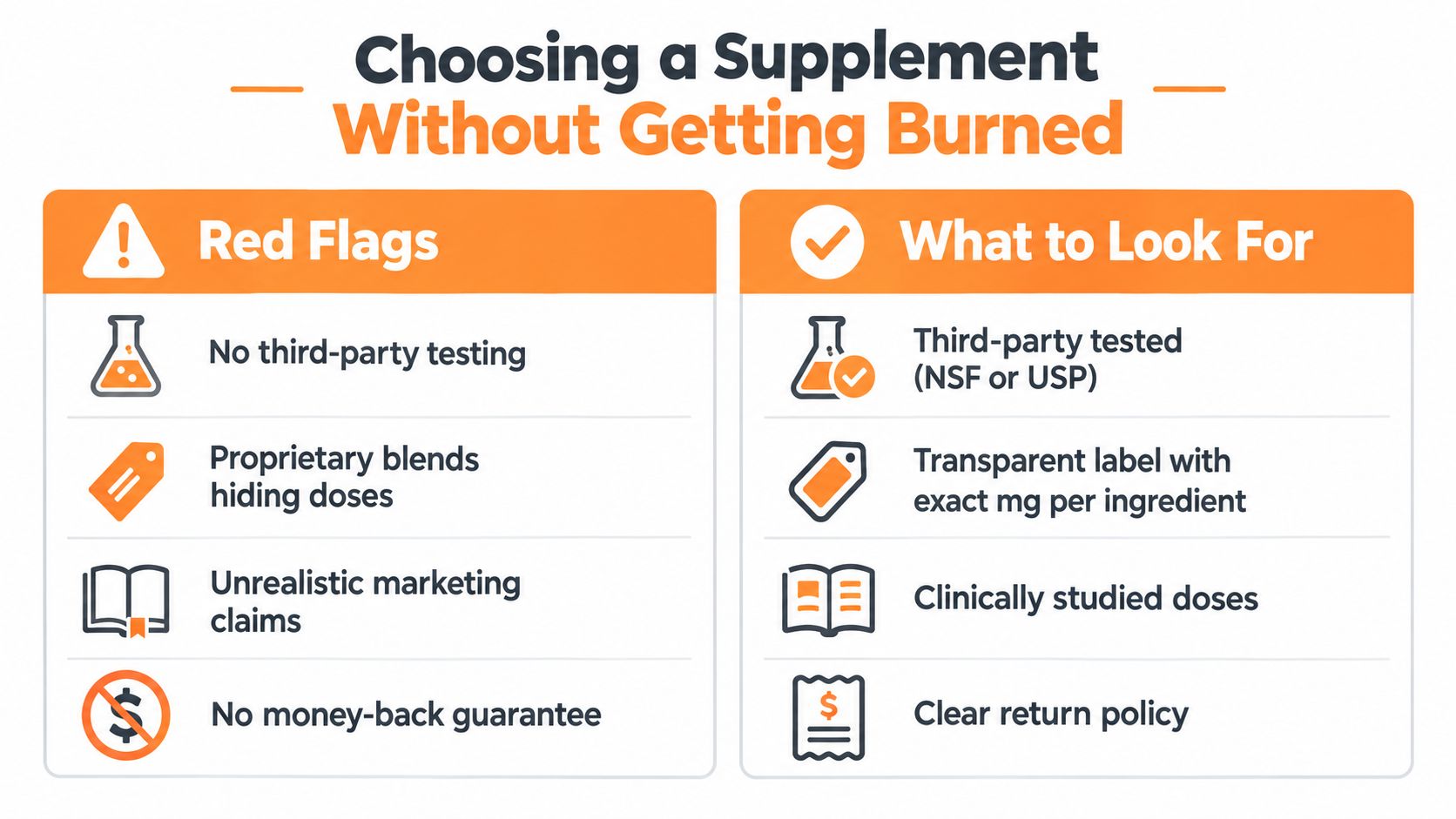
What to demand before you buy
Look for transparent dosages, not vague proprietary blends. You should know exactly how many milligrams of zinc, L-arginine, or any herb you're taking. If the label hides doses, that's a red flag.
Third-party testing matters too. It's one thing to say the product is clean, it's another to show it. cGMP manufacturing, allergen disclosure, and origin clarity are basic trust signals, not luxury extras.
What to ignore fast
Be suspicious of miracle timelines. Anything promising instant volume, guaranteed fertility, or dramatic bedroom transformation is overreaching. A 2025 systematic review and meta-analysis of 50 studies found no demonstrated effect of dietary supplements on pregnancy or live-birth outcomes, and arginine didn't improve any sperm parameter in the analyzed evidence (2025 systematic review).
That doesn't mean supplements are pointless. It means the promise has to match the evidence. A formula can support normal reproductive function, sexual vitality, or nitric-oxide availability, but it shouldn't pretend to diagnose, treat, cure, or prevent anything.
If you want a simple buying rule, use this checklist:
- Exact doses listed so you know what you're taking.
- Third-party testing for quality and contamination control.
- No ridiculous claims about fertility fixes or instant volume jumps.
- A return policy that shows the brand stands behind its product.
For a simple walkthrough of label reading, this supplement label guide is worth a look. And if you're considering a formula that combines zinc, L-arginine, lecithin, bromelain, and men's wellness herbs, SEMEX is one option built around that kind of routine support.
Realistic Timelines and What to Expect
Stop expecting week-one magic. Semen volume changes respond to a routine that stays steady long enough for the body to adapt. The guys who get annoyed fastest are usually the ones changing five things at once. Pick a clean setup, stick with it, and judge the result over time.
The routine that works
In the first 30 days, aim for consistency, not heroics. Keep hydration steady, sleep on schedule, control ejaculation timing, and use a supplement only if you take it daily. That is the point where you find out whether your routine is realistic enough to keep doing.
By 60 days, you should know whether the changes are holding. Men often notice more predictable output because the routine is no longer bouncing around. If you are still guessing, your inputs are too noisy.
A 90-day window is the fairest way to judge a routine that combines lifestyle and supplementation. Your body does not care about your emotional timeline, it responds on its own biology. That matters even more when abstinence timing and steady intake are part of the plan.
The abstinence window matters too. A 2 to 7 day window is the clinical standard, with 2 to 3 days balancing volume and freshness and up to 7 days used when single-ejaculation volume is the goal.
Use a simple daily template.
- Morning: drink water early and eat normally.
- Daytime: train or walk, then avoid junky recovery habits.
- Evening: sleep on time, and do not stack alcohol with late nights.
- Before a planned high-volume encounter: hold a 2 to 3 day abstinence window.
That routine supports bigger visible volume without turning your life into a supplement experiment. Keep the basics tight, because they do more than any flashy promise.
These statements have not been evaluated by the Food and Drug Administration. This product is not intended to diagnose, treat, cure, or prevent any disease.