

How Much Tongkat Ali Per Day Dosage Guide for Men
The most studied daily range is 100–400 mg of standardized Tongkat Ali root extract, with 200 mg per day appearing as the single most common research dose. The exact amount depends on the extract type and its standardization, so 200 mg of one product may not equal 200 mg of another.
That distinction matters because a shopper can hold two bottles with the same milligram number and still be comparing very different materials. One label may describe powdered root, another a water extract, and a third a concentrated extract standardized to a marker such as eurypeptides. So, how much Tongkat Ali per day makes sense? The answer starts with the extract, then moves to the research range, product-label details, daily routine, and safety context.
Table of Contents
- Introduction to Daily Tongkat Ali Dosing
- Understanding Tongkat Ali and How Standardization Works
- How Much Tongkat Ali Per Day Research Suggests
- Why Extract Type Changes Your Daily Amount
- How to Take Tongkat Ali Daily for Consistent Results
- Safety Upper Limits and When to Be Cautious
- Choosing Your Daily Amount and Next Steps
Introduction to Daily Tongkat Ali Dosing
How much Tongkat Ali per day makes sense when two bottles show the same milligram amount? A label listing 200 mg may appear easy to compare with one listing 400 mg, yet those figures can represent raw root powder, a water-extracted root, or a standardized preparation. The number on the front is only one part of the dose.
A useful starting point is a standardized extract within the 100–400 mg daily range. 200 mg daily is the most common dose in published human efficacy research, according to the available review of human evidence. Water-extracted root standardized to 22% eurypeptides is also discussed at 50–200 mg per day. These ranges cannot be interpreted properly without knowing which type of material the label describes.
Why one universal number falls short
Milligrams tell you how much product is in a serving. They do not automatically show how concentrated the material is or how consistently a named marker is present. Comparing every Tongkat Ali product by weight alone is like comparing a spoonful of mild coffee with a spoonful of espresso concentrate. The scoop size matches, but the strength does not.
That difference gives this guide its starting point: read the extract before judging the dose. A standardized product may provide more information about its intended composition than a label that lists only Tongkat Ali root. The stated marker still does not answer every quality question, so the rest of the label matters too.
Tongkat Ali is discussed here as a botanical ingredient that may support vitality or general men's wellness. It is not presented as a treatment for a medical condition. Men with symptoms that need assessment should seek professional guidance rather than relying on product marketing or changing a supplement dose on their own.
A simple way to use the information
Use the label in this order:
- Identify the form: Check whether it lists powdered root, water extract, or another extract.
- Find the standardization: Look for a named marker and stated level, not only total milligrams.
- Compare with research: Match the product with findings involving a similar extract.
- Start conservatively: A lower amount of a clearly described extract is easier to assess than a large amount of unknown material.
- Track consistency: Note regular use and tolerance instead of changing the dose repeatedly.
The aim is not to choose the biggest number. It is to match a transparent extract with a sensible research-informed range, then use it consistently enough to judge whether it fits an individual routine.
Understanding Tongkat Ali and How Standardization Works
Tongkat Ali is the common name for the root of Eurycoma longifolia, a botanical traditionally used in Southeast Asia. Supplements may contain the root as a powder or as an extract. Extraction changes what the finished material contains, while standardization adds another layer by indicating that the product has been measured against a specified marker.
One marker used in the dosing literature is eurypeptides. A label that states a standardization level gives readers more information than a label that lists only “Tongkat Ali root.” It helps show that the manufacturer is targeting a more consistent composition from serving to serving, although the marker alone doesn't answer every question about quality.
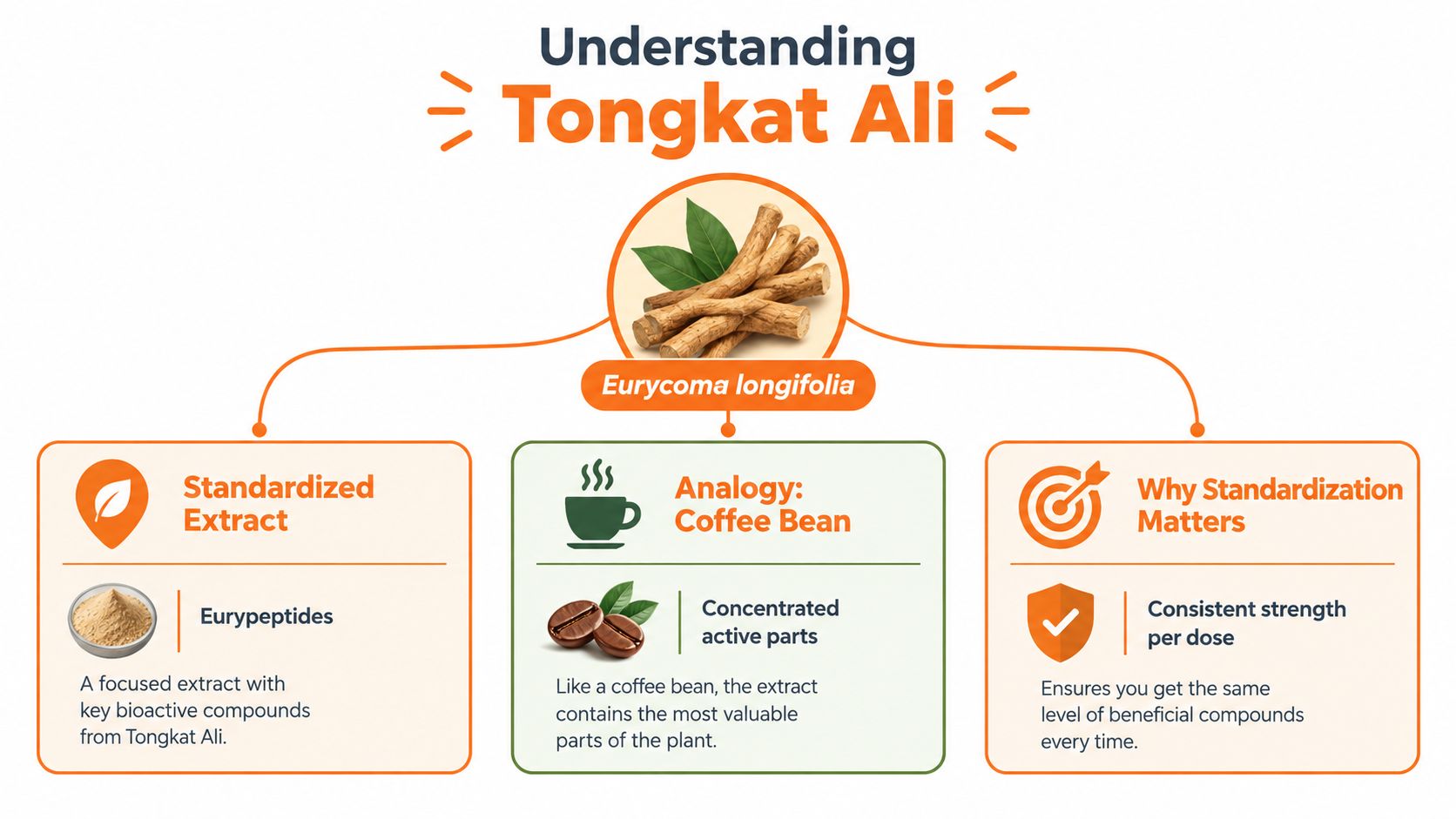
The coffee-strength analogy
Coffee makes the difference easier to understand. A scoop of ground coffee and a small amount of concentrated coffee may come from the same plant, but they don't deliver the same strength in the cup. The weight is only one part of the comparison. Processing and concentration change what that weight represents.
Tongkat Ali works similarly for label reading. One hundred milligrams of powdered root isn't automatically equivalent to 100 mg of a concentrated water extract, and neither should be assumed equivalent to a highly standardized extract. The milligram figure tells the amount of finished ingredient, while the extraction method and standardization help explain its composition.
The Tongkat Ali extract overview provides useful background for readers comparing these forms. A shopper doesn't need to turn a supplement label into a chemistry project, but the shopper does need to ask whether the serving is clearly identified.
What to look for on the panel
A clearer label usually answers several practical questions:
- Botanical identity: Does it name Eurycoma longifolia root?
- Extract form: Does it specify water extract or another preparation?
- Standardization marker: Does it identify eurypeptides or another measured marker?
- Serving amount: Does it state the amount per capsule and the suggested daily serving?
- Blend transparency: Does it disclose the Tongkat Ali amount rather than hiding it inside a proprietary blend?
A product that leaves these details unclear may be harder to compare with human research. Standardization doesn't create a magic dose, but it makes the dose more meaningful. That's why the first question isn't “How many milligrams?” It's “How concentrated and consistently defined is each milligram?”
How Much Tongkat Ali Per Day Research Suggests
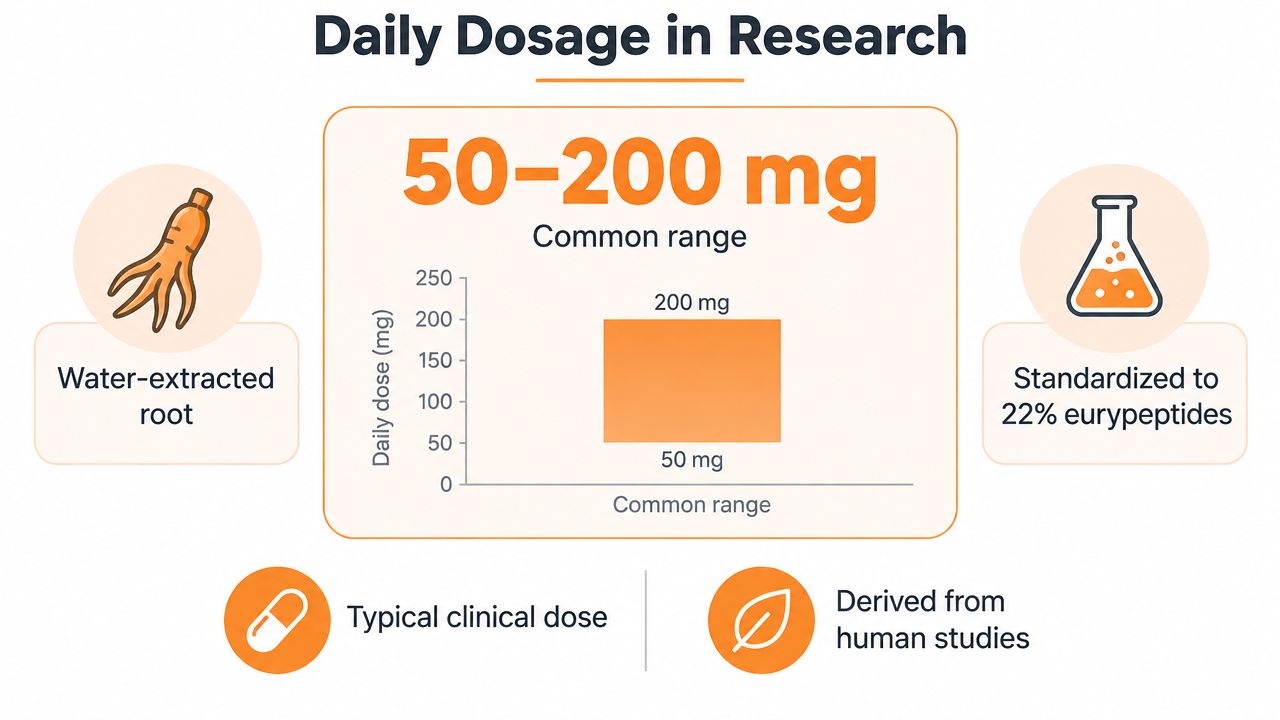
Which daily amount should you choose when two Tongkat Ali products list the same milligrams? Start with the extract, not the number. Human research does not support one universal dose for every preparation. A water-extracted root standardized to 22% eurypeptides is commonly discussed in the range of 50–200 mg per day, based on traditional use and available scientific evidence as described in the clinical review.
That distinction works like comparing coffee by weight without knowing how concentrated it is. 200 mg of one extract may not equal 200 mg of another if their extraction methods or marker levels differ. The milligram value measures the finished ingredient, while standardization helps show what that ingredient contains.
A randomized four-week trial used 200 mg per day with 64 adults, 32 men and 32 women. The value of that figure is not that every person needs 200 mg. It shows that 200 mg is a recurring research dose, rather than a number found only on supplement labels.
Reading the range without flattening it
Broader human research places study doses between 100 and 600 mg per day. Positive outcomes commonly cluster around 200 mg and 200–400 mg per day, across study periods lasting 2–12 weeks. These figures describe research settings, not a guaranteed personal target. The extract form and standardization still determine how closely a product matches the material studied.
Use the ranges as a map:
- 50–200 mg daily: A commonly cited range for a water-extracted root standardized to 22% eurypeptides.
- 100–400 mg daily: A practical range associated with standardized root extracts in published human research.
- 200 mg daily: A frequently used dose in efficacy studies.
- 400–600 mg daily: A range that appears in human research and sits near the upper edge of what has been systematically tested.
Why duration belongs beside dose
A daily amount is only one part of a research design. Studies keep the dose and product consistent for a defined period, while consumers may switch products, skip servings, or raise the amount after a few days. Those changes make personal impressions harder to interpret.
The research periods described above run from 2 to 12 weeks, so a fair evaluation requires consistency rather than rapid adjustments. A steady routine can help you observe tolerance and general experience over time, but it cannot guarantee a particular outcome.
For readers focused on libido, this Tongkat Ali dosage guide for libido offers additional context for including the ingredient in a broader men's wellness routine. The practical rule is simple: research supports ranges for particular extracts, not a promise attached to every product carrying the Tongkat Ali name.
Research-minded rule: A dose becomes meaningful only when the product's extract form and standardization make it reasonably comparable with the material used in human studies.
Why Extract Type Changes Your Daily Amount
200 mg is not automatically 200 mg. The number only becomes meaningful after you identify what the product contains. Powdered root is ground plant material. An extract has been processed to concentrate selected constituents, while a standardized extract also states a target marker and aims for more consistent strength.
That distinction changes how you read a serving recommendation. A large amount of unstandardized powder cannot be assumed to match a smaller amount of standardized extract. The useful question is not which bottle shows the biggest milligram figure. Ask what the figure represents, how the ingredient was extracted, and whether the label identifies a marker.
A side-by-side label framework
| Extract Form | Typical Studied Daily Range | Standardization Signal | What to Check on Label |
|---|---|---|---|
| Powdered root | Not directly interchangeable with standardized extract ranges | May have no defined marker | Confirm that it is root powder, not an extract, and look for any disclosed testing |
| Water extract | 50–200 mg per day for water-extracted root standardized to 22% eurypeptides, as described in this clinical review | Water extraction method and stated eurypeptide standardization | Check the extraction method, marker level, serving size, and whether the daily amount matches the stated form |
| Highly standardized extract | Research products use varied amounts, with some positive findings concentrated around 200–400 mg per day | A named marker with a disclosed standardization level | Check the marker, amount per capsule, total daily serving, and independent quality documentation |
The table is a comparison framework, not a conversion chart. There is no reliable way to translate every product into an equivalent amount of another preparation without knowing its extraction method and standardization.
How to calculate the daily serving
Start with the Tongkat Ali amount per capsule. Multiply it by the number of capsules listed for the daily serving. Then check whether the label describes powder or extract and whether it names a standardization marker.
Two products may both list 200 mg per capsule while providing different material. One could be a standardized extract, and the other could be unspecified root powder. Matching numbers do not establish matching strength. A proprietary blend creates another problem because the Tongkat Ali amount may not be shown separately.
The NCBI LiverTox summary identifies a traditional daily dose of 100–400 mg and notes that online products may sell much higher capsule amounts of 1,000–1,600 mg in its Tongkat Ali entry. These figures show why a large retail number does not prove that a product matches the evidence base.
Label-reading shortcut: If the form, standardization, and full daily serving are unclear, do not treat the milligram number as equivalent to a research dose.
How to Take Tongkat Ali Daily for Consistent Results
A cautious routine begins with clarity, not escalation. For a clearly standardized extract, starting near the lower end of the relevant research range gives the user a chance to evaluate tolerance before considering any adjustment. The aim is a stable daily pattern, not a race toward the largest serving.
Timing can be practical rather than dramatic. Many users prefer morning or earlier-day use, particularly if an ingredient feels alerting. Taking a serving with food can also be more comfortable for someone with a sensitive stomach, although personal tolerance should guide the routine.
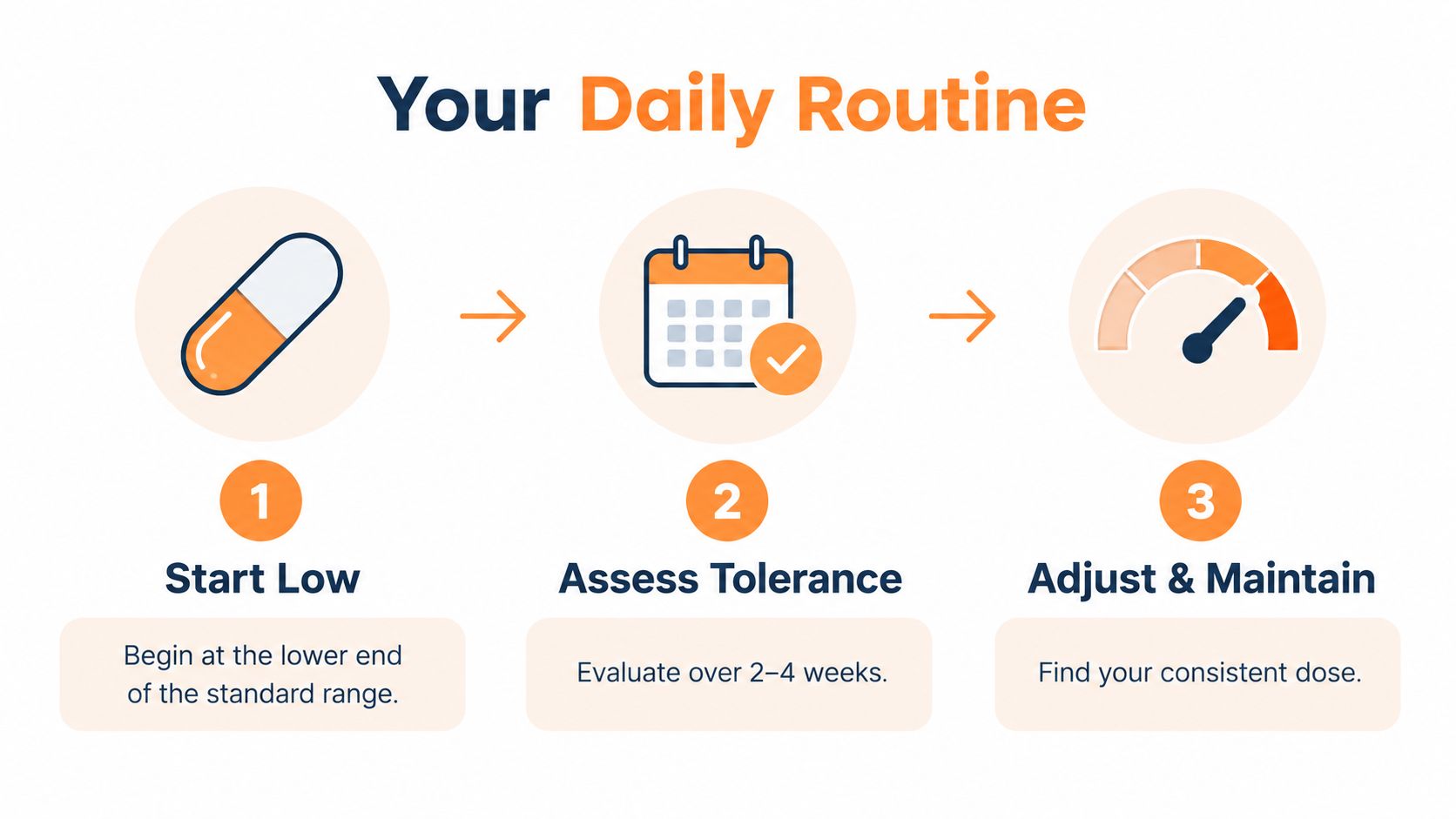
A simple three-step process
- Start low: Use the lower end of the stated standardized range and follow the product label. A product's serving directions may reflect its specific extract, so they shouldn't be replaced casually with directions from a different preparation.
- Assess tolerance: Keep the amount consistent for 2–4 weeks while tracking sleep, digestion, alertness, and general comfort. This isn't a promise that a specific effect will appear within that period. It's a way to avoid confusing a dose change with a response.
- Adjust and maintain: If the product is well tolerated but the serving appears lower than the relevant research range, a person can discuss options with a qualified healthcare professional. Holding steady is often more sensible than increasing because another label lists a bigger number.
What to track each day
A brief record can include the serving time, whether food was taken, sleep quality, stomach comfort, perceived alertness, and any unwanted changes. Keeping caffeine and other supplements consistent can make that record easier to interpret. If a new symptom appears after a change, the person shouldn't keep escalating to test whether more will help.
Cycling is often discussed in supplement routines, but the available information doesn't establish one required cycling schedule. A consistent period of use followed by a reassessment is more transparent than switching on and off rapidly.
SEMEX is a daily men's supplement whose listed routine is 3 capsules daily, with benefits described as building gradually over about 30 days of consistent use. That example belongs to the complete product formula and shouldn't be treated as a Tongkat Ali-only dosing instruction.
Safety Upper Limits and When to Be Cautious
Higher doses require more care because evidence varies with extract strength, formulation, and product quality. Human reviews describe studies using up to 600 mg per day over 2–12 weeks. Some safety summaries also mention adult use up to 1.2 g per day, but that amount has not been well studied in human trials, as summarized in the NCBI Bookshelf entry.
Animal toxicology findings provide context, not a human dosing instruction. One rat study reported a no-observed-adverse-effect level of 2 g per kilogram of body weight per day and used a 100-fold safety factor to calculate an acceptable daily intake of up to 1.2 g per 60 kg adult per day. That calculation should not be treated as evidence that people should take that amount.
Why “more” isn't automatically better
The research-supported target remains below the highest amounts mentioned in safety summaries. Two hundred milligrams per day is the most common research dose for standardized extracts. 400–600 mg per day also appears in research, but it sits nearer the upper edge of systematic human testing. The practical meaning is simple: a larger serving does not automatically provide a larger benefit, especially when the extract is not standardized.
People taking prescription medicines, or managing cardiovascular, metabolic, liver, kidney, or hormone-related conditions, should speak with a clinician before using Tongkat Ali. The same applies during assessment for hormone concerns, when combining several supplements, or when considering a high-dose product. A clinician can review medications, health history, and the full supplement routine together.
Watch the wording on product pages
Dietary supplement structure/function claims must include a specific FDA disclaimer and must not diagnose, mitigate, treat, cure, or prevent a disease or class of diseases according to the FDA's labeling requirements. Product descriptions should therefore use support-oriented wording, such as supporting general vitality, rather than promise a medical result.
Pause use and seek professional guidance if concerning symptoms appear. Poor tolerance is a reason to stop and reassess, not to raise the dose. Persistent or significant health concerns also deserve medical evaluation rather than delayed attention.
Choosing Your Daily Amount and Next Steps
How should you choose a daily amount when milligrams do not tell the whole story? Start with standardization, because 200 mg of one extract may not match 200 mg of another. The label should identify the extract and explain its standardization before you compare serving sizes.
For a clearly standardized extract, begin near the lower end of the relevant range and assess tolerance before making changes. A research-matched option generally falls within 100–400 mg per day, with 200 mg per day commonly used for efficacy in human research. An unclear product does not become more reliable because its milligram figure is higher. Any high-dose plan deserves discussion with a qualified clinician, particularly alongside medication or an existing condition.
Compare products by extract identity, transparent labeling, standardization, cGMP manufacturing, and third-party testing where available. Use the product consistently for about 30 days when assessing your response, while remembering that individual results vary and no outcome is guaranteed. This guide to selecting Tongkat Ali supplements can organize those checks before purchase.
These statements have not been evaluated by the Food and Drug Administration. This product is not intended to diagnose, treat, cure, or prevent any disease.
SEMEX offers a daily men's supplement containing Tongkat Ali and other men's wellness ingredients. Review its information using the same standardization and consistency criteria.