

7 Hand Job Techniques for Comfort and Connection
Two partners may want to try something new, yet still feel unsure about how to explain what feels good. One person may prefer lighter contact, while the other assumes more pressure is better. That uncertainty is normal. There's no universal technique that works the same way for every body or every couple.
The most useful approach is simple: ask first, begin gently, use lubrication when appropriate, notice verbal and nonverbal feedback, and stop or adjust whenever comfort changes. The seven hand job techniques below are options to explore, not a performance checklist. Each one focuses on a practical decision, such as pressure, motion, focus, coordination, or pacing. The language stays non-graphic and practical, with consent, comfort, sensitivity, and communication at the center.
Table of Contents
- 1. The Grip Variation Technique
- 2. The Twisting Motion Technique
- 3. The Dual-Hand Alternating Technique
- 4. The Focused Glans Technique
- 5. The Shaft Base-to-Tip Technique
- 6. The Pressure-Point and Circular Motion Technique
- 7. The Build-and-Release Pacing Technique
- 7-Point Comparison of Handjob Techniques
- Choose Connection Over a Perfect Technique
1. The Grip Variation Technique
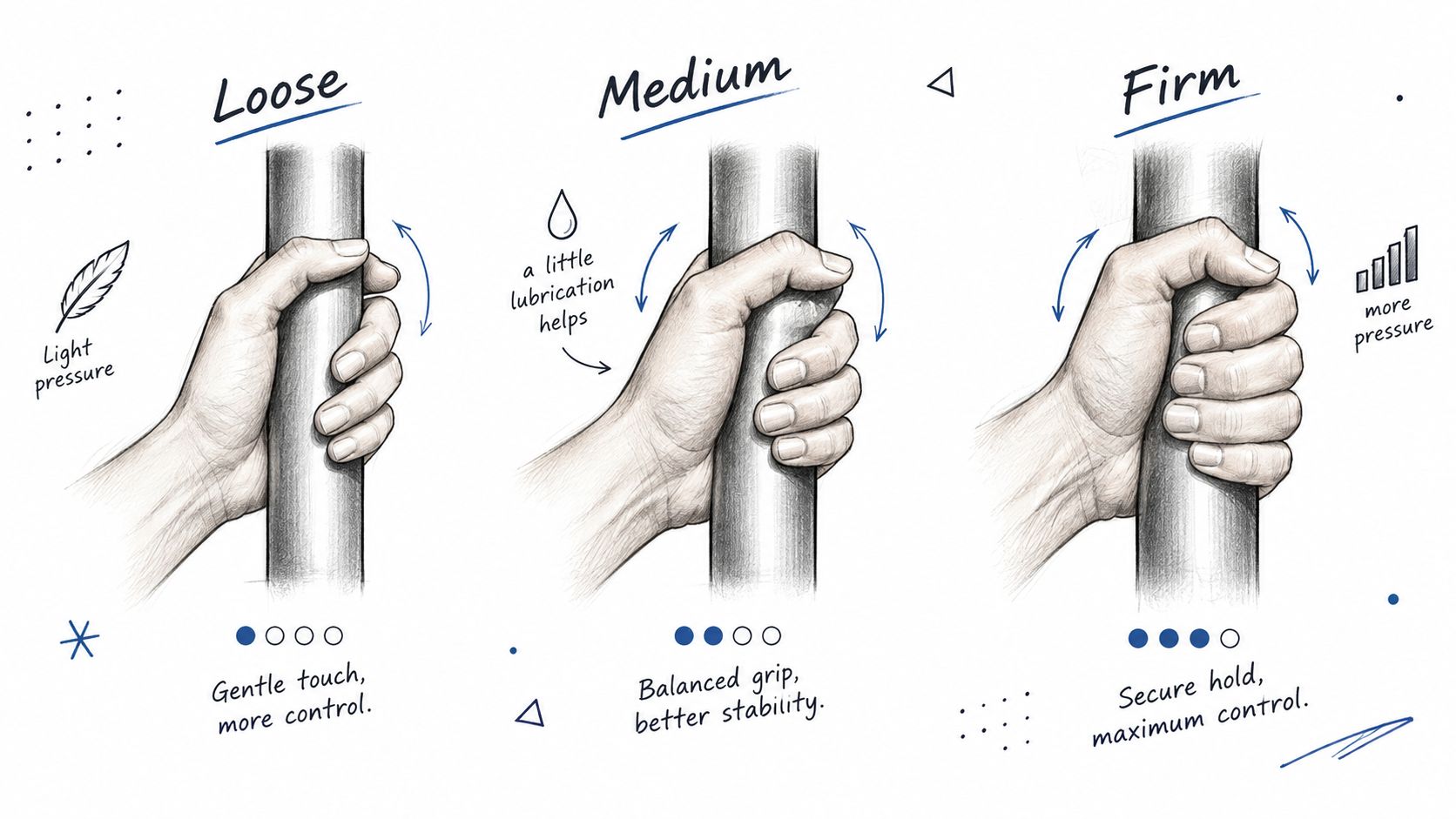
A changing grip can make manual stimulation feel more responsive than a fixed hold. Partners can begin with a loose grip, then adjust hand position, angle, and pressure according to feedback. A full-grip stroke, a side grip, or an overhand and underhand position can each create a different sensation without requiring faster movement.
Start with the pressure used to hold a glass of water, then make small adjustments as arousal develops. One practical guide describes manual stimulation as adjustable mechanics and recommends changing one variable at a time, including grip, rhythm, pressure, and hand placement. It also presents a loose-grip default rhythm of about 60 to 80 strokes per minute. The guide's discussion of adaptable hand job technique emphasizes that speed alone isn't the main measure of effectiveness.
Consent check: “Is this pressure comfortable, or should the grip be lighter?”
Water-based lubricant can reduce friction and help the hand move smoothly between positions. The receiving partner's breathing, muscle tension, and movements can offer useful clues, but nonverbal signals shouldn't replace a direct check-in. If the skin feels irritated, dry, numb, or uncomfortable, the motion should stop while the partners reassess.
A partner can also change hands periodically to reduce fatigue. Before intimate contact, both partners may want to discuss basic hygiene preferences, including whether showering before sex helps them feel more relaxed. The focus should remain on comfort, not on maintaining a particular grip for its own sake.
2. The Twisting Motion Technique
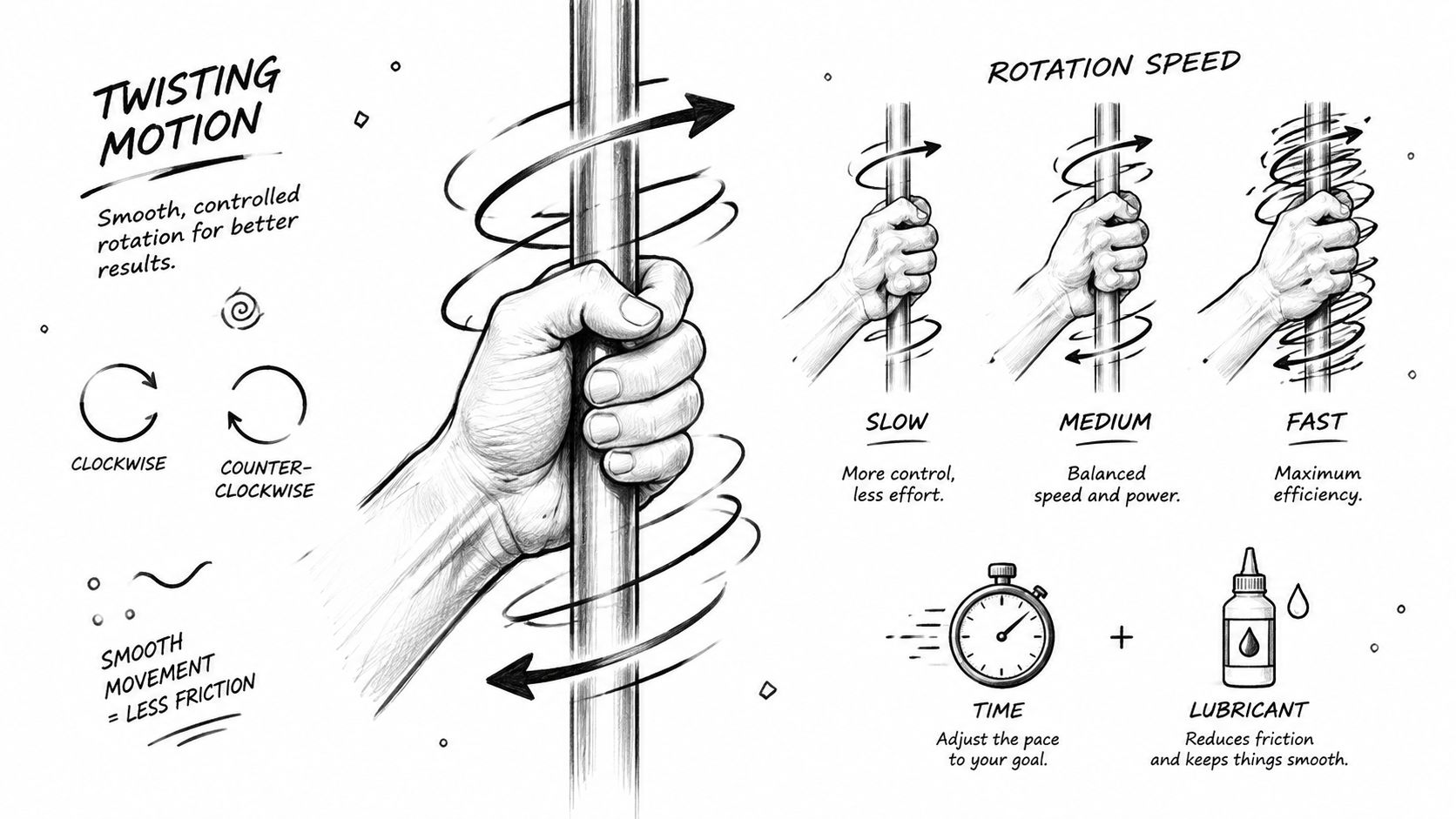
Some partners prefer rotational movement rather than a purely linear stroke. The twisting motion technique adds a gentle wrist rotation to an upward and downward movement, creating changing contact points across the hand. It can be used through a longer motion or limited to a smaller area, depending on what the receiving partner prefers.
The safest starting point is slow and controlled. A narrow rotation generally gives the partner more control than a wide, forceful turn, especially before feedback has established a comfortable range. Water-based lubricant is important because dry twisting can pull or pinch sensitive skin.
Practical rule: Rotation should glide over the skin, not grip or drag it.
Partners can experiment with clockwise and counterclockwise movement, but the direction should change only when the receiving partner remains comfortable. A partner who notices wrist strain can reduce the rotation, change hand position, or take a short break. There's no need to treat endurance as a goal.
Adjusting motion without losing communication
One partner might say, “Keep the stroke the same and make the rotation smaller.” That kind of specific feedback is more useful than a general request to “do more.” The giving partner can then change one feature, such as rotation width, while keeping pressure and pace stable.
The frenulum and glans may respond differently from the shaft, so focused rotation should begin lightly. A neuroimaging study reported the greatest subjective pleasure during stimulation of the frenulum, making that area a reason to use targeted, careful contact rather than assuming the whole penis has the same sensitivity. The study's findings on genital hedonic sensation support a sensitivity-mapping approach, not a promise of a particular outcome.
3. The Dual-Hand Alternating Technique
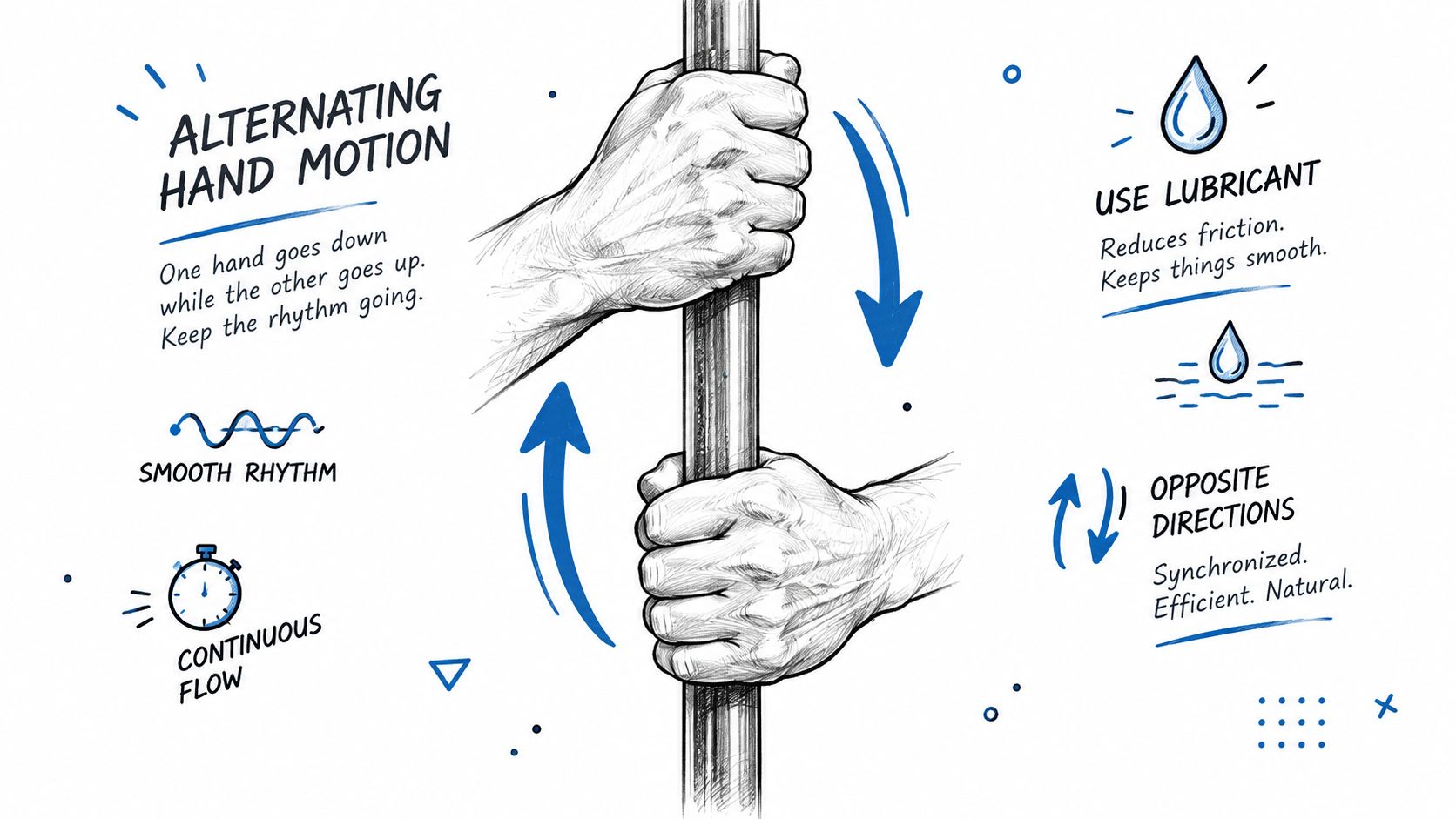
The dual-hand alternating technique creates a continuous pattern by offsetting the movement of each hand. One hand begins its motion as the other reaches the opposite point, allowing the partners to explore an even rhythm without asking one hand to do all the work. The hands should remain slightly separated so they don't collide or create unwanted pressure.
A useful way to learn the pattern is to practice the alternating movement away from the body first. Once the rhythm feels natural, the giving partner can apply it slowly and ask whether the spacing feels comfortable. Closer hand spacing may create a concentrated sensation, while wider spacing may distribute contact more broadly.
Consent check: The receiving partner should be able to request “slower,” “lighter,” “more space,” or “pause” without needing to explain further.
Lubrication can make transitions smoother, but excess fluid can also reduce control. Partners can add a small amount, reassess the glide, and adjust as needed. If the movement begins to feel slippery in a way that makes pressure difficult to regulate, slowing down is safer than tightening the grip.
Building a sustainable rhythm
The technique works best as a coordination exercise, not a speed challenge. The giving partner can increase intensity through modest pressure changes while keeping the pace stable. Alternating hands also gives each hand a chance to relax, which can help prevent cramping and reduce accidental pressure caused by fatigue.
A real-world example might involve a couple who usually relies on one repetitive motion. They could try the alternating pattern briefly, ask which hand spacing feels better, and return to the earlier technique if the new movement doesn't feel comfortable. The receiving partner's preference determines whether the variation stays in use.
4. The Focused Glans Technique
The glans can be highly sensitive, but sensitivity varies significantly between individuals. A focused approach therefore requires less pressure at the beginning than a partner might expect. Instead of concentrating on broad shaft movement, the giving partner can use light contact around the head while the other fingers provide steady, supportive contact elsewhere.
Small circular movements around the ridge may feel different from direct contact. Some partners prefer support near the shaft while the glans receives attention, while others prefer very brief focused contact followed by a return to broader movement. The right choice can change during the same encounter.
Feedback matters more than anatomy charts. A sensitive area isn't automatically an area that always welcomes stronger contact.
Lubrication should be adequate around the glans because dryness can quickly become distracting or uncomfortable. Partners can ask direct questions, such as whether pressure should be lighter, whether the movement should stay consistent, or whether the focus should shift. A sudden change in breathing or body tension may signal increased sensation, but it may also signal discomfort, so a verbal check remains valuable.
Historical writing has addressed genital stimulation for centuries, with one survey describing writings on the subject as existing “from Antiquity right up until the 20th century.” The historical survey of sexual and educational writing describes a long shift from taboo and informal knowledge toward more systematic categories, including stimulation of the glans, shaft, and frenulum.
The same communication principle applies to any related sexual-health topic, including questions about finger stimulation. Curiosity doesn't remove the need for boundaries, preparation, or permission.
5. The Shaft Base-to-Tip Technique
A base-to-tip motion gives partners a clear, full-length pattern to follow. The giving partner starts with a steady rhythm, then changes pressure or speed only after the receiving partner confirms that the baseline feels good. This structure can be helpful for couples who feel overwhelmed by too many variations at once.
Pressure doesn't need to be identical throughout the motion. Some partners prefer firmer contact near the base and lighter contact toward the tip, while others want an even hold. A brief pause at the end of a motion may add emphasis, but it should be introduced carefully because some people prefer uninterrupted consistency.
A smoother way to vary the pattern
Partners can agree on a signal before changing pace. For example, the receiving partner might ask for “steady,” “lighter,” or “pause.” The giving partner can then make one adjustment and wait for feedback rather than changing pressure, speed, and direction at once.
Water-based lubricant supports smoother movement and can reduce friction. The partners should add more if the skin begins to feel dry, but they should also watch for reduced control. Breathing together can make the motion feel less mechanical, especially when one partner is anxious about doing everything correctly.
A couple trying this technique for the first time might keep the movement slow, ask whether the pressure is even, and then experiment with a slight difference between the base and tip. If the receiving partner reports irritation or numbness, the session should stop. No technique needs to continue just because it was selected in advance.
6. The Pressure-Point and Circular Motion Technique
Broad strokes aren't the only option. Focused circular movement lets partners explore specific zones with precision, including the frenulum, the underside of the shaft, or the perineum. The receiving partner should identify whether those areas are sensitive and welcome before the giving partner increases contact.
Small movements are easier to control than large circles. Fingertips, the palm, or the full hand may all be appropriate, but the starting pressure should remain light. Lubrication can help the contact glide, particularly when the partners are working in a concentrated area.
A pressure point is a question, not a target. The body's response decides whether that area deserves more attention.
Mapping sensation together
One partner can ask, “Which area feels most responsive?” The other can answer verbally or guide the hand to a preferred location. This creates a shared map instead of relying on assumptions about anatomy.
The frenulum may deserve brief, targeted attention because it can be highly sensitive, but the same contact can feel too intense for someone else. The perineum also requires care, and pressure should be reduced immediately if there's pain, tenderness, or a feeling of unwanted intensity. If one hand explores a focused area, the other can provide broader, steady contact to keep the overall sensation balanced.
A real-world example might involve a partner who enjoys full-length movement but finds concentrated contact too strong. The giving partner can use circular motion for a short interval, return to the shaft, and ask whether the change improved the experience. That alternating approach respects sensitivity without treating intensity as the goal.
Frequent check-ins are especially important when a partner's body language is ambiguous. Silence isn't automatic consent to continue, and arousal signals don't override a request to stop.
7. The Build-and-Release Pacing Technique
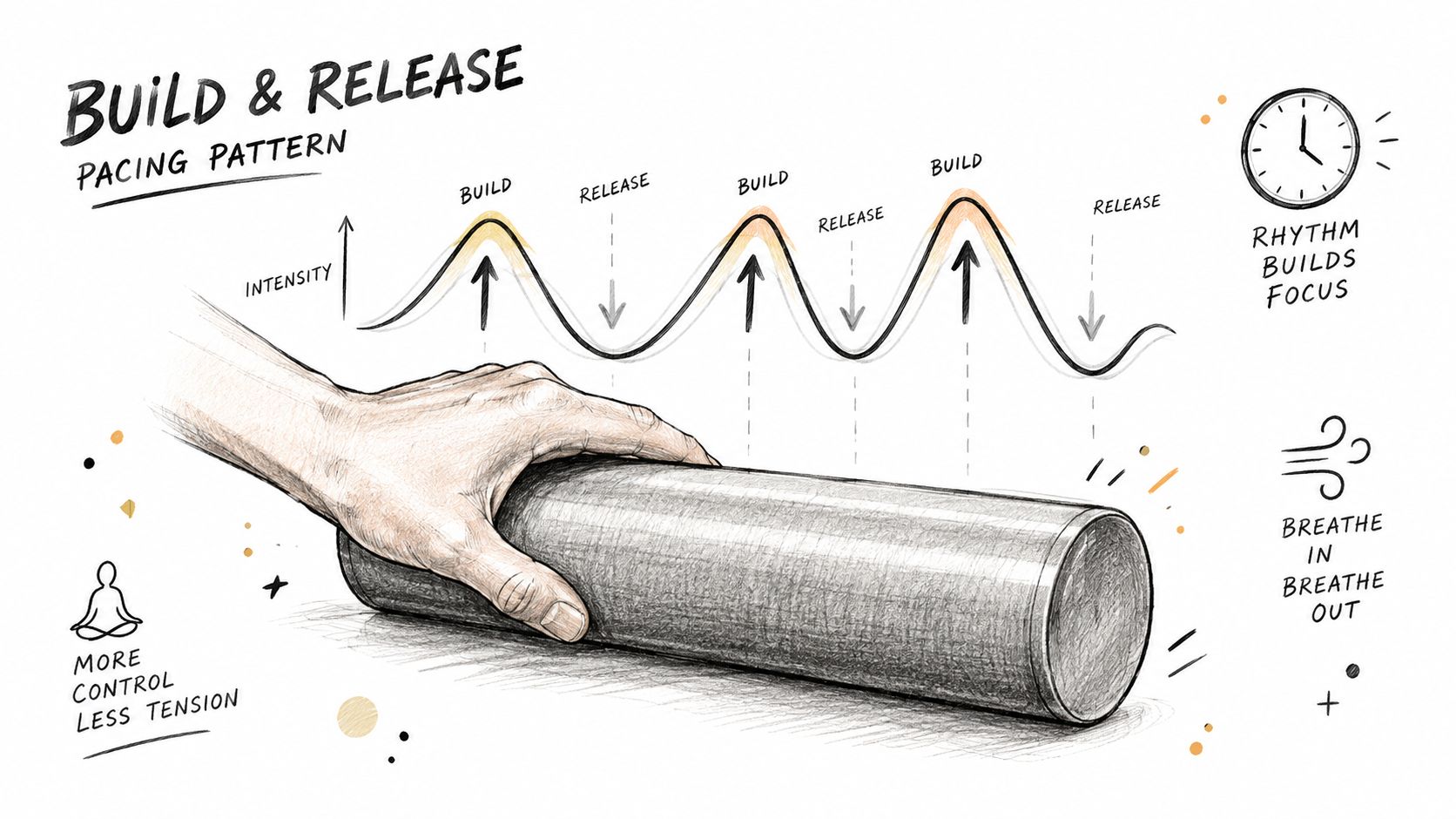
Pacing changes intensity over time rather than keeping every moment at the same level. A couple might build sensation gradually, ease back, and then decide together whether to resume or pause. This approach can support control because it creates regular opportunities to check comfort and timing.
The giving partner should learn the receiving partner's preferred signals before trying deliberate changes. Those signals might include “more,” “slower,” “pause,” or a nonverbal gesture agreed upon in advance. A brief pause is only useful if both partners understand that it can happen without frustration or pressure.
Letting feedback set the timing
A guide on manual stimulation recommends starting with low-to-moderate pressure and making incremental changes in speed and grip rather than moving immediately to high intensity. The expert discussion of hand stimulation and feedback also describes brief pauses near climax as one way to increase control and perceived intensity.
The approach doesn't need rigid stages. One partner may prefer a gradual build followed by a short reduction, while another may find changes distracting and prefer consistency. The receiving partner's response determines whether pacing continues.
“Pause” should always mean pause, without negotiation.
Partners can coordinate breathing and reduce pressure if the body becomes tense. A session involving breathing techniques for premature ejaculation should still remain focused on comfort and communication, not on guaranteeing a particular sexual result. If there's pain, irritation, numbness, anxiety, or uncertainty, the safest adjustment is to stop and talk.
7-Point Comparison of Handjob Techniques
| Technique | Implementation complexity | Resource requirements | Expected outcomes | Ideal use cases | Key advantages |
|---|---|---|---|---|---|
| The Grip Variation Technique | Low–Medium; easy to learn, some pressure tuning | One or two hands; optional water-based lube; partner feedback | Variable sensations; prevents desensitization; steady arousal build | General stimulation, experimentation, real-time adjustment | Highly customizable; simple to adapt; reduces monotony |
| The Twisting Motion Technique | Medium; requires wrist rotation and coordination | One or two hands; ample lubrication; wrist flexibility | Spiral stimulation that engages different nerve endings; effective for building intensity | Adding novelty; targeting glans or shaft zones; building toward climax | Unique rotational sensation; fine speed control for intensity |
| The Dual-Hand Alternating Technique | Medium; needs practiced coordination for smooth rhythm | Two hands; generous lubricant; comfortable hand spacing | Continuous, sustained stimulation; reduced single-hand fatigue; steady buildup | Longer sessions; endurance-focused play; consistent rhythm | Distributes effort; maintains uninterrupted stimulation; customizable |
| The Focused Glans Technique | Medium; requires sensitivity and precise control | Precise touch; focused lubrication; ongoing partner feedback | Intense, localized sensation; can accelerate arousal and climax | Targeted pleasure, quick stimulation, combining with other methods | High intensity with minimal motion; precise pressure control |
| The Shaft Base-to-Tip Technique | Low–Medium; straightforward rhythmic pattern to master | One or two hands; abundant lube; consistent motion | Full-shaft engagement; predictable progressive arousal; easy to sustain | Establishing baseline rhythm; beginner-friendly sustained stimulation | Natural, easy-to-maintain motion; engages entire shaft progressively |
| The Pressure-Point and Circular Motion Technique | Medium; requires knowledge of sensitive zones and precision | Fingertip or palm precision; lubricant; clear communication | Concentrated intense sensations; minimal large-motion fatigue | Intensifying specific zones (frenulum, perineum); precision stimulation | Highly targeted; intense results with small movements; low physical strain |
| The Build-and-Release Pacing Technique | High; demands strong partner awareness and timing | Continuous feedback; attention to arousal cues; lubricant | Extended experience; stronger aggregated sensation; controlled climax timing | Prolonging sessions; managing climax; integrated with other techniques | Extends pleasure; enables climax control; increases anticipation |
Choose Connection Over a Perfect Technique
The most useful takeaway from these hand job techniques is that no partner needs to master all seven. A couple can choose one variation, agree on boundaries and feedback signals, begin at a comfortable intensity, and adjust according to ongoing communication. Grip variation may suit partners who want to explore pressure. Twisting may add motion. Alternating hands may offer coordination. Focused contact may help partners map sensitivity. Base-to-tip movement can provide structure, while circular pressure and build-and-release pacing offer more targeted changes.
Consent should remain active throughout the experience. A partner can change their mind at any point, and the other partner should respond without complaint or pressure. Silence, arousal, or a previous agreement doesn't replace a current willingness to continue.
Practical safety matters as much as technique. Clean hands, smooth nails, patient pacing, and appropriate lubrication can reduce avoidable discomfort. Water-based lubricant is a practical choice when condom compatibility may matter, while oil-based products can create compatibility problems with some condoms. If pain, irritation, numbness, pinching, or discomfort appears, stimulation should stop until the partners understand what happened.
The receiving partner doesn't need to provide a performance review, and the giving partner doesn't need to guess perfectly. Short questions such as “lighter or the same?” and “keep going or pause?” create useful information without interrupting connection. A partner can also guide the other's hand or demonstrate a preferred rhythm, provided both people have agreed to participate.
If SEMEX fits into a broader men's wellness routine, it should be understood only as a dietary supplement. Its formula includes zinc, L-arginine, sunflower lecithin, bromelain, maca root, Panax ginseng, ashwagandha, tongkat ali, saw palmetto, and horny goat weed. Zinc plays a role in normal male reproductive biology, but an NIH-reviewed trial found that zinc-containing supplementation didn't significantly improve semen quality or couples' live birth rates, so ingredient support shouldn't be presented as treatment. The NIH review of zinc and male reproductive function provides that important distinction.
These statements have not been evaluated by the Food and Drug Administration. This product is not intended to diagnose, treat, cure, or prevent any disease.
SEMEX offers a daily dietary supplement formulated with zinc, L-arginine, sunflower lecithin, bromelain, and a men's wellness blend. Partners and individuals exploring sexual wellness can visit SEMEX to review the formula and decide whether it fits their routine.