

Gas Station Sex Pills: Safety Risks and Safer Options
The most dangerous thing about gas station sex pills isn't that they may fail to deliver. It's that a product sitting beside the register can look like a harmless herbal supplement while containing undisclosed prescription-style drugs. In a Sacramento-area retail survey, 67% of products marketed for sexual enhancement contained at least one PDE-5 inhibitor, and more than half of the adulterated products contained multiple drug ingredients, according to the published retail survey.
Convenience-store availability creates a false sense of legitimacy. A shelf, a barcode, and confident packaging don't prove that a product is safe, accurately labeled, or effective. For men seeking reliable sexual wellness support, the right standard isn't instant access. It's transparent ingredients, controlled manufacturing, independent testing, and medical guidance when symptoms persist.
Table of Contents
- The Reality of Gas Station Sex Pills
- What Is Actually Inside Convenience Store Supplements
- The Hidden Dangers of Undeclared Pharmaceutical Ingredients
- Red Flags to Spot on Supplement Labels
- How Third-Party Testing Protects Your Health
- Safer Ingredients for Male Vitality and Performance
- Making Informed Choices for Long-Term Men's Wellness
The Reality of Gas Station Sex Pills
Gas station sex pills are impulse products built around urgency. They're placed where shoppers make fast decisions, often near the register or among other convenience items, and their packaging promises immediate performance, extended stamina, or dramatic enhancement. That combination targets a real concern, but it encourages the worst possible buying process: no medical history, no pharmacist, no verified dosage, and no meaningful review of the label.
The central mistake is treating retail presence as regulatory approval. A product can be sold in a convenience store without proving that its claims are accurate or that every ingredient appears on the package. The FDA has warned that some sexual-enhancement products sold in gas stations and convenience stores contain undeclared PDE-5 inhibitors, including sildenafil or tadalafil, and that those hidden ingredients can create dangerous blood-pressure drops when combined with nitrates, as reported in coverage of the FDA warning.
Why the shelf creates false confidence
The package often uses familiar supplement language: herbal, natural, energy, performance, or male enhancement. Those words can make a product feel less serious than a prescription medicine. They don't tell consumers whether the formula was independently tested, whether the listed dose is accurate, or whether the manufacturer screened for pharmaceutical adulterants.
The checkout aisle also removes friction. A man who might discuss persistent erection difficulties with a clinician may instead choose a brightly packaged capsule because it avoids an appointment and promises a quick answer. That's understandable, but it turns a health concern into an uncontrolled experiment.
Practical rule: If a product promises prescription-like results while refusing to show exact ingredients and independent test results, treat the missing information as a safety warning.
The better interpretation
Gas station sex pills shouldn't be evaluated only by whether they produce an erection. A product can create a noticeable effect and still expose a consumer to an unknown drug dose or a dangerous interaction. The key question is whether the consumer knows what entered the body and whether the amount can be verified.
The direct recommendation is simple: skip the impulse purchase. Men experiencing recurring performance concerns should speak with a qualified healthcare professional, while men seeking general wellness support should choose products with precise labels and documented quality controls.
What Is Actually Inside Convenience Store Supplements
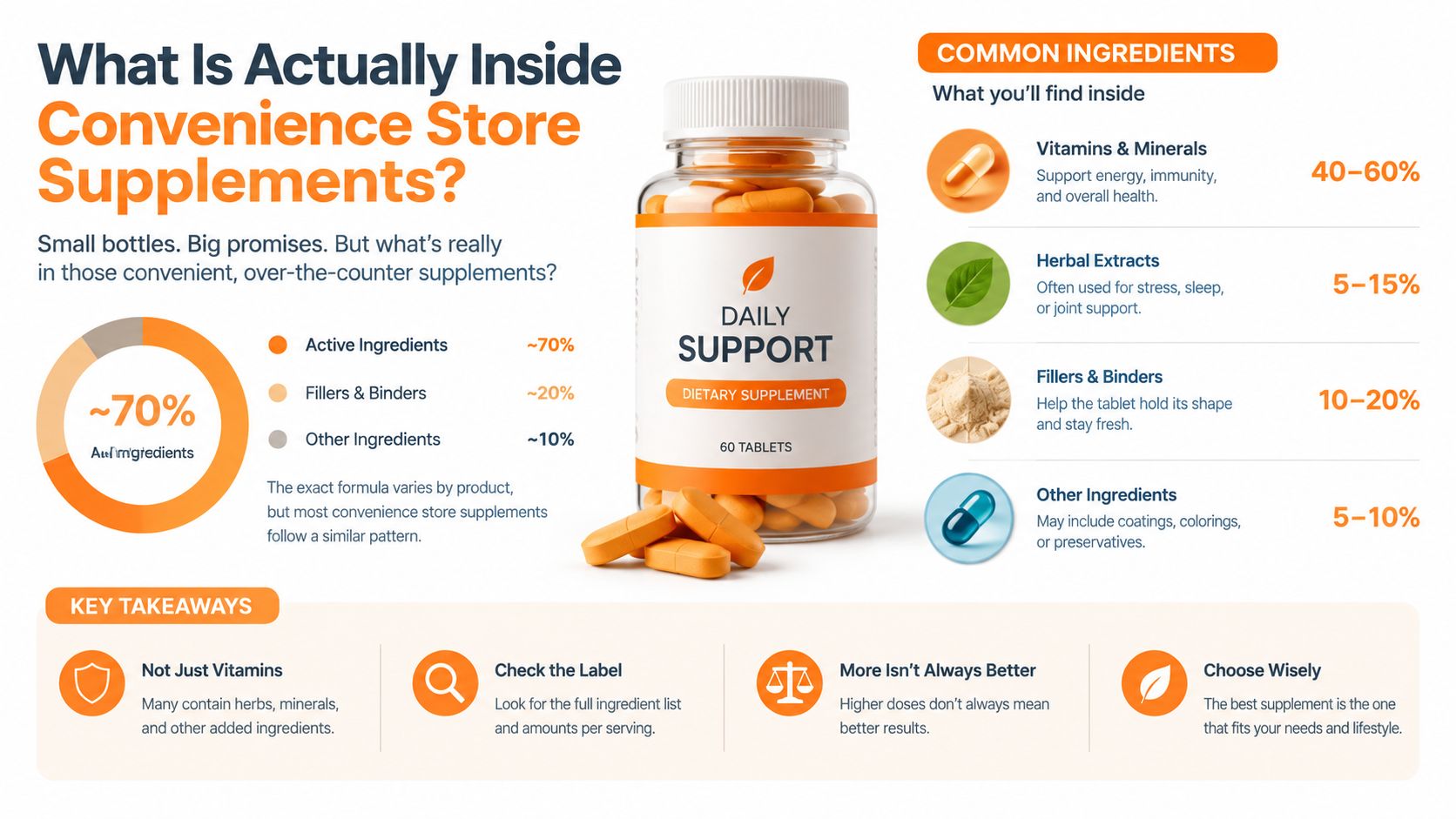
The label and the laboratory result can tell two different stories. Retail sexual-enhancement supplements sold through informal channels, including gas stations, liquor and cigarette stores, mini marts, and corner markets, have repeatedly been found with hidden PDE-5 inhibitors. In the Sacramento-area survey, sildenafil appeared in 74% of adulterated products and tadalafil in 59%, based on the retail analysis.
Those figures describe a tested retail sample, not every product in every store. They still make the risk impossible to dismiss as an isolated manufacturing mistake. A product marketed as herbal may contain a pharmacologically active compound that isn't disclosed on its packaging, and the consumer has no dependable way to calculate the actual exposure from the front of the box.
How the labeling gap works
Dietary supplements don't follow the same market pathway as prescription drugs. That doesn't mean every supplement is unsafe, but it does mean consumers need to judge manufacturers by their transparency and quality systems rather than assuming a store has performed that work for them.
A vague proprietary blend is a problem because it can group several ingredients together without showing the amount of each one. Even when a label lists recognizable herbs or amino acids, the panel doesn't prove that the product contains those ingredients in the stated strength. It also doesn't rule out compounds that were never declared.
The most concerning products combine natural-sounding branding with claims that resemble medication advertising. A package may suggest immediate or extraordinary performance without explaining a mechanism, a dose, or a testing process. That language can distract from the practical question, which is whether an independent laboratory has verified the contents.
Why multiple hidden ingredients matter
A single undisclosed drug is already a serious labeling failure. Multiple undisclosed ingredients make the exposure harder to predict because the consumer can't know how the compounds may interact or how strongly each one is present. More than half of the adulterated products in the Sacramento-area survey contained more than one drug ingredient, according to the same survey findings.
That distinction separates a transparently formulated daily supplement from an opaque convenience-store product. A legitimate formula should identify its ingredients, disclose their amounts, provide manufacturer information, and offer accessible evidence of batch-level testing. Without those basics, attractive packaging is just presentation, not proof.
The Hidden Dangers of Undeclared Pharmaceutical Ingredients
The danger becomes clearer when the hidden ingredient is treated as a real drug rather than as an exotic herb. Sildenafil- and tadalafil-like compounds affect blood-vessel activity and can lower blood pressure. If a consumer takes one unknowingly, the risk doesn't stop at an inaccurate label. It extends to medication interactions, underlying cardiovascular issues, and an exposure level that nobody has verified.
FDA enforcement and peer-reviewed analysis found unapproved pharmaceutical ingredients in 776 dietary supplements across FDA warnings from 2007 through 2016. Sexual-enhancement products were a major category, 97.6% of adulterated products contained undeclared drug ingredients, and 20.2% contained more than one unapproved ingredient, according to the peer-reviewed analysis of FDA warnings.
How a dangerous interaction can unfold
Consider a man who takes prescribed nitrates for a heart condition. He buys a capsule labeled as natural male enhancement and takes it without realizing that it contains a PDE-5 inhibitor. The hidden compound can widen blood vessels and lower blood pressure, while the nitrate has a similar blood-pressure-lowering effect.
That combination can produce a dangerous drop in blood pressure. The man may not know what caused the symptoms, and a clinician treating the emergency may not immediately know which compound or dose he consumed. The problem isn't just that the supplement is impure. It's that the product has converted a supervised medication decision into an uncontrolled dose.
The real hazard is uncontrolled pharmacology hidden inside a supplement format.
Other prescription medicines and health conditions can also change the risk profile. That's why a consumer can't reliably assess these products by reading the front label or by judging whether a previous capsule seemed tolerable. A mild reaction one time doesn't verify the contents of the next product or batch.
What should happen after a suspected reaction
Anyone who develops severe symptoms after taking a sexual-enhancement product should seek urgent medical care and bring the package, if available. The product name, lot information, and remaining capsules may help clinicians and regulators identify the exposure.
Men should also disclose these products openly during medical appointments. Embarrassment is less important than knowing what may have entered the bloodstream. A clinician can evaluate medication interactions and determine whether a supervised treatment or broader health assessment is appropriate.
Red Flags to Spot on Supplement Labels
A label can't prove safety, but it can reveal when a product fails the most basic transparency test. The first warning sign is a promise that sounds like a prescription without the accountability of a prescription. Claims about immediate, extreme, or guaranteed sexual performance deserve rejection, especially when the package gives no precise formula or testing documentation.
FDA guidance says structure/function claims must be truthful and not misleading. It also says the required disclaimer must appear in boldface, and a supplement can't claim to diagnose, mitigate, treat, cure, or prevent a specific disease or class of diseases, as explained in the FDA guidance on structure/function claims.
A quick store-level filter
- Exact amounts: Avoid proprietary blends that conceal the dose of individual ingredients.
- Specific claims: Avoid language promising instant or medication-like effects without substantiation.
- Manufacturer details: Avoid packages missing a responsible company name, address, or customer contact method.
- Batch evidence: Trust products that make a current certificate of analysis easy to access and connect it to a batch.
- Required disclaimer: Treat missing, altered, or hard-to-find regulatory language as a transparency concern.
- Packaging pressure: Avoid products built around urgency, secrecy, or exaggerated sexual promises.
| Label Feature | Red Flag, Avoid | Green Flag, Trust |
|---|---|---|
| Ingredient panel | Proprietary blend with no individual amounts | Named ingredients with exact quantities |
| Performance language | Instant, extreme, or medication-like promises | Measured structure/function wording |
| Manufacturer | No clear company or contact information | Identifiable manufacturer and responsive contact details |
| Testing | No batch documentation | Accessible certificate of analysis |
| Quality claims | Vague “natural” or “pure” language | Specific manufacturing and testing information |
| Disclaimer | Missing, modified, or disconnected from the claim | Required wording shown clearly beside the claim |
A deeper guide to evaluating panels is available in how to read supplement labels. The same principle applies to any men's wellness product: a clean-looking label isn't enough unless the manufacturer can support it with verifiable documentation.
How Third-Party Testing Protects Your Health
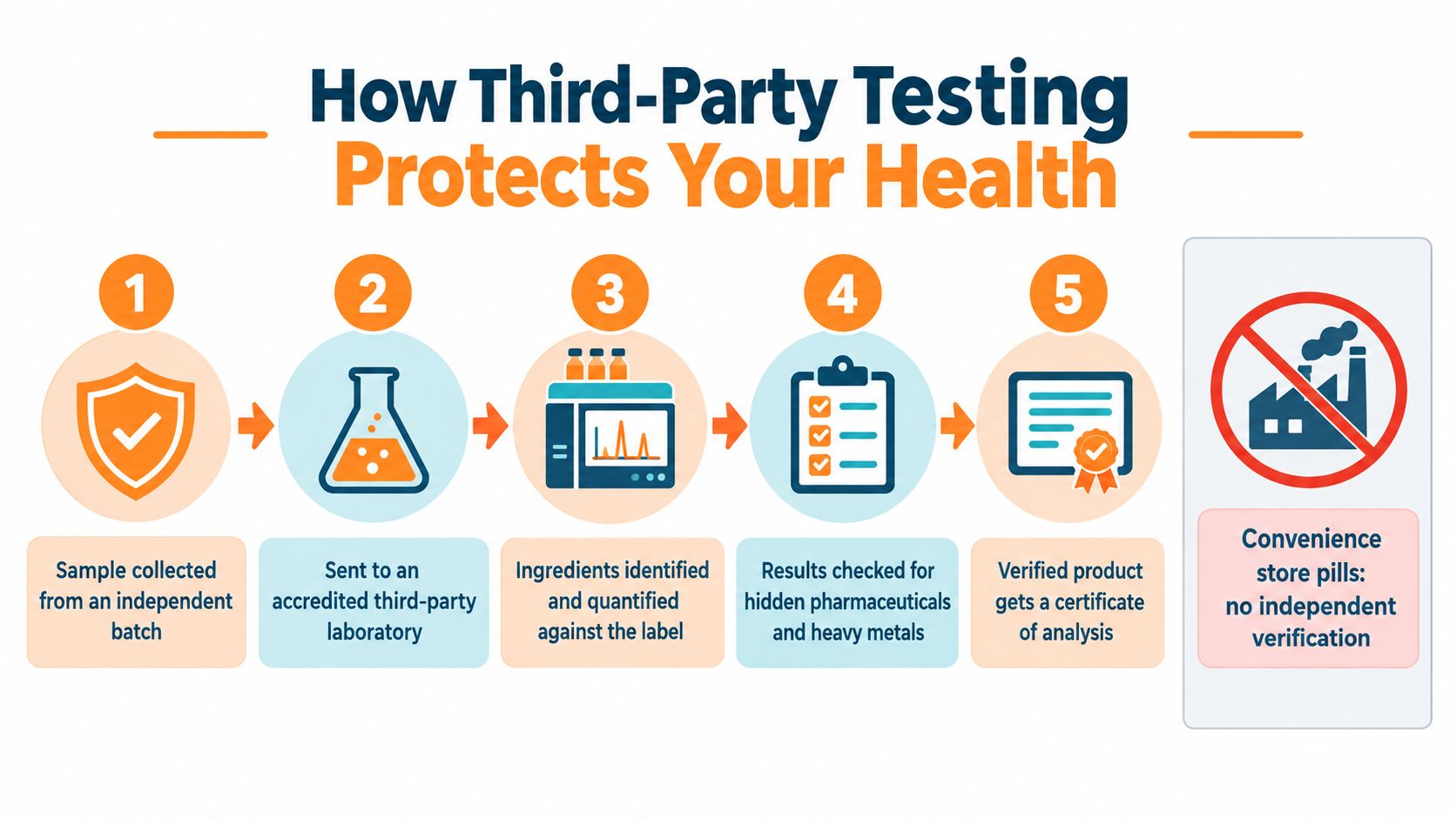
Third-party testing creates a separation between the company selling a supplement and the laboratory checking it. An independent lab can compare the finished product with its label, identify and quantify ingredients, and screen for contaminants or adulterants. That process doesn't make every supplement effective for every person, but it gives consumers a meaningful basis for evaluating what they're buying.
The NIH Office of Dietary Supplements says manufacturers must follow Good Manufacturing Practices to support product identity, purity, strength, and composition. Its consumer guidance on dietary supplements also reinforces that supplement claims require the FDA disclaimer and can't be treated as proof that a product diagnoses or treats disease.
What a useful report should show
A certificate of analysis should be more than a logo on a product page. It should identify the tested product or batch and show what the laboratory measured. For a men's wellness supplement, consumers should look for verification of labeled ingredients alongside screening for microbials, heavy metals, and undeclared pharmaceutical adulterants.
The testing laboratory's identity matters too. A credible manufacturer should explain who performed the work, what the test covered, and whether the documentation applies to the product being sold. A generic statement such as “lab tested” doesn't answer those questions.
The quality benchmark
Convenience-store pills usually ask the consumer to trust marketing. A transparent supplement asks the consumer to inspect evidence. That difference should guide every purchase.
More detail on interpreting laboratory documentation appears in this guide to third-party testing for supplements. Consumers don't need to become laboratory scientists, but they should expect a manufacturer to explain its standards without evasion.
Safer Ingredients for Male Vitality and Performance
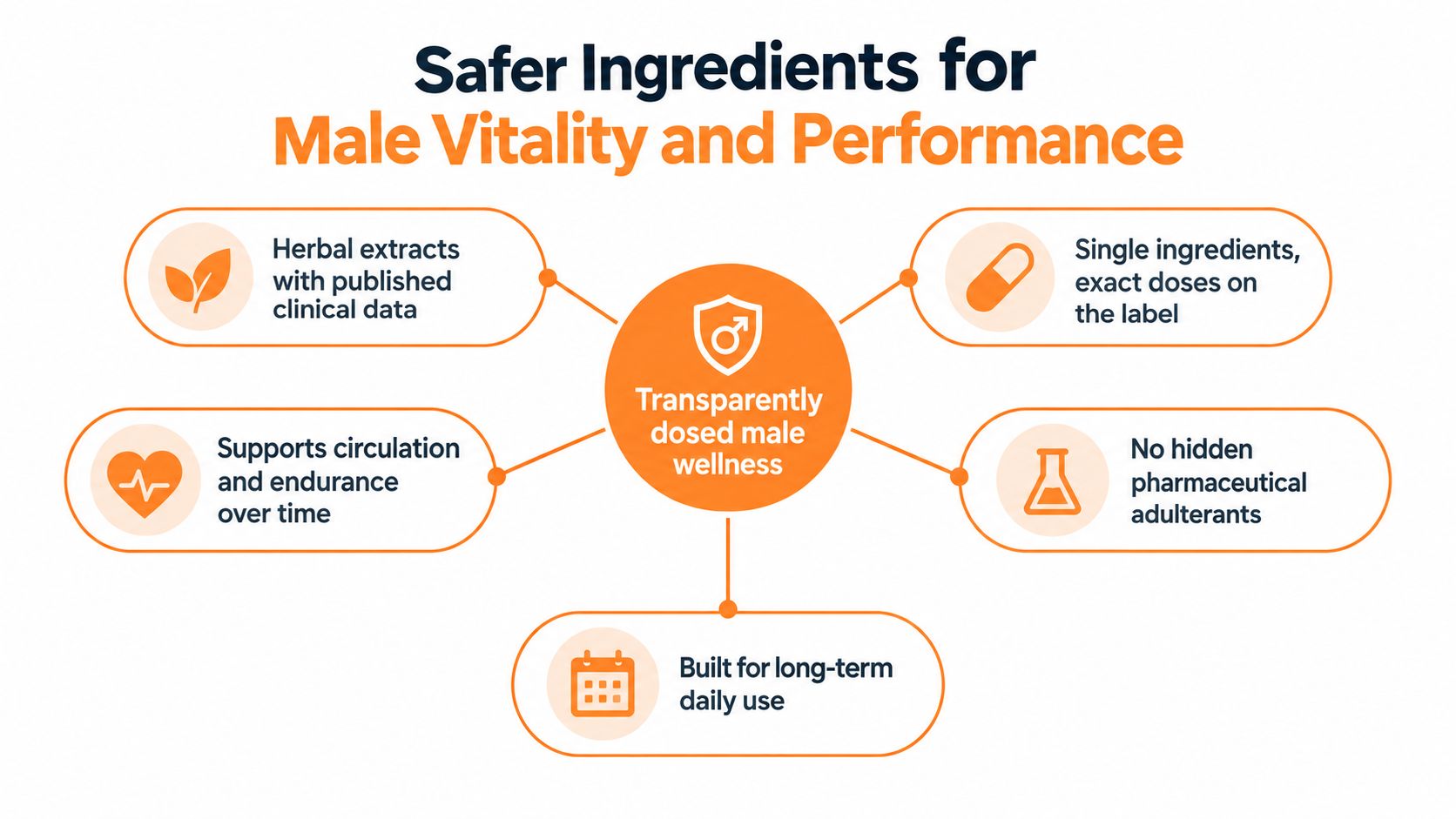
Long-term male wellness doesn't need the drama of a single mystery capsule. A more sensible formula uses clearly identified ingredients, exact doses, appropriate quality controls, and realistic expectations. The purpose is steady nutritional and physiological support, not a sudden medication-like effect that the label never disclosed.
Zinc plays a role in normal male reproductive function. L-arginine is an amino acid involved in nitric oxide pathways and blood-vessel function. Maca root is commonly used in men's wellness formulas, while other botanical ingredients may be selected for broader vitality support. Those ingredient-level roles shouldn't be converted into promises that a finished supplement treats a condition.
What a responsible formula looks like
A credible product makes it possible to answer basic questions before purchase:
- What is included: Each active ingredient appears by name rather than being hidden in a catch-all blend.
- How much is included: The label provides a specific amount for each ingredient.
- Why it is included: The manufacturer uses structure/function language tied to the ingredient's role, not disease-treatment promises.
- How it was checked: Independent testing addresses identity, purity, strength, composition, and potential adulterants.
- How it fits daily use: The formula supports a consistent routine instead of encouraging reckless, one-time dosing.
The male enhancement ingredients guide can help shoppers compare ingredient roles without confusing general wellness support with medical treatment. Men taking prescriptions or managing cardiovascular concerns should consult a healthcare professional before adding ingredients that may affect circulation or interact with medication.
Consistency beats the impulse fix
A daily wellness routine has a different logic from a gas station purchase. It starts with a label review, continues with consistent use as directed, and includes a reassessment if the product causes unwanted effects. Sleep, resistance training, cardiovascular activity, stress management, smoking cessation, and moderated alcohol use also belong in the same conversation because sexual performance and overall vitality are connected to general health.
Products such as SEMEX fit the transparent-formula category when evaluated by their listed ingredients and available quality information, not by promises of treating a medical condition. The sensible standard remains the same for every brand: verify the label, examine testing evidence, and avoid any product that hides behind hype.
Making Informed Choices for Long-Term Men's Wellness
The decision is not between a flashy gas station capsule and doing nothing. Men can choose professional evaluation for persistent concerns, lifestyle changes that support general health, and dietary supplements that disclose their ingredients and quality controls. That approach takes more thought than an impulse purchase, but it removes the central danger, unknown drug exposure.
A responsible shopping decision should pass four tests:
- The label is precise. Ingredients and amounts are visible.
- The claims are restrained. The product supports normal functions rather than promising to diagnose or treat disease.
- The manufacturing is accountable. Good Manufacturing Practices and responsible company information are clearly documented.
- The testing is independent. The manufacturer can connect laboratory results to the product or batch being sold.
The FDA states that the exact disclaimer for dietary supplement structure/function claims is: “These statements have not been evaluated by the Food and Drug Administration. This product is not intended to diagnose, treat, cure, or prevent any disease.” The wording shouldn't be modified, and it should appear immediately beside the claim or on the same panel or page, according to the FDA dietary supplement labeling guide.
Men should stop treating convenience-store availability as a safety certificate. A transparent daily routine, careful label review, independent testing, and appropriate medical advice offer a far stronger foundation for long-term men's wellness than a mystery pill bought at the register.
SEMEX offers a transparently labeled daily men's wellness supplement for shoppers who want an alternative to unverified gas station sex pills. Visit SEMEX to review the product information and evaluate whether its ingredient and quality details fit a careful, evidence-focused routine.