

Does Ashwagandha Work: What the Research Actually Shows
Ashwagandha does work for some outcomes, but not in the all-purpose way marketing often suggests. The strongest human evidence shows improvements in stress, cortisol, and sleep, with a pooled sleep effect of SMD -0.59 and a 2026 meta-analysis reporting reductions in Perceived Stress Scale scores by -4.72, Hamilton Anxiety scores by -2.19, and serum cortisol by -2.58.
That changes the usual framing. The better question isn't “does ashwagandha work?” in the abstract. It's what does it work for, how consistently, and at what cost in real-world safety? When the trials are sorted by outcome, a clear pattern appears: ashwagandha looks most defensible as a stress-and-recovery ingredient, less convincing as a broad performance booster, and nuanced enough on safety that short-term tolerability shouldn't be confused with zero downside.
Table of Contents
- What the Evidence Actually Says About Ashwagandha
- How Ashwagandha Is Thought to Work in the Body
- Ashwagandha and Male Wellness Markers in Trials
- Typical Doses and How Trials Structure Use
- Safety, Side Effects, and Who Should Be Cautious
- Practical Takeaways for Reading a Supplement Label
- Bottom Line and FAQ
What the Evidence Actually Says About Ashwagandha
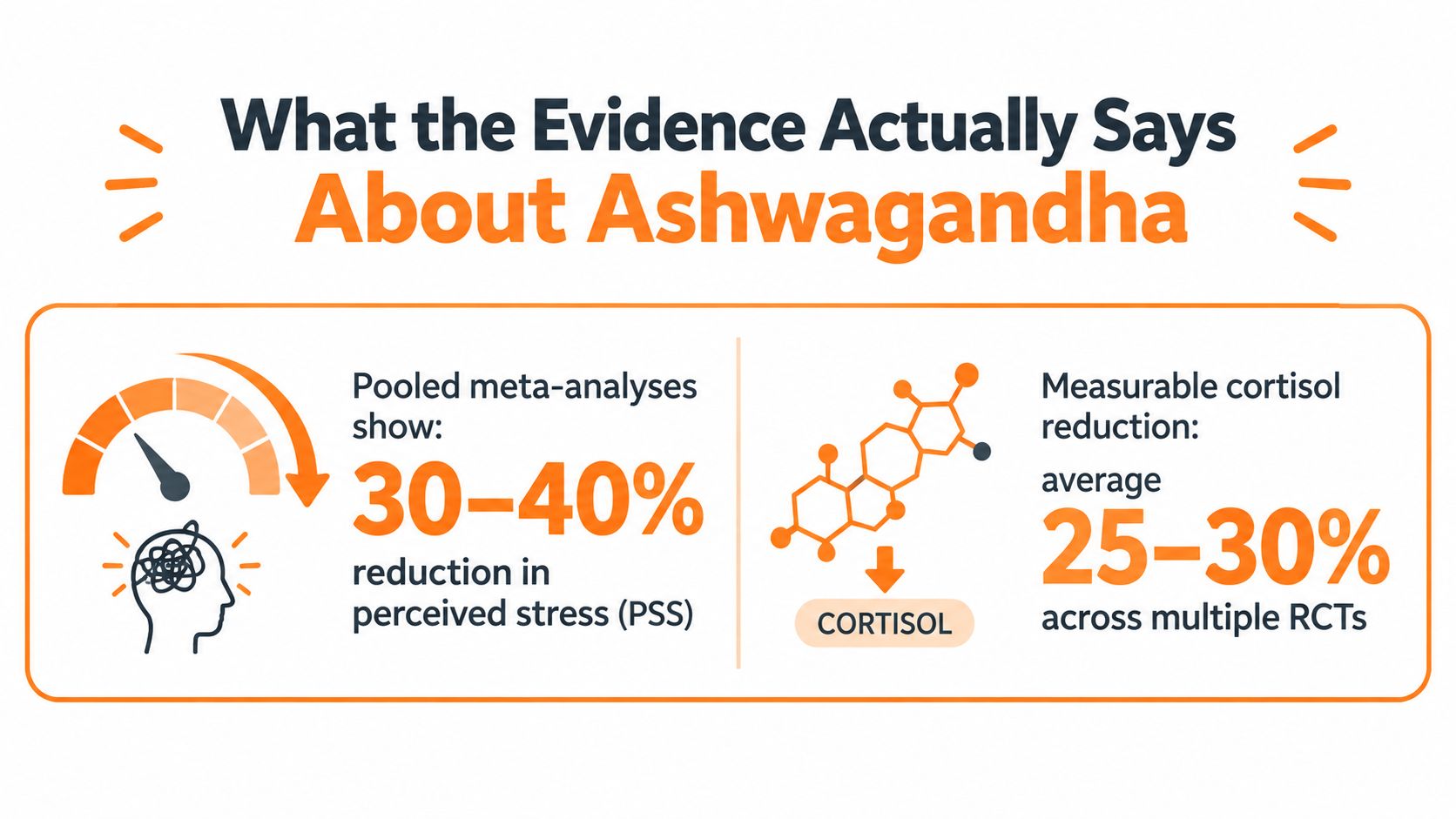
The cleanest answer starts with pooled evidence. A 2021 meta-analysis of five trials with 1,764 participants found that ashwagandha extract improved overall sleep versus placebo with SMD -0.59 (95% CI -0.75 to -0.42; p < 0.001), according to the PLOS One sleep meta-analysis. In that same evidence thread, a 2026 meta-analysis of anxiety and stress trials reported reductions in Perceived Stress Scale scores by -4.72, Hamilton Anxiety scores by -2.19, and serum cortisol by -2.58, as summarized in the same PLOS One research record.
That matters because these endpoints hang together biologically. Lower perceived stress, lower cortisol, and better sleep all point in the same direction. They don't prove that ashwagandha is a cure for anything, but they do show a repeatable signal on the stress axis.
Why stress and sleep are the strongest claims
Three reasons make this the most defensible use case.
- The outcomes repeat across reviews. Stress biology and sleep keep showing up, while other benefits appear less consistently.
- The measurements are coherent. Subjective scales and biological markers move in the same direction.
- The mechanism is plausible. Cortisol is part of the stress-response system that ashwagandha is often theorized to influence.
Practical rule: If someone asks whether ashwagandha works, the most evidence-based answer is “yes, mainly for stress support and sleep-related outcomes.”
The contrast with performance-style claims is important. A clinical evidence summary in HerbalGram's Withania somnifera trial listing notes a pattern many consumer articles miss: the strongest and most repeatable signal is for short-term stress support, while evidence for performance, testosterone, and body composition is more mixed, smaller, or statistically fragile.
Where the evidence gets shakier
That doesn't mean the other outcomes are false. It means they're less settled.
Strength, testosterone, libido, and body-composition endpoints often come from smaller trials, narrower populations, or designs that don't generalize well. Some studies are promising. Some are neutral. That's exactly why a yes-or-no headline tends to mislead readers. Ashwagandha isn't one claim. It's several different claims sharing one ingredient.
A more accurate frame is this:
| Outcome area | What the evidence suggests |
|---|---|
| Stress biology | Strongest and most repeatable signal |
| Sleep | Supported, especially as part of the same stress-recovery pattern |
| Testosterone | Positive in some male trials, but not universal |
| Body composition and performance | Mixed and less consistent |
| Broad “energy” claims | Too vague to treat as well-supported |
Readers who keep that map in mind are less likely to overread one positive trial and less likely to dismiss the ingredient entirely just because it isn't a universal enhancer.
How Ashwagandha Is Thought to Work in the Body
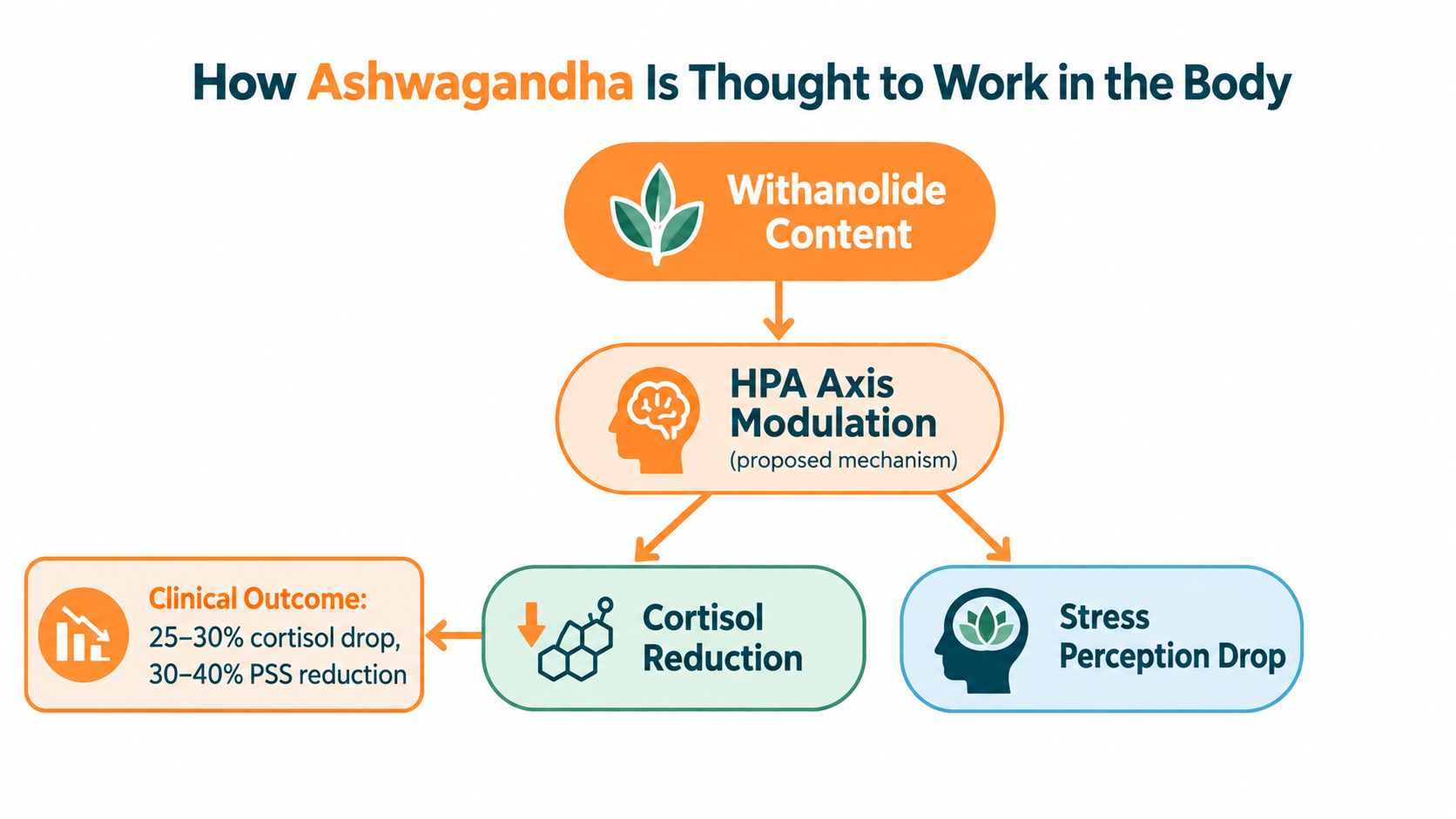
The proposed mechanisms only matter if they line up with the outcomes seen in people. With ashwagandha, the best fit is HPA-axis modulation, which is a technical way of saying the ingredient may influence the body's stress-response system. That theory matches the strongest clinical results far better than the common idea that ashwagandha directly “boosts everything.”
The mechanism that best matches the trial record
A 2026 systematic review and meta-analysis of 23 randomized controlled trials with 1,706 participants found that ashwagandha significantly reduced cortisol with SMD = -1.18, p < 0.04 and increased testosterone in men by a mean difference of 57.43 ng/dL, while showing no meaningful effect on TSH, T3, or estradiol, according to the PubMed record for the 2026 hormone meta-analysis. That pattern supports a stress-axis explanation first, with a sex-hormone signal that appears male-specific rather than a broad endocrine reset.
That distinction matters. If cortisol shifts while several other hormones don't, the ingredient looks less like a direct hormone driver and more like a regulator acting upstream through stress biology.
Mapping mechanism to outcome
The clinical picture makes more sense when each proposed pathway is matched to what readers notice.
- HPA-axis modulation most plausibly maps to lower perceived stress and lower cortisol.
- GABAergic and serotonergic effects in preclinical models fit better with sleep and calmer mood than with muscle gain.
- Antioxidant and anti-inflammatory activity may help explain recovery or general wellbeing signals, though those outcomes are less standardized in trials.
Ashwagandha makes the most sense when treated as a regulator of stress response, not as a direct androgenic shortcut.
Why testosterone claims should be handled carefully
Testosterone is where mechanism-talk often outruns evidence. When male trials do show improvement, the cleaner explanation is often downstream normalization. Lower stress burden may create conditions in which some men see improved reproductive or hormonal markers. That's different from saying ashwagandha acts like a direct testosterone drug.
That difference also helps explain why the signal appears uneven. If the pathway is indirect, results will depend on baseline stress, sleep, health status, and population. A man under chronic stress may respond differently than someone already sleeping well and training consistently.
For that reason, “does Ashwagandha work” has one answer for stress outcomes and a more conditional answer for hormone-related ones. The biology supports that split.
Ashwagandha and Male Wellness Markers in Trials
Male-specific interest in ashwagandha usually centers on three endpoints: testosterone, sperm parameters, and sexual-function-adjacent markers such as semen volume or libido. The evidence here is more interesting than many people assume, but it's also less uniform than the stress data.
Testosterone looks positive, not settled
A randomized, double-blind, placebo-controlled study of standardized ashwagandha root extract reported a statistically significant testosterone increase in men. The ashwagandha group rose by about 17% (Δ = 72 ng/dL; p < 0.0001), while the placebo group changed by about 2% (Δ = 5.48 ng/dL; p = 0.39), according to the full trial report in PMC.
That's a real human data point, not hype. Still, one positive trial doesn't settle the question for all men. Population differences, baseline status, and trial design all affect how much weight that result should carry.
Sperm parameters may be the more concrete male signal
The more striking male-specific findings often come from subfertile populations rather than general wellness populations. In a randomized study summary, 46 men with oligospermia received KSM-66 ashwagandha root extract at 675 mg/day for 90 days, and the treatment arm reported sperm concentration up 167%, sperm motility up 57%, semen volume up 53%, and serum testosterone up 17%, according to the clinical evidence summary at Naturopathic Science.
Those are substantial changes, but context matters. Men with oligospermia are not the same as the average supplement buyer. A result in a subfertile cohort can support ingredient-level relevance for reproductive markers without proving the same effect size in healthy men.
The male-wellness case for ashwagandha is strongest when it stays specific. Reproductive markers in selected male populations look more defensible than broad claims about becoming more muscular, more fertile, and more energized all at once.
The right way to read the male data
The evidence points in a generally favorable direction, but readers should judge it with a narrower lens than the stress literature.
| Outcome | Trial Signal | Sample Size Range | Evidence Strength |
|---|---|---|---|
| Testosterone | Positive in some randomized male trials | Small to moderate | Mixed but promising |
| Sperm concentration | Improvement reported in subfertile men | Small | Moderate within specific populations |
| Sperm motility | Improvement reported in subfertile men | Small | Moderate within specific populations |
| Semen volume | Improvement reported in subfertile men | Small | Moderate within specific populations |
| Libido or sexual function | Variable instruments and mixed designs | Small | Limited |
The practical takeaway isn't that ashwagandha “fixes” male hormone issues. It's that some male reproductive and hormonal markers have human data behind them, but those signals are narrower and more population-dependent than the cleaner stress-and-sleep story.
Typical Doses and How Trials Structure Use
Dose questions matter because “ashwagandha” on a label can mean very different things. Trials usually evaluate standardized extracts, not just raw herb weight, which is why a smaller milligram number can still be more relevant than a much larger number on a generic blend.
What trials usually test
Across the clinical literature, standardized extracts such as KSM-66 and Sensoril appear repeatedly. Whole-root powder also appears in some research and safety discussions, but extract-based trials are easier to compare because the active profile is more controlled.
| Extract Form | Typical Daily Dose | Standardization | Common Trial Length |
|---|---|---|---|
| KSM-66 root extract | Qualitatively, commonly in the few-hundred-milligram range | Standardized extract | Often several weeks to a few months |
| Sensoril extract | Qualitatively, commonly in the few-hundred-milligram range | Standardized extract | Often several weeks to a few months |
| Whole-root powder | Qualitatively higher by weight than extracts | Less directly comparable by raw weight | Varies |
A useful way to think about this is ingredient density. A standardized extract tells the buyer more about what's being delivered than a large raw-herb number alone.
Why standardization matters more than marketing weight
Two labels can both say “ashwagandha” and still be hard to compare if one lists a branded or standardized extract and the other hides the form inside a proprietary blend. Standardization helps because it anchors the ingredient to a reproducible preparation rather than vague plant mass.
Readers who want a deeper ingredient-level breakdown can compare trial-style intake patterns in this guide to ashwagandha daily dosage.
Label-reading shortcut: extract type first, actual milligrams second, and blend totals last. If the label hides the ashwagandha amount, it's hard to compare with any trial.
Duration shapes the outcome
Trials also separate by timeline. Stress and sleep outcomes are often studied over weeks, while hormone and body-composition endpoints usually need longer observation. That's why a product shouldn't be judged after a few inconsistent doses. The clinical model is structured daily use, not one-off use.
This doesn't turn ashwagandha into a guaranteed responder ingredient. It just means trial logic depends on consistency, extract identity, and enough time for the chosen endpoint.
Safety, Side Effects, and Who Should Be Cautious
The biggest mistake in ashwagandha safety discussions is treating trial tolerability and real-world safety as if they say the same thing. They don't. Short-term studies often look reassuring. Pharmacovigilance data add a more cautionary layer.
Trial safety is good, but incomplete
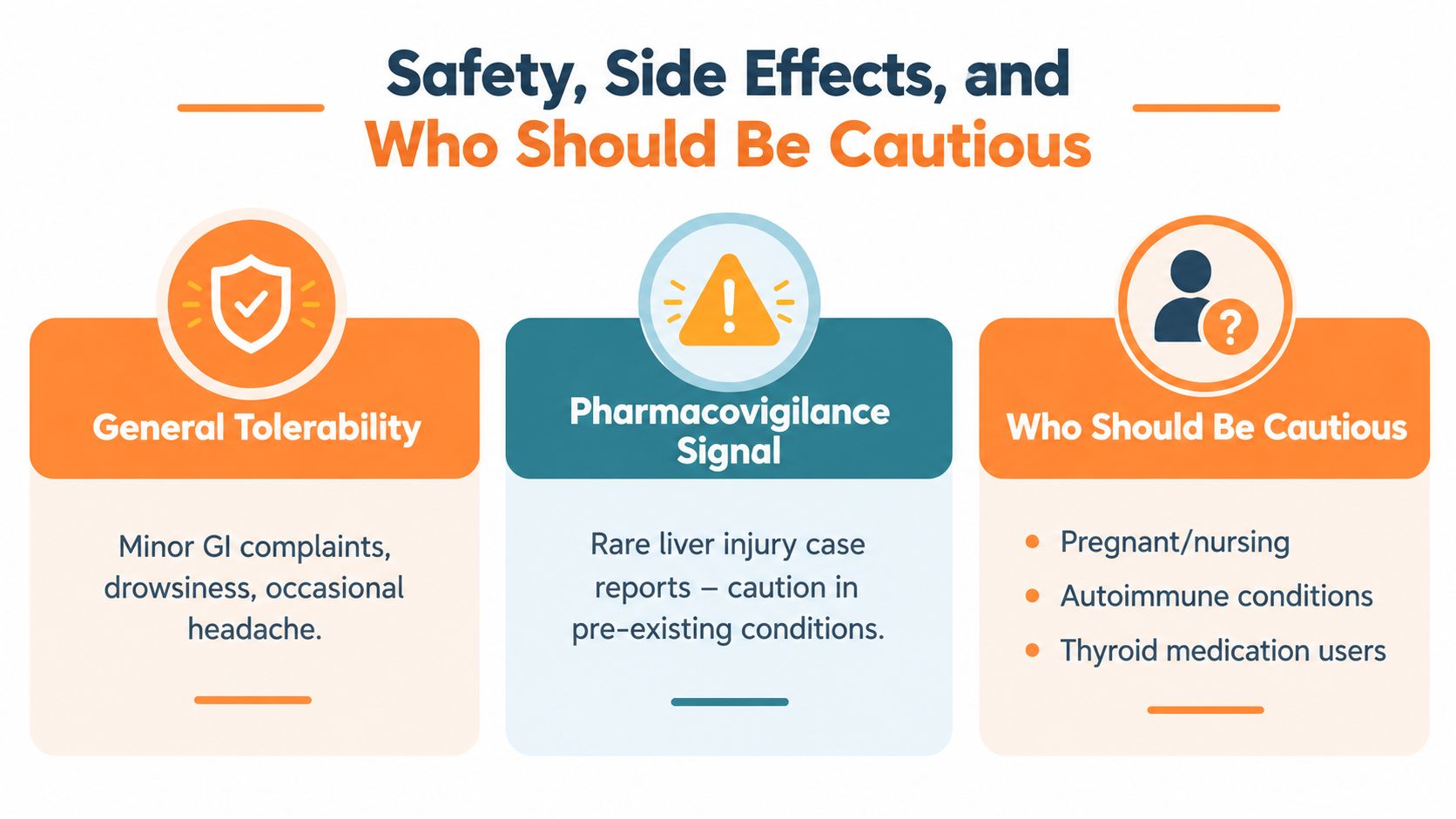
A 2026 safety discussion highlights that split clearly. One healthy-adult study reported 2,000 mg/day for 12 weeks was well tolerated with no serious adverse events and no liver, kidney, or thyroid impact, while New Zealand pharmacovigilance reporting documented 24 ashwagandha-related reports since 2010, including severe gastrointestinal symptoms and 4 liver-related cases, according to the PubMed safety review record.
That doesn't prove that every case was caused by ashwagandha alone. It does mean real-world surveillance has identified a signal that consumer content often leaves out.
The liver signal is rare, not imaginary
The most direct caution comes from two official sources. The NIH LiverTox monograph on ashwagandha states that ashwagandha is generally considered safe in clinical trials, but clinically apparent liver injury has occurred, albeit rarely, and use should be avoided in people with cirrhosis or advanced chronic liver disease. It also notes that most reported cases were mild to moderate and self-limited, but fatal cases from acute liver failure or acute-on-chronic liver failure have been described.
Separately, the Therapeutic Goods Administration safety alert for Withania somnifera reported receiving 12 liver-problem reports linked to products containing the ingredient by 5 February 2024 and concluded there may be a very rare risk of liver injury.
Rare doesn't mean irrelevant. It means most users won't encounter the problem, but people with liver disease or concerning symptoms shouldn't treat the ingredient as risk-free.
Who should think twice
Some caution categories come up repeatedly in safety discussions and clinical commentary:
- People with liver disease: official sources are explicit that advanced liver disease changes the risk calculation.
- People using thyroid medication: endocrine effects don't look broad, but caution is still sensible when thyroid status is medically managed.
- People taking sedatives or anxiolytics: additive calming effects may matter for some users.
- Pregnant or breastfeeding individuals: safety data remain limited.
- People using immunosuppressive therapy: theoretical immunomodulatory concerns make unsupervised use less straightforward.
Men comparing use cases can also review a broader ingredient-level discussion in this article on whether males can take ashwagandha.
The sensible position isn't alarmism. It's realism. Short-term tolerability can be good, and a rare but credible liver signal can still justify caution.
Practical Takeaways for Reading a Supplement Label
Most label confusion comes from one habit: buyers compare front-panel claims instead of comparing the actual ingredient form used in trials. Ashwagandha labels become much easier to judge once the reader ignores branding language and looks for a few specific details.
Four checks that matter
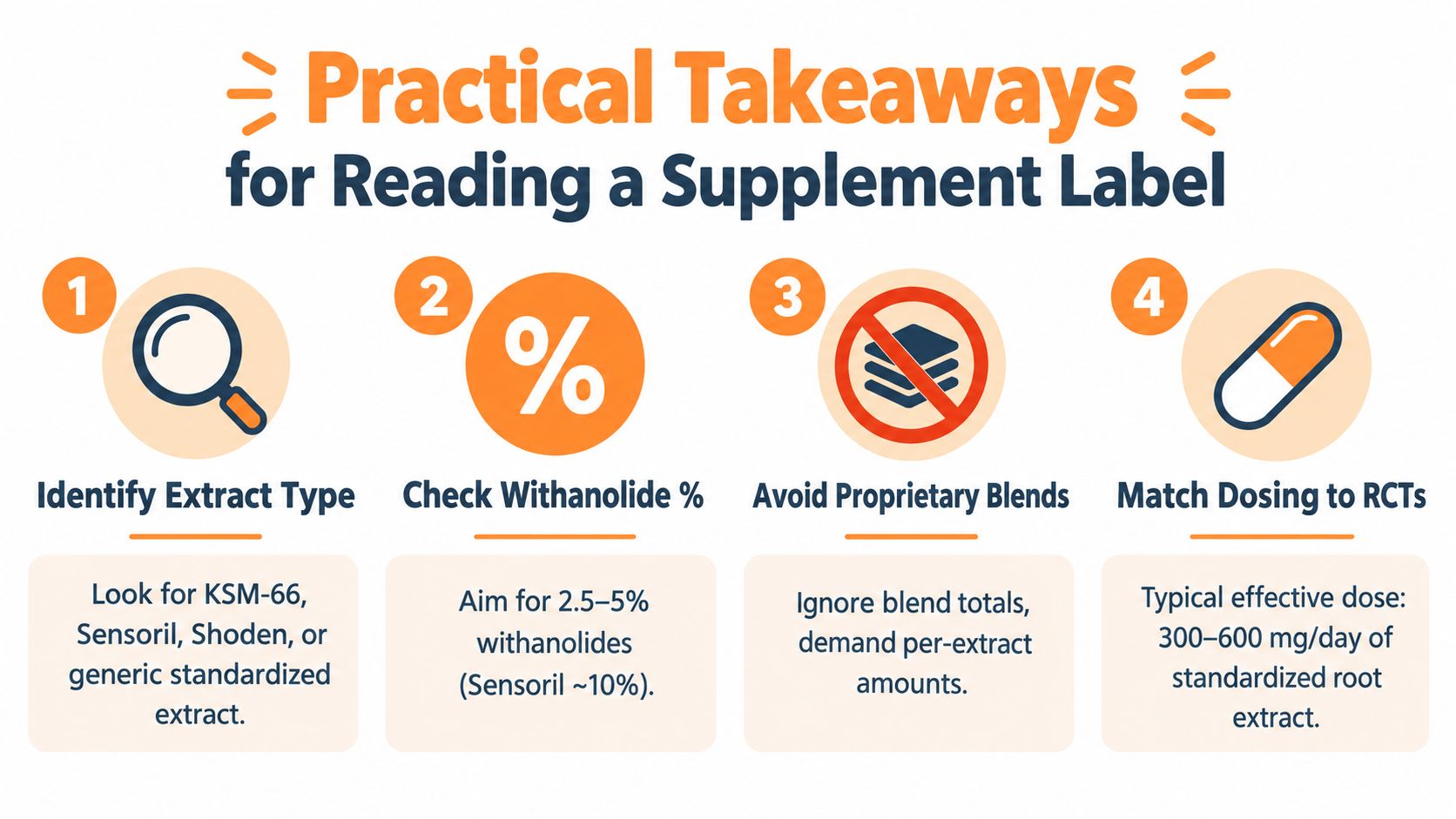
- Identify the extract type. A named extract such as KSM-66, Sensoril, Shoden, or a clearly standardized generic extract gives more useful information than “ashwagandha blend.”
- Check the withanolide disclosure. Standardization helps the buyer compare one formula with another on something more meaningful than raw herb weight.
- Ignore proprietary blend totals. If the label doesn't reveal how much ashwagandha is present, it's difficult to map that product to any clinical evidence.
- Match the expected outcome to the formula's design. A men's wellness formula using ashwagandha may be aiming at stress response support and reproductive-marker support, not acting as a pharmaceutical substitute.
What this means in a men's wellness formula
Ingredient-level thinking matters. In a broader formula, ashwagandha usually isn't there to do everything by itself. It functions as one component of a larger structure/function strategy. In a men's wellness supplement such as SEMEX, for example, ashwagandha sits alongside ingredients used for male vitality and semen-volume-focused positioning. That placement makes sense when the ingredient is framed as support for stress response and male reproductive markers, not as a cure or direct treatment.
Readers who want a cleaner framework for comparing panels can use this guide on how to read supplement labels.
Buying ashwagandha based on milligram hype alone misses the point. The better question is whether the label tells enough truth to compare it with the human research.
A short decision checklist
Before taking any ashwagandha-containing formula, a careful buyer should ask:
- Is the ingredient form disclosed clearly?
- Is the ashwagandha amount visible, not hidden in a blend?
- Does the expected outcome match the evidence tier?
- Is there any personal reason for added caution, especially around liver or medication issues?
That approach won't guarantee a response. It does filter out many of the weakest labels.
Bottom Line and FAQ
Ashwagandha works best where the evidence is least glamorous. It has the strongest support for lowering cortisol and improving stress and sleep metrics, more selective support for male reproductive markers, and a mixed record for testosterone and body-composition narratives. Safety looks generally good in short trials, but rare real-world liver injury reports mean the ingredient shouldn't be treated casually.
FAQ
Does Ashwagandha work for anxiety
It may help support a calmer stress response, and anxiety-scale improvements do appear in pooled research, but the evidence looks stronger for the broader stress-and-cortisol pattern than for every anxiety presentation.
How quickly do sleep and stress effects appear
Trials usually assess these outcomes over weeks, not days. A fair reading is that ashwagandha is a daily-use ingredient, not an instant-effect supplement.
What's the difference between KSM-66 and Sensoril
Both are standardized extracts used in research, but they aren't interchangeable labels in a casual sense. The key issue is whether the product clearly identifies the extract and amount so the formula can be judged against trial-style use.
Does ashwagandha increase testosterone
Some male trials show an increase, and pooled research suggests a male-specific testosterone signal. But that result isn't uniform enough to treat ashwagandha like a universal testosterone solution.
What's the safest way to stop taking it
Ashwagandha isn't typically framed like a drug that requires tapering in the clinical literature provided here. The more practical question is whether the user has noticed benefit and whether any adverse effects suggest stopping and checking with a clinician.
Who should avoid it entirely
People with cirrhosis or advanced chronic liver disease should avoid it based on the LiverTox monograph. Others who are pregnant, breastfeeding, or managing thyroid, sedative, or immunosuppressive therapies should use added caution.
SEMEX offers a daily men's wellness formula built around semen-volume and taste-focused ingredients, with ashwagandha included as one researched component in a broader blend for male vitality support. For readers comparing labels and trying to separate ingredient evidence from marketing language, SEMEX gives a concrete example of how ashwagandha can appear in a multi-ingredient men's formula without being treated as a stand-alone fix.
These statements have not been evaluated by the Food and Drug Administration. This product is not intended to diagnose, treat, cure, or prevent any disease.