

What a cGMP Supplement Actually Means for Quality
The quickest advice about a cGMP supplement is also the most misleading. A label that says cGMP doesn't mean a bottle has been independently verified as clean, potent, or contaminant-free, it means the product was supposed to be made under a regulated manufacturing system. That distinction matters, because buyers often treat the phrase like an FDA approval seal when it's really a process standard.
A smarter way to read the label is to think in layers. cGMP is the first layer, it governs how a supplement is made, packaged, labeled, and held. Third-party testing is the second layer, it checks the finished product for identity, potency, and contaminants such as heavy metals and microbes. When those two layers work together, the quality claim becomes far more defensible.
Table of Contents
- The Misconception Most Shoppers Bring to the cGMP Label
- What cGMP Actually Covers in a Supplement Facility
- The Quality Risks cGMP Is Designed to Control
- Where cGMP Stops and Why That Matters
- What Independent Third-Party Testing Actually Checks
- Label and Website Cues That Signal Real Verification
- Connecting Manufacturing Standards to Ingredient-Level Evidence
- Your Two-Layer Quality Checklist Before You Buy
The Misconception Most Shoppers Bring to the cGMP Label
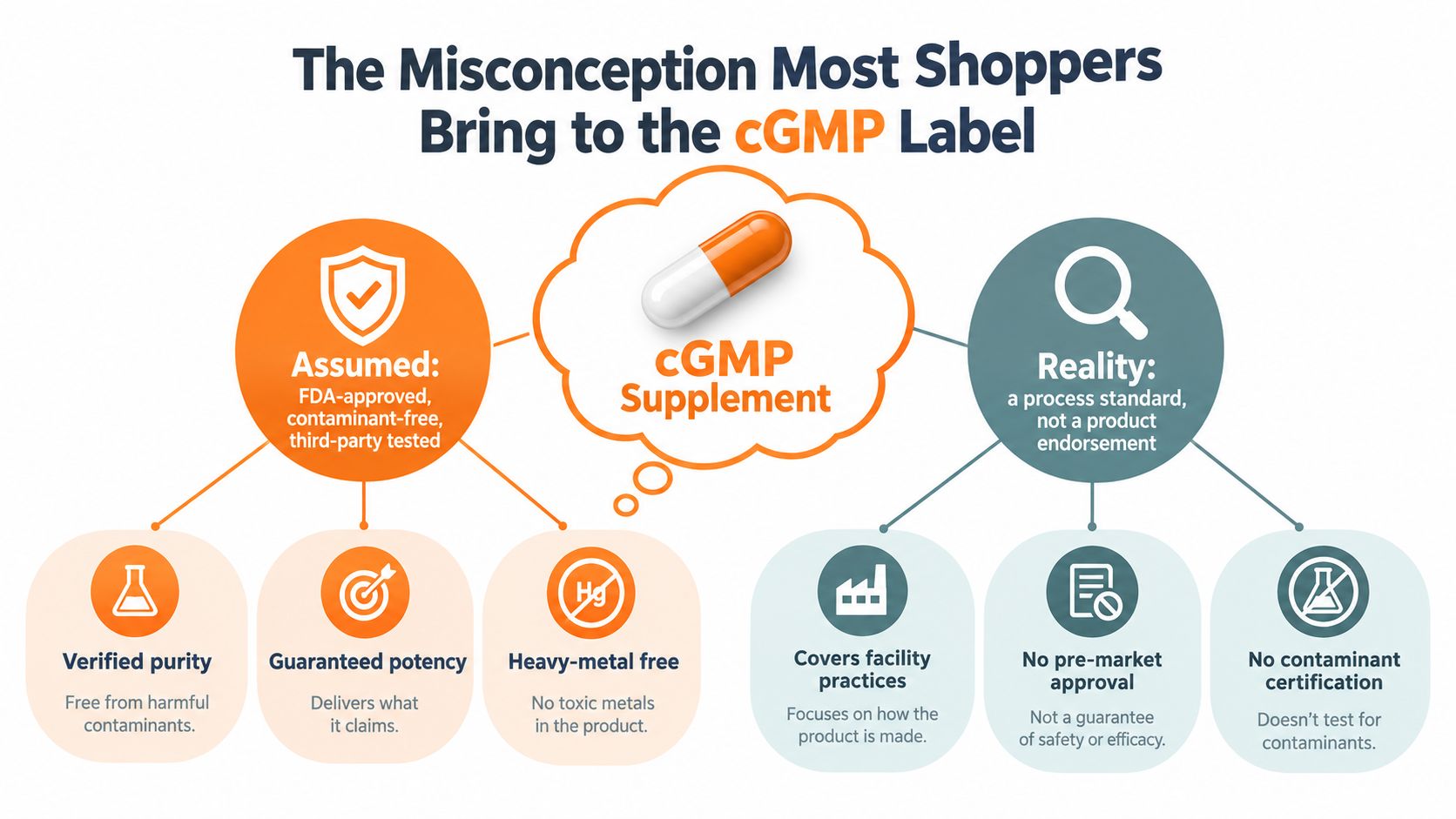
Most shoppers see “cGMP” and assume the bottle has already passed a final quality stamp. That's the wrong mental model. The FDA's supplement rule is about production controls, not a blanket endorsement of the finished product, and the key question is whether the company can prove that each batch was made under control and then verified against specifications.
The label says process, not promise
A cGMP supplement is built on the idea that quality has to be designed into the process from the start. The FDA's rule requires manufacturers to follow production and process controls across manufacturing, packaging, labeling, and holding, so the finished supplement matches the master manufacturing record and is checked against established specifications. In practical terms, that means quality isn't supposed to appear at the end as a lucky outcome, it's supposed to be managed at every stage.
That's why the label can't be read as a contaminant-free guarantee. A brand may follow the right procedures and still need outside verification to show the actual contents meet the claim. Buyers usually want reassurance about purity, consistency, and safety, but cGMP alone only tells part of that story.
Practical rule: treat a cGMP statement as a manufacturing checkpoint, not a finished-product certificate.
Confusion usually starts here. People hear “manufactured in a cGMP facility” and assume that means the capsule inside the bottle has already been independently checked. It hasn't, unless the brand also shows evidence of finished-product testing.
Why the distinction changes how buyers shop
If the product is positioned around consistency or purity, the difference matters even more. Process control helps reduce lot-to-lot variation in ingredient identity, strength, and composition, but that doesn't replace testing of the final batch. A good buyer reads the claim as a starting point, then looks for the evidence that turns process control into verifiable quality.
What cGMP Actually Covers in a Supplement Facility
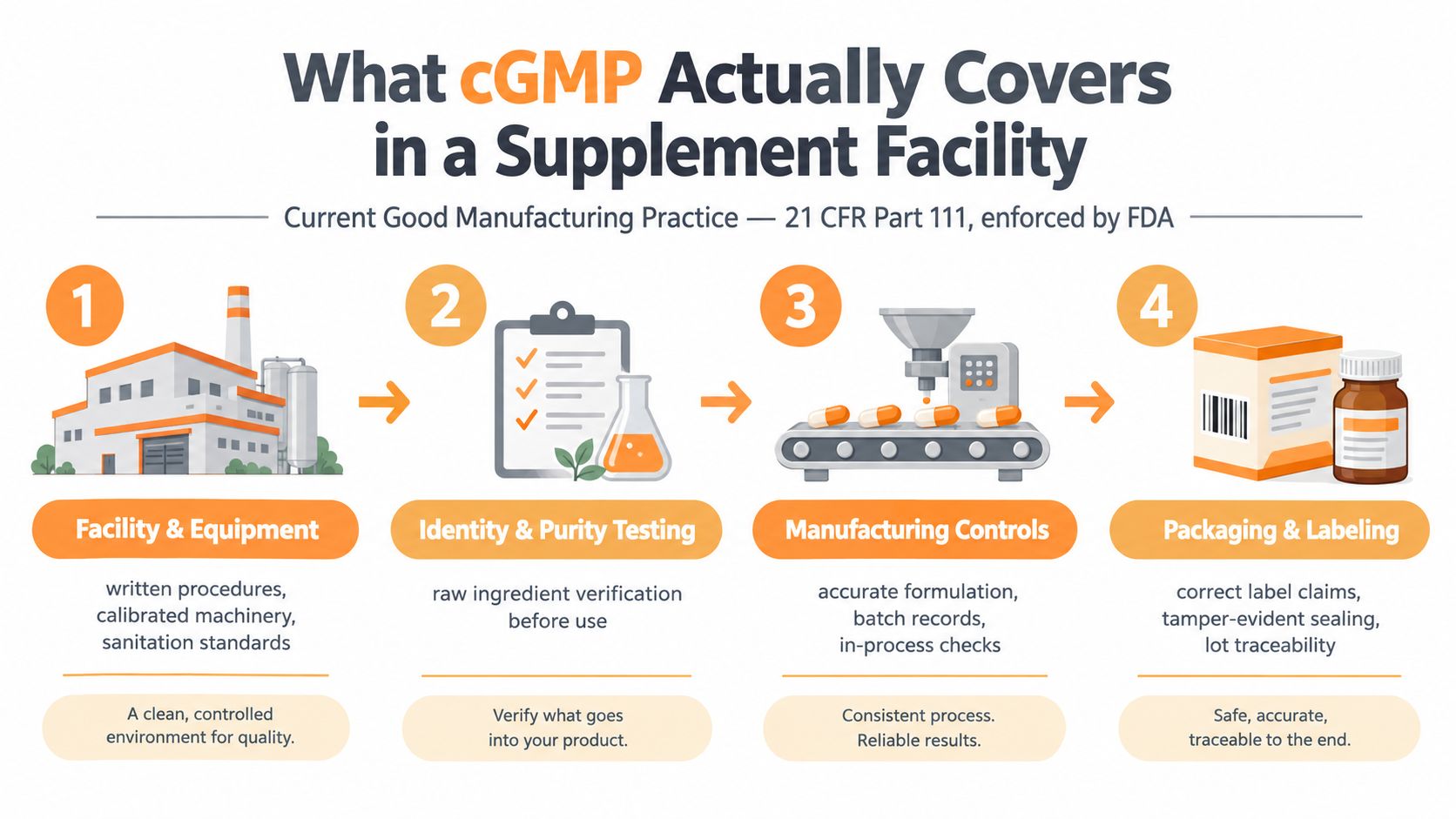
cGMP stands for Current Good Manufacturing Practice, the FDA framework that governs how dietary supplements are produced and controlled. The practical focus is not the marketing promise on the front label, it's the manufacturing discipline behind the scenes. That includes the facility, the people, the records, and the way the product moves from raw material to packaged bottle.
The four places cGMP reaches
The FDA's rule applies to manufacturing, packaging, labeling, and holding. In plain English, that means the company needs written procedures for how ingredients are received, how they're processed, how the product is packed, how the label is applied, and how the product is stored before release. It also means the brand needs role-based quality review, representative sampling, and batch verification so the operation can prove each lot was handled correctly.
A compliant facility also depends on trained personnel, equipment that's maintained and sanitized, and batch records that can be reviewed later. If a label is wrong, a lot number is missing, or a blend is made with the wrong ingredient, the whole point of cGMP is to catch that kind of failure through the system, not after complaints start rolling in.
The practical effect is straightforward. Two bottles from the same brand, made months apart, should still look, measure, and perform like the same product because the process is controlled.
Why this matters to a buyer
That's the main value of cGMP, consistency. It doesn't make a supplement magical, and it doesn't turn a weak formula into a strong one. It does make the manufacturing process more defensible, which is the baseline a buyer should expect before asking any deeper quality questions.
See how supplement manufacturing is usually organized in practice.
A facility can only claim good process if it can show the records, checks, and controls behind each batch.
The Quality Risks cGMP Is Designed to Control
The best way to understand cGMP is to ask what can go wrong without it. The FDA's framework is built to reduce failures in identity, strength, composition, and contamination control, which are the categories that matter most when a supplement moves through a real production line.
What the controls are trying to prevent
If a company follows its master manufacturing record, verifies batches, and uses role-based quality review, it's trying to prevent wrong-ingredient substitution, under-dosing, and broken labeling. That's the operational heart of cGMP. It's also why representative sampling matters, because the company can't just assume one good result proves the whole batch was made correctly.
Contamination control is another major piece. A compliant process is supposed to reduce the chance that microbes, filth, or cross-contact problems enter the product during production. That includes cleaning, sanitation, and checking that equipment and material flow don't create mix-ups between batches. For readers comparing brands, this is the difference between a company that hopes its process is fine and one that can document control.
| Quality Risk | What Could Go Wrong | cGMP Control Mechanism |
|---|---|---|
| Identity | The bottle may contain the wrong ingredient | Written procedures, raw material verification, batch review |
| Strength | The dose may be too low or too high | Master manufacturing record, in-process checks, batch verification |
| Composition | Ingredients may be substituted or mixed incorrectly | Ingredient controls, label reconciliation, quality review |
| Contamination | Microbes or cross-contact may enter the batch | Sanitation, equipment controls, representative sampling |
Why batch review is so important
The FDA's approach assumes quality doesn't happen by accident. A finished supplement should be compared against the record that says how it was supposed to be made, and the people responsible for quality should sign off before release. That's why a compliant brand can't rely on “we use good ingredients” as a quality argument. It has to prove the batch was made the right way and reviewed against the right standard.
Where cGMP Stops and Why That Matters
cGMP reaches the production process, but it doesn't certify that the final capsule is free from every contaminant or adulterant. That's the boundary most shoppers miss. A company can run a compliant facility and still need independent testing to verify what ended up in the bottle.
The gap between process control and product proof
The manufacturing side can be spotless on paper and still leave important questions unanswered. Heavy metals can show up in botanical ingredients, microbial contamination can slip into certain blends, and undeclared drug adulterants can surface in product categories where the market attracts aggressive claims. Those are finished-product risks, and they need finished-product verification.
That's why cGMP is not the same thing as an analytical result. It says the company should have controlled how the product was made, packaged, and held. It does not, by itself, prove the final product passed a contaminant panel, potency check, or identity confirmation.
Simple boundary: cGMP controls the process, third-party testing checks the bottle.
The difference matters because the buyer's real question is usually simple. Is this bottle what the label says it is? A compliant facility helps answer that with records and controls, but it doesn't fully answer it on its own.
Why third-party verification has to pick up the rest
Independent testing is the layer that measures the finished product instead of the production story. That's the missing step between “we made it correctly” and “we can prove what's in it.” Without that second layer, the buyer is still relying on trust rather than verification, which is exactly where confusion starts in supplement shopping.
What Independent Third-Party Testing Actually Checks
A credible third-party lab looks at the finished supplement, not just the incoming raw materials. That's the practical value of outside verification. It gives the buyer a separate measurement of what is in the bottle and whether the product carries contamination risks that a manufacturing claim can't resolve on its own.
The main test categories
Independent labs commonly screen for microbiology, heavy metals, identity, potency, and undeclared adulterants. Eurofins says dietary supplement labs can test for heavy metals, detect pathogens, and confirm the absence of contaminants such as Salmonella spp., E. coli, total aerobic microbial count, and total combined yeast and mold count. It also notes that low-level heavy-metal compliance testing often uses ICP-MS, and that dietary-supplement contaminant services can cover arsenic, cadmium, lead, and mercury. Eurofins dietary supplement testing services
| Test Category | What It Screens For | Why It Matters |
|---|---|---|
| Microbiology | Salmonella, E. coli, yeast, mold, aerobic counts | Helps detect contamination that can affect safety |
| Heavy metals | Arsenic, cadmium, lead, mercury | Confirms the product is checked for trace contaminants |
| Identity | Whether the ingredient matches the label | Reduces the risk of substitution or mislabeling |
| Potency | Whether the active amount matches the claim | Helps show the dose is what the brand says it is |
| Adulterants | Undeclared drug-like compounds | Helps catch hidden ingredients in risky categories |
Why the method matters
ICP-MS matters because it's a technical way to look for trace heavy metals in the final product. That's a stronger signal than a vague “tested” badge with no details, because it shows the company didn't stop at process claims. It measured the finished supplement itself.
For buyers comparing verification logos, names like USP, NSF, Informed Choice, and ConsumerLab usually indicate an audit-based or testing-based program rather than a self-issued claim. The label still matters, but the testing layer is what turns a brand promise into something closer to evidence.
See how third-party testing fits into supplement quality control.
Label and Website Cues That Signal Real Verification
A supplement brand doesn't have to shout about quality for the evidence to be there. The smarter move is to look for small but concrete cues that a real verification system exists behind the marketing. Those cues usually show up on the bottle, in the product page, or in a downloadable batch document.
What a serious label usually shows
A useful label often includes lot or batch numbers, a real facility location, a storage statement, and an expiration date. If the brand says “Manufactured in a cGMP-compliant facility,” that tells a buyer the product was made under a process standard, not that the finished product was independently certified. The stronger brands also make a Certificate of Analysis available, or provide a way to request one tied to a specific batch.
- Third-party seal: A real seal from USP, NSF, or a similar verifier suggests independent review, not self-approval.
- Facility details: A named manufacturing location is better than vague wording with no traceable site.
- Batch traceability: A lot number lets a buyer connect the bottle to a production run.
- COA access: A batch-specific certificate gives the best glimpse into identity, potency, and contaminant checks.
- Storage and expiry: Clear handling instructions usually reflect more disciplined quality control.
Red flags that should slow a purchase
When a product page leans on phrases like “pharmaceutical-grade” without documentation, that's usually marketing language, not proof. The same warning applies when there's no facility identifier, no batch number, no testing disclosure, or no accessible COA. Marketplace badges can be useful signals, but they're not the same thing as batch-level testing.
If a brand can't show the lab name and a sample certificate of analysis, the claim is still just a claim.
A buyer who wants to make the right call only needs one habit, check the lab name and verify that a sample COA exists before buying. That single step filters out a lot of vague quality language.
Connecting Manufacturing Standards to Ingredient-Level Evidence
Manufacturing quality is only half the story. For men's wellness products, the ingredient list has to earn its place, because a clean bottle with weak ingredients still won't justify the purchase. The best supplement decisions start with named compounds and the question of whether those compounds have meaningful human evidence.
Follow the ingredient, not the slogan
Many products market broad outcomes, but evidence usually lives at the ingredient level. Zinc is often discussed for normal male reproductive function, L-arginine is tied to nitric oxide pathways, and ingredients like saw palmetto or ashwagandha are usually discussed for broader wellness support rather than sweeping promises. The more a formula leans on "male vitality" language, the more important it becomes to check each ingredient and the exact dose on the Supplement Facts panel.
That dose check matters because a cGMP-compliant, third-party-tested capsule can still be too weak to matter. If the amount in the bottle doesn't resemble the amount used in the study context, the label may be selling a story instead of a result.
The practical reading habit
The easiest habit is simple. Read the Supplement Facts panel, write down each active ingredient, note the exact milligram amount, then search that ingredient plus dose plus “clinical trial.” If no human study exists at that dose, the claim is much thinner than the marketing suggests.
| Ingredient | Claimed Use | Evidence Strength |
|---|---|---|
| Zinc | Supports male reproductive function | More plausible when deficiency is present |
| L-Arginine | Supports nitric oxide pathways | Mechanistically relevant, product claims can outrun proof |
| Saw Palmetto | Often used in prostate-support blends | Mixed, product-specific evidence varies |
| Ashwagandha | Often used in vitality and stress-support blends | Ingredient-specific support exists, but claims should stay narrow |
| Tongkat Ali | Often marketed for male vitality | Evidence is more limited and product-dependent |
That kind of reading keeps the buyer focused on what the product can plausibly do, not what the marketing implies. For a related deeper look at ingredient-level purity and verification, the discussion on supplement purity testing is a useful companion.
Your Two-Layer Quality Checklist Before You Buy
A good supplement purchase decision comes down to two layers and one final check. First, the manufacturing layer. Second, the independent verification layer. Then a quick review of the formula itself to make sure the label isn't hiding low doses behind glossy language.
Layer one is manufacturing integrity
Look for a brand that states cGMP-compliant production, identifies where the product is made, prints a lot or batch number, and makes a Certificate of Analysis accessible or available on request. That combination shows the company has traceability, not just branding. It also means there's a paper trail if something ever needs to be investigated.
Layer two is independent verification
Look for testing by a named lab or recognized certifier, and confirm that the testing covers identity, potency, heavy metals, and microbial contaminants. The strongest brands publish updated results or make batch documents easy to find. If the product is sold through a retailer, treat marketplace badges as secondary, because they don't replace batch-level testing.
The ingredient transparency check
A full Supplement Facts panel should show every active ingredient and each dose. If the brand hides behind proprietary blends, the buyer can't tell whether the formula has enough of anything to matter. That's a problem even when the manufacturing looks solid.
A final reminder belongs here because it clears up the legal and practical boundary. These statements have not been evaluated by the Food and Drug Administration. This product is not intended to diagnose, treat, cure, or prevent any disease. Even a well-made supplement only makes sense when it fits into sleep, nutrition, movement, and a realistic plan.
SEMEX is one example of a men's supplement brand that centers its process around cGMP manufacturing and third-party testing, which makes it relevant to this quality framework. Men who want a formula with ingredient-level transparency can review the product details and testing information at SEMEX before deciding what fits their routine.