

Can Hickeys Be Dangerous? Risks, Red Flags, and Safety
A new reddish-purple mark has appeared on the neck, and a partner has called it “just a hickey.” Then a frightening headline raises a more serious question: can hickeys be dangerous? The concern is understandable, but the answer needs more precision than either “never” or “every time.”
Most hickeys are ordinary superficial bruises. A small number of medical reports have described serious events after forceful suction on the neck, particularly near a carotid artery. Those reports don't show that routine hickeys commonly cause strokes, but they do explain why certain symptoms deserve urgent attention.
The useful distinction is between the bruise itself and a possible injury beneath it. The sections below explain how a hickey forms, what rare complications have been reported, which warning signs require emergency care, why placement matters, and how to care for a normal bruise without making it worse. The goal is calm, practical safety information, not alarm.
Table of Contents
- A Quick Look at Why This Question Matters
- What a Hickey Actually Is
- The Rare Reported Complications Worth Knowing
- Red Flag Symptoms That Require Emergency Care
- Where on the Body Risk Changes
- Common Myths and What Actually Helps
- Putting the Risk in Proportion
A Quick Look at Why This Question Matters
A new mark in the bathroom mirror can prompt an awkward joke, while a dramatic story about a hickey and a stroke can create real fear. The useful medical question is more specific: does the mark behave like an ordinary bruise, or are other symptoms pointing to a deeper injury?
In clinical terms, most hickeys present as a superficial ecchymosis, meaning blood has leaked from tiny vessels beneath the skin after suction or localized pressure. The body gradually reabsorbs that blood, so the discoloration fades without treatment when no concerning symptoms are present. Guidance from Cleveland Clinic on hematomas and bruising supports watching for a bruise that is unusually large, firm, painful, expanding, or slow to improve.
The rare concern is forceful suction over the neck, rather than the purple mark itself. The neck contains major arteries, including the carotid arteries, and rare case reports have described clotting or arterial injury after a love bite. These reports are safety signals, not a population-wide risk estimate. The medical literature contains only a handful of hickey-associated serious events across several decades.
The question to ask first
Start with three observations:
- Appearance: Does the mark resemble a stable bruise?
- Local behavior: Is it becoming unusually large, firm, painful, throbbing, or rapidly expanding?
- Whole-body symptoms: Are there changes in strength, speech, vision, breathing, swallowing, or consciousness?
A stable-looking mark without other symptoms generally calls for observation rather than panic. Sudden weakness, facial drooping, trouble speaking, vision changes, severe dizziness, fainting, or breathing difficulty requires urgent medical attention.
Practical rule: The bruise is usually the visible aftermath. Neurological or airway symptoms signal a more urgent problem.
This distinction keeps the risk in proportion. A hickey is not automatically dangerous, but a small skin mark does not rule out a significant neck injury. Pay attention to the bruise's behavior, its location, and any change in how the person feels.
What a Hickey Actually Is
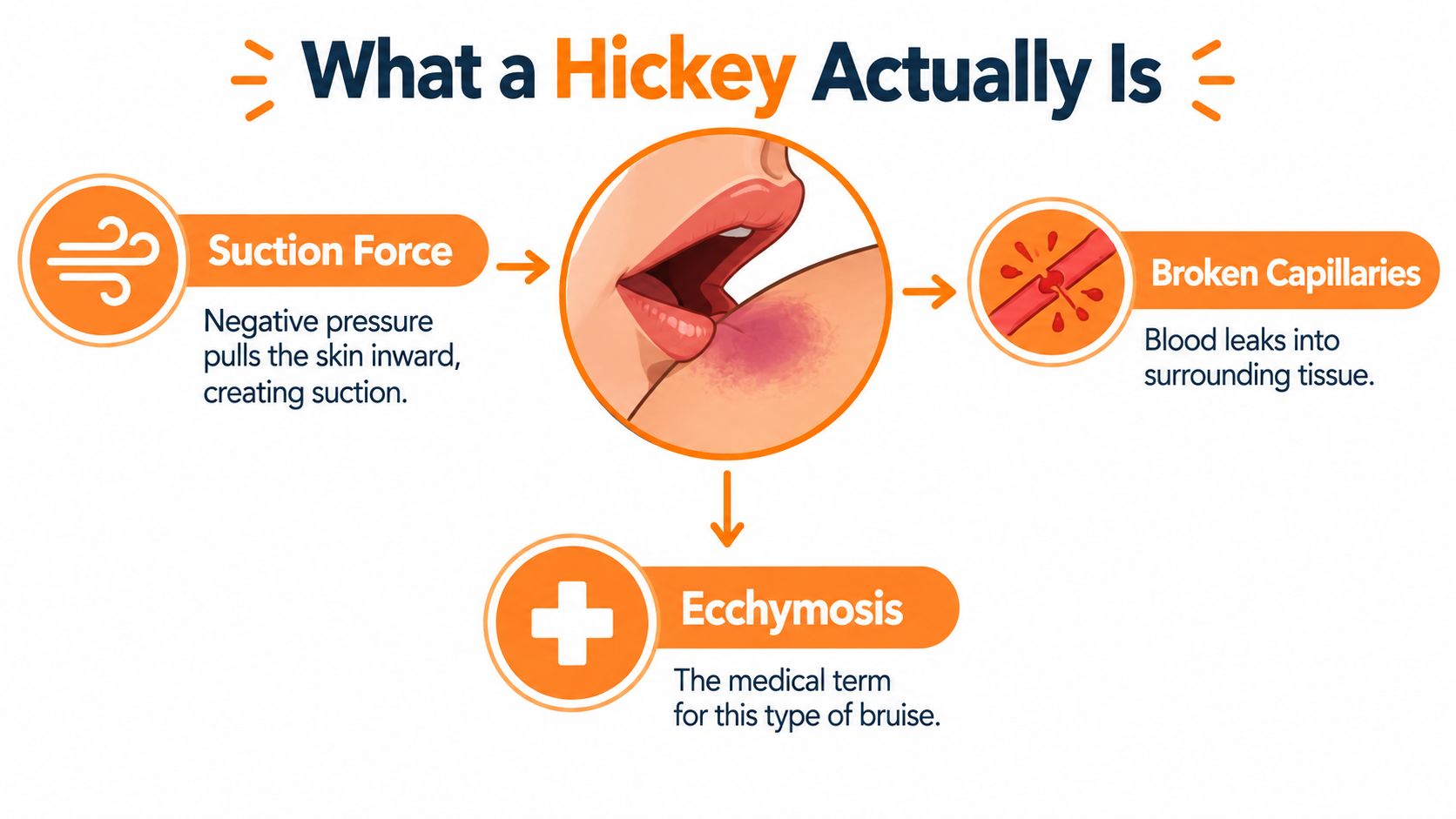
A hickey is usually a superficial ecchymosis, the medical term for a bruise. It forms when suction and localized pressure affect small blood vessels near the skin's surface.
Suction draws the skin inward and stresses tiny vessels called capillaries. Some rupture, allowing blood to leak into the skin and the tissue beneath it. That trapped blood produces the visible red, purple, or dark mark. The process is similar to a small vacuum cup pressed against the skin. The surface does not need to break. Pressure alone can make fragile vessels leak.
What normal healing looks like
After the vessels leak, the body gradually breaks down and clears the pooled blood. The mark may change as that process unfolds, because different breakdown products have different colors. On darker skin tones, color changes can be subtler, and the bruise may appear brown, deep purple, or nearly black.
A routine hickey should gradually become less noticeable as the body reabsorbs the blood. Its exact appearance depends on the pressure involved, the person's skin tone, and how easily their capillaries bruise. A stable mark that slowly fades usually reflects a localized surface injury rather than damage to a major vessel.
When the bruise may be deeper
A superficial hickey generally does not feel severely painful or increasingly tight. A mark that is unusually large, firm, painful, expanding, or persistent may indicate a deeper hematoma, meaning a larger collection of blood beneath the surface.
Depth changes the concern because pooled blood can press on nearby tissue. The finding alone does not prove an arterial injury, yet a deeper-feeling mark on the neck deserves more attention than an ordinary skin-level bruise. The location and force matter, as do symptoms involving the brain, breathing, swallowing, or circulation. These features distinguish the everyday bruise from the rare arterial event discussed later.
The Rare Reported Complications Worth Knowing
A hickey is usually a surface bruise. The rare concern involves a different structure beneath the skin: a cervical artery, one of the blood vessels that carries blood toward the brain. Forceful suction near the artery could injure its inner lining, called the intima. A clot might then form at the injury site, and part of it could travel toward the brain as an embolus, reducing blood flow.
This mechanism is biologically possible, but the evidence remains limited. Case reports document unusual events that occurred after an exposure. They cannot show how often the event happens or prove that the exposure caused every outcome.
What the case reports describe
The best-known published report appeared in the New Zealand Medical Journal in 2010. A 44-year-old woman developed paralysis in her left arm several days after receiving a love bite. Imaging found thrombosis in the right internal carotid artery and a resulting cerebral ischemic infarct. After excluding more typical explanations, the authors classified the event as an unusual form of blunt internal carotid-artery injury. The New Zealand Medical Journal case report does not establish a measurable risk for the general population.
A separate published clinical report involved a 35-year-old woman who developed sudden right-sided weakness 12 hours after a love bite on the left side of her neck. Duplex ultrasound showed near-occlusion of the left internal carotid artery, while CT angiography identified a mural thrombus. The reported mechanism was local arterial injury followed by clot formation and embolization to the brain, producing a left middle cerebral artery stroke. The clinical record is available through the PubMed case report.
A third widely repeated account concerns a 17-year-old boy in Mexico in 2016 who reportedly collapsed during dinner and died after a stroke linked in contemporaneous reporting to a hickey received earlier that day. Unlike the published clinical cases, this account relied largely on local news coverage rather than a detailed peer-reviewed report. The Medical Daily account should therefore be treated as a reported association, not proof that the hickey definitively caused the death.
Comparison of the reported events
| Year and source | Patient | Timing | Reported finding | Strength of evidence |
|---|---|---|---|---|
| 2010, New Zealand Medical Journal | 44-year-old woman | Several days after a love bite | Right internal carotid thrombosis and cerebral ischemic infarct | Published case report |
| Published clinical report | 35-year-old woman | 12 hours after a neck love bite | Near-occlusion and mural thrombus involving the left internal carotid artery, with stroke | Published case report |
| 2016, local news-linked reporting | 17-year-old boy | Earlier the same day | Reported stroke and death | Reported association, not a detailed peer-reviewed clinical report |
Research on cervical-artery dissection provides context, but it should not be applied directly to hickeys. The American Heart Association scientific statement on cervical-artery dissection notes that cervical-artery dissections account for up to one in four strokes in adults younger than 50. That statistic concerns cervical-artery dissection overall, not hickeys.
Taken together, these reports represent a historical safety signal rather than evidence of a common outcome. Serious hickey-associated events are possible in theory and documented in rare reports, yet they remain exceptionally uncommon compared with the many hickeys that heal without serious consequences.
Red Flag Symptoms That Require Emergency Care
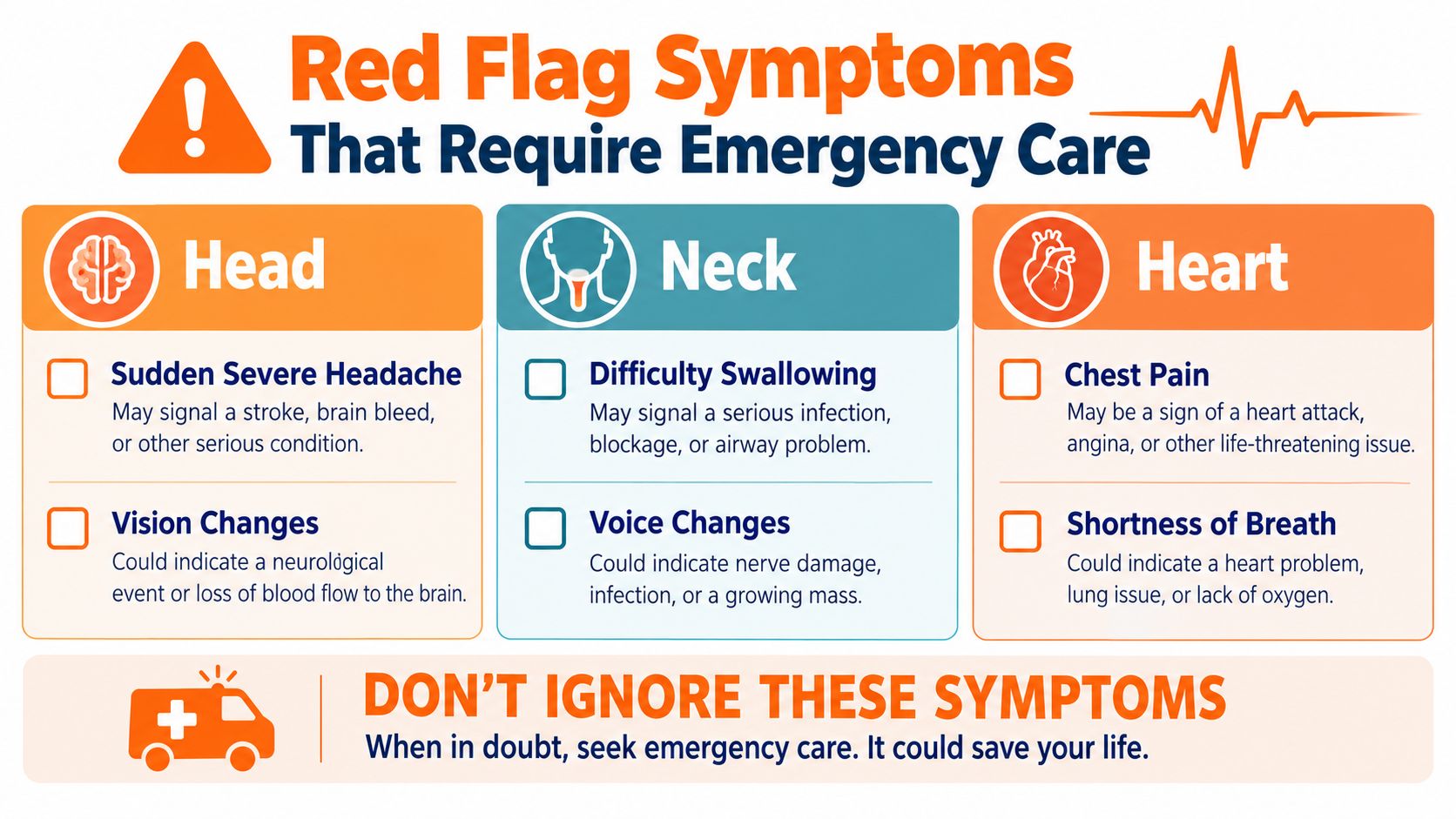
A neck hickey needs urgent attention when the person develops a change in brain function, consciousness, swallowing, or breathing. The skin may still look like an ordinary bruise while a deeper problem is developing, so the appearance of the mark is not a reliable safety test.
Brain and neurological warning signs
Call emergency services immediately for any sudden neurological change, especially:
- One-sided weakness or numbness: An arm, leg, or side of the face feels weak or loses sensation.
- Facial drooping: One side of the mouth or face suddenly sags.
- Speech or thinking changes: Speech becomes slurred, words are difficult to find, or the person cannot understand simple language.
- Vision changes: Sudden blindness, double vision, or a major change in sight requires urgent assessment.
- Severe dizziness or loss of balance: New difficulty walking, intense spinning, or poor coordination should not be monitored at home.
- A sudden severe headache: An unusually intense or unfamiliar headache is another warning sign.
- New one-sided neck or head pain: Pain on the side of the neck or head after forceful suction deserves prompt medical evaluation, even before other neurological symptoms appear.
The American Heart Association guidance on cervical-artery dissection describes new neck or head pain as a possible early symptom, with neurological problems sometimes developing later. The practical rule is simple: treat a sudden, severe, or unusual symptom as an emergency rather than waiting for the bruise to change.
Airway and consciousness symptoms
Trouble breathing, difficulty swallowing, voice changes, fainting, or loss of consciousness also require emergency care. They may reflect swelling or irritation in the neck, or a more serious problem affecting nearby structures.
Do not drive yourself if severe symptoms are present. Call emergency services, note when the symptoms began, and tell clinicians which side of the neck received suction. This information can help them assess the situation quickly. WebMD's hickey safety guidance also supports seeking medical care when a hickey is associated with concerning symptoms.
A bruise that steadily fades is a different situation from a bruise accompanied by altered brain function, fainting, swallowing difficulty, or breathing problems.
An ordinary hickey without these signs generally does not require emergency triage. A separate topic, this guide to types of boners, concerns sexual health and does not replace urgent assessment when any warning sign appears.
Where on the Body Risk Changes
The body location changes which tissues lie beneath a hickey. The neck contains the carotid and vertebral arteries, airways, glands, nerves, and other sensitive structures. The carotid arteries carry blood toward the brain, so forceful suction over the side of the neck deserves more caution than similar suction on the forearm or shoulder.
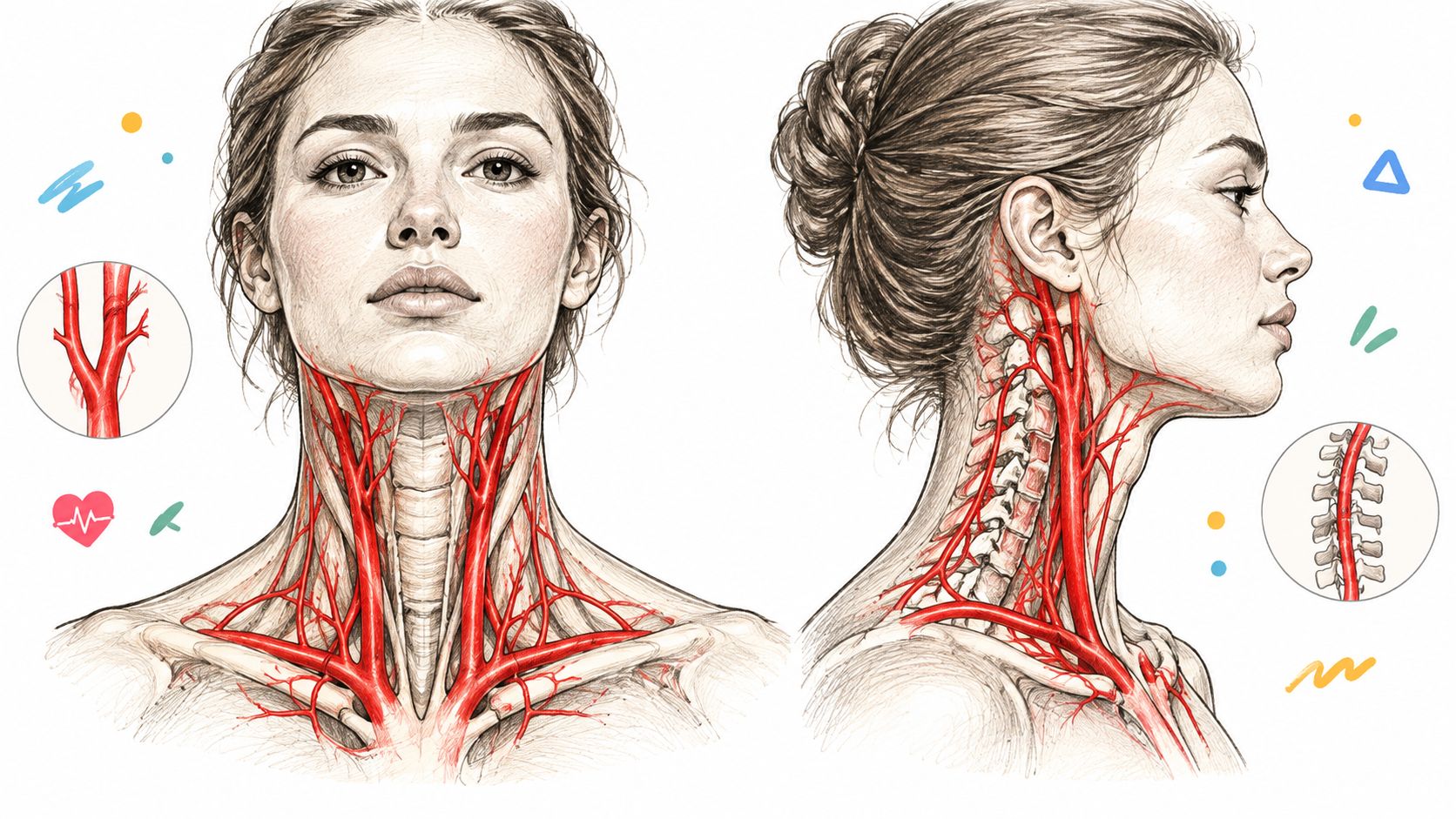
A hickey on the forearm, shoulder, or an area near the collarbone generally affects small superficial capillaries farther from the major neck arteries. These areas can still bruise, especially over a bony prominence, and may feel tender. Their anatomy does not create the same proximity concern as the sides of the neck.
A neck mark is not automatically dangerous. Placement and intensity are practical variables. Avoid forceful suction where a carotid pulse can be felt, particularly along the sides of the neck. Gentler contact reduces extensive bruising and avoids placing unnecessary pressure near important vessels and airways.
A location-based safety check
Use this guide to distinguish lower-concern locations from areas that deserve more care:
- Further from major neck vessels: A stable bruise on the forearm or shoulder is usually a superficial skin injury.
- Over the side of the neck: Greater caution is appropriate because major arteries lie beneath the tissues.
- Directly over a pulse: Avoid forceful suction rather than testing how much pressure the area can tolerate.
- Unusually painful or throbbing: Prompt medical evaluation is sensible, particularly if the mark expands or becomes firm.
As detailed in the case reports above, imaging in one report showed near-occlusion of the left internal carotid artery after a left-sided neck hickey. This is why forceful suction over the carotid pulse area warrants more caution than the same suction on the forearm or shoulder.
Serious outcomes remain exceptionally rare. Choosing a less vulnerable location is a practical way to reduce an already-low risk, not a reason to treat ordinary intimacy as hazardous. The key distinction is anatomical: a superficial bruise farther from major vessels presents a different concern from forceful suction over the side of the neck.
Common Myths and What Actually Helps
One myth says that hickeys cause permanent damage every time. Another says they regularly trigger strokes. Neither reflects the available evidence. Most are superficial bruises, while the severe cases are rare reports that deserve attention because of their symptoms, not because every hickey carries the same danger.
Home care should stay gentle. A cold compress early on may help limit swelling. Later, light handling can be more comfortable, but aggressive massage, coin scraping, repeated sucking, or other attempts to “break up” the bruise can cause more tissue injury and prolong discoloration. Time remains the main driver of resolution.
Practical aftercare
- Protect the area: Avoid further trauma for several days.
- Observe the pattern: Gradual fading and changing color are generally consistent with healing.
- Check the texture: Expansion, firmness, or unusual pain warrants clinical review.
- Watch the person, not only the mark: Neurological, swallowing, breathing, or consciousness symptoms require emergency care.
A hickey isn't a moral issue or a reason for shame. It can be discussed like any other minor skin injury, with attention to anatomy and symptoms. Articles about bromelain enzyme benefits concern a different wellness topic and shouldn't be treated as a remedy for a bruise or a substitute for medical evaluation.
Putting the Risk in Proportion
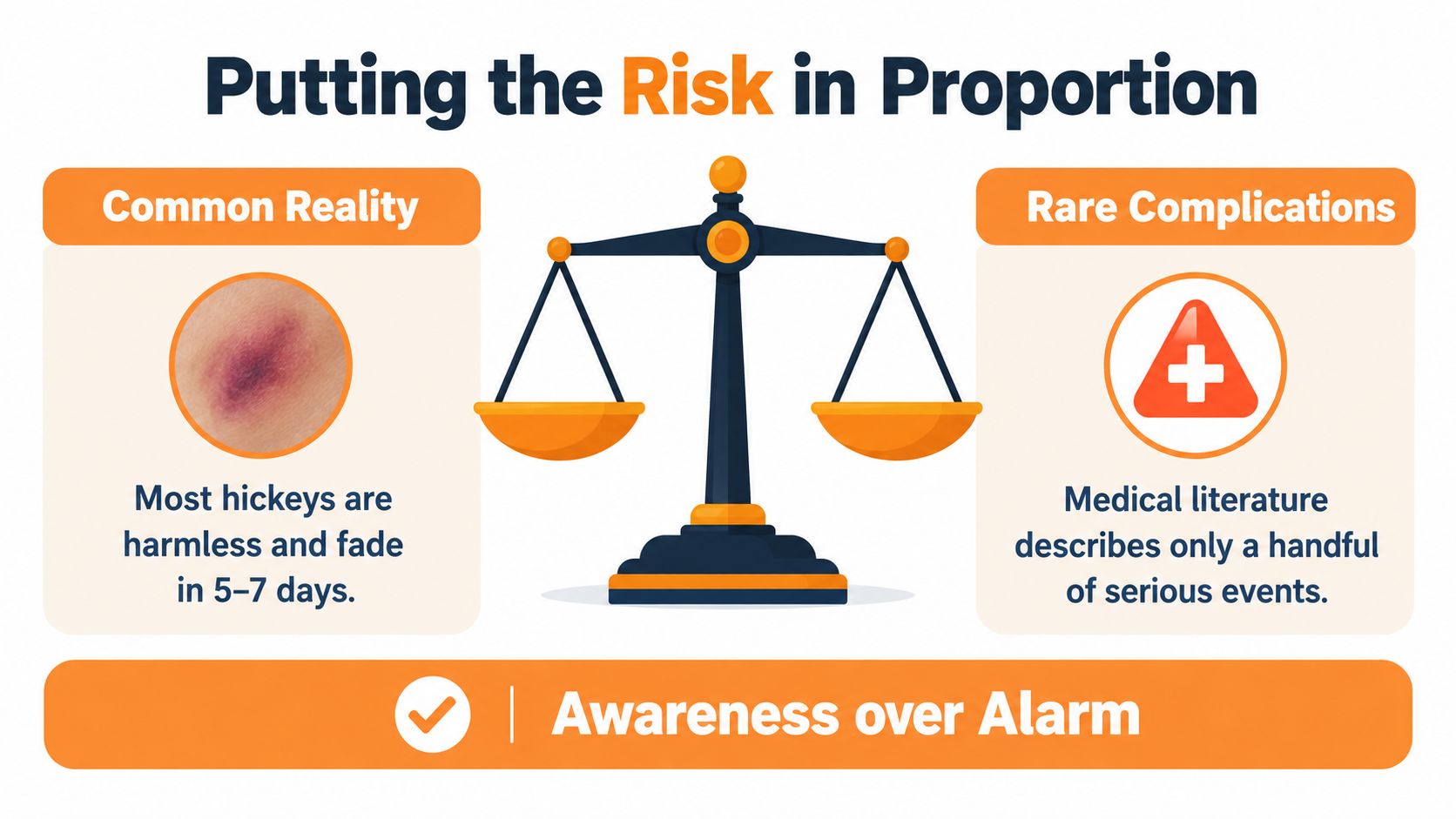
The most balanced answer is that most hickeys are harmless superficial bruises that fade over roughly two to three weeks, while serious arterial events are possible but exceptionally uncommon. The medical literature describes only a handful of hickey-associated serious events across several decades, not a reliable percentage risk for everyone who gets a hickey.
Placement near the neck's major arteries is the practical risk factor worth remembering. Gentler pressure and avoiding forceful suction over the sides of the neck reduce an already-low concern. A stable bruise without warning signs usually needs protection and observation, while sudden one-sided weakness, facial drooping, slurred speech, severe headache, vision changes, severe dizziness, fainting, or trouble swallowing or breathing after a neck hickey calls for emergency evaluation.
For readers exploring broader men's wellness resources, male sexual health information covers a separate area of health education. SEMEX is a dietary supplement product, and it isn't a treatment for bruising, arterial injury, stroke, or any other medical condition.
Anyone with red-flag symptoms should contact emergency services now rather than waiting for the discoloration to disappear. For routine wellness questions, visit SEMEX to review what the brand offers, while keeping urgent symptoms within the care of qualified medical professionals.
These statements have not been evaluated by the Food and Drug Administration. This product is not intended to diagnose, treat, cure, or prevent any disease.