

Best Male Supplement Guide for Volume and Vitality
The most common advice on a best male supplement is too vague to be useful. It lumps semen volume, taste, libido, sperm quality, and fertility into one promise, even though those are different outcomes with different evidence behind them. A credible product should be judged by what it can support, what it cannot claim, and how clearly it labels its ingredients and testing.
| Product style | Best fit | Main tradeoff |
|---|---|---|
| Volume and taste focused | Men prioritizing ejaculation volume and sensory experience | Narrower goal set, less emphasis on broader vitality |
| Broad wellness blend | Men who want libido, energy, and routine support in one formula | More ingredients to vet, greater need for dose transparency |
| Fertility-focused support | Men studying sperm parameters and reproductive-function support | Stronger need to separate lab measures from pregnancy outcomes |
Table of Contents
- Defining the Best Male Supplement for Your Goals
- Analyzing Key Ingredients for Volume and Taste
- Evaluating Botanicals for Libido and Vitality
- Verifying Purity and Third-Party Safety Testing
- Matching Supplement Profiles to Specific Use Cases
- How SEMEX Aligns with Modern Wellness Criteria
- Dosing Expectations and Final Recommendations
Defining the Best Male Supplement for Your Goals
A larger semen sample does not automatically mean better sperm concentration, motility, morphology, or reproductive outcomes. The WHO's 2021 manual treats semen-analysis reference values as distributions, not pass-or-fail labels, and cautions that the 5th percentile alone should not be used to diagnose infertility because conception depends on both partners and multiple factors (WHO manual). That distinction matters because many supplement pages merge volume, libido, and fertility into one promise.
A credible product strategy starts by matching the primary goal first, then judging the formula against that goal. For a step-by-step framework, see personalized supplement plans.
Separate the bedroom goal from the clinical goal
A man choosing a daily formula should decide whether he wants sensory support, sexual-wellness support, or reproductive support. Those goals often sit in the same conversation, but the research does not treat them as interchangeable. A product that supports normal reproductive function through an ingredient like zinc is still not the same as a product that can prove pregnancy or live-birth benefit.
The evidence history reinforces that boundary. A 2025 review found that some ingredients were associated with changes in individual sperm measures, but it found no convincing evidence that supplements improved pregnancy or live-birth rates, and no specific supplement had substantial evidence for improving male infertility overall (2025 systematic review). That is the right lens for comparison shopping, because it keeps expectations tied to measurable support rather than marketing language.
Practical rule: if a label talks about “male enhancement,” the first question should be, “Which outcome is actually being measured?”
A useful supplement strategy starts with the outcome, not the brand story. If the goal is semen volume and taste, the label should be judged on ingredient transparency and safety testing. If the goal is reproductive-function support, the reader should look for ingredients with human data and avoid assuming that a finished formula proves fertility outcomes.
Analyzing Key Ingredients for Volume and Taste
Zinc is the clearest benchmark ingredient in this category because its research includes measurable semen-parameter outcomes. In a review covering 20 studies with 2,600 infertile participants and 867 controls, seminal-plasma zinc was lower in infertile men than in controls, and zinc supplementation was associated with higher semen volume, motility, and normal morphology, while showing no significant effect on concentration, total count, viability, or abnormal morphology (zinc meta-analysis). That makes zinc relevant to reproductive-function support, but not a standalone fertility solution.
What the ingredient can support
The practical issue is dose and form. Product labels should show elemental zinc, not just the compound name, and the total daily amount from food, supplements, and medications should be considered against the adult upper intake level of 40 mg/day (NIH zinc fact sheet). Sustained excess can affect copper status, so more zinc is not automatically better.
L-arginine is commonly included because it plays a role in nitric oxide production and blood flow. That makes it a structure/function ingredient, not a treatment claim. A formula can reasonably use that language, but it should stay away from implying it fixes erectile dysfunction or infertility, because that would cross into disease territory.
Bromelain and sunflower lecithin sit in a different category. Bromelain is often discussed in taste-focused formulas, while lecithin is usually positioned for texture or volume support. Human evidence for those use cases is much thinner than the zinc data, so a label should be judged more on disclosure and dose clarity than on dramatic promises.
| Ingredient | Primary role | Wellness target |
|---|---|---|
| Zinc | Supports normal reproductive function and selected semen measures | Volume and reproductive-function support |
| L-Arginine | Plays a role in nitric oxide production and blood flow | Circulation-related wellness support |
| Bromelain | Commonly used in taste-focused formulas | Sensory support |
| Sunflower Lecithin | Often included in volume-focused blends | Semen-volume support |
A product page that hides ingredient quantities inside a proprietary blend gives the buyer too little information. A credible formula gives exact doses, explains the intended role of each ingredient, and avoids pretending that one ingredient can deliver every outcome at once. For a practical comparison of these formula styles, see what volume pills are designed to do.
Evaluating Botanicals for Libido and Vitality
Botanical blends deserve a different standard from mineral-based formulas. Maca root, Panax ginseng, ashwagandha, Tongkat Ali, saw palmetto, and horny goat weed are usually positioned around libido, stress response, energy, or general vitality, not around semen chemistry alone. That framing is fine, but only if the label stays in structure/function language and the testing story is real.
What to inspect on the bottle
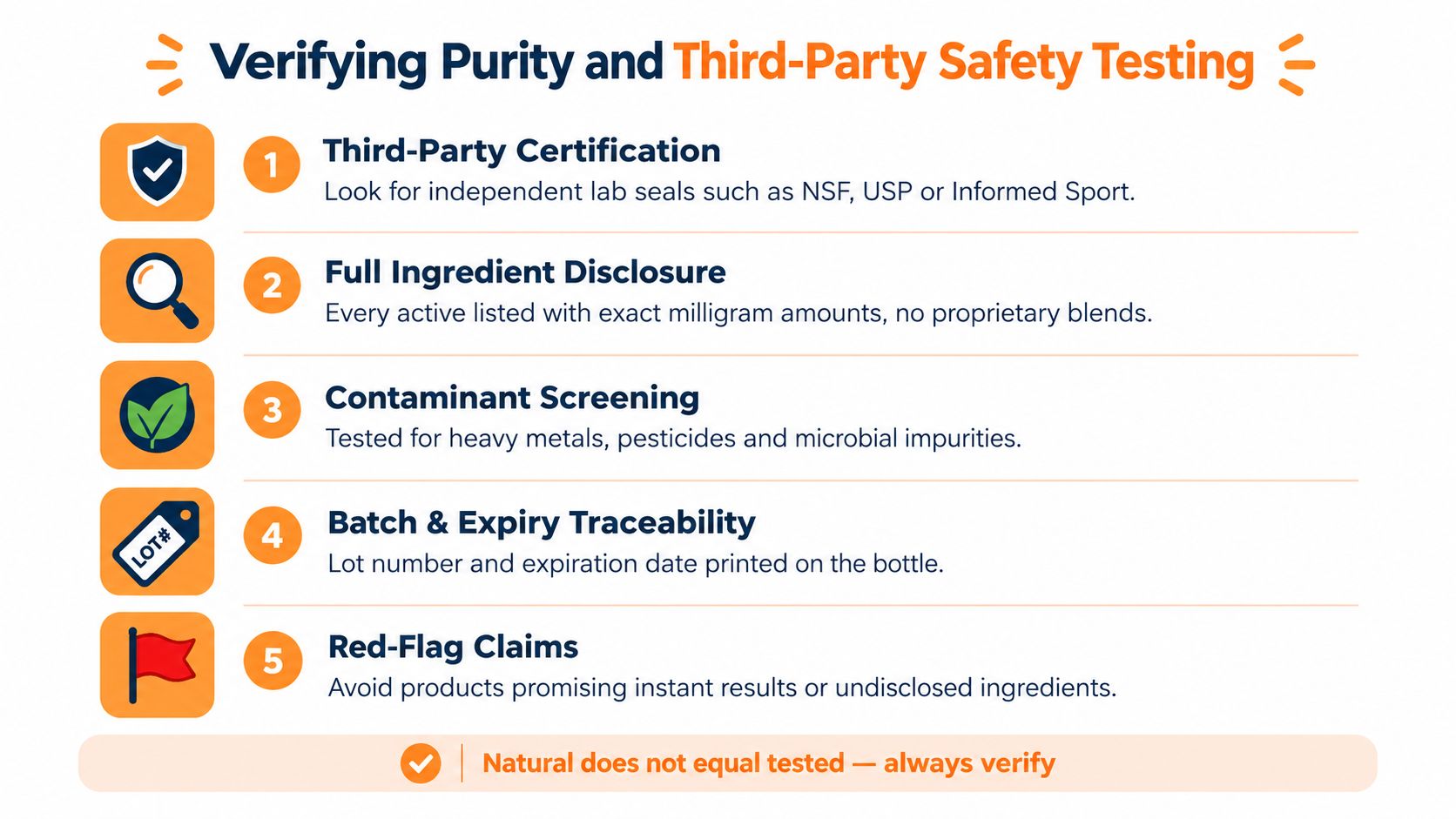
The label should show the exact botanical names and serving sizes, not just a long blend with no breakdown. Readers checking a vitality formula should also look for a third-party certification mark, a lot number, and an expiration date. Those details don't prove efficacy, but they do help establish accountability.
Safety rule: “natural” only describes origin, not purity.
The bigger issue in men's enhancement products is adulteration. FDA recall records show multiple sexual-enhancement products in 2025 were found to contain undeclared sildenafil, tadalafil, or related compounds, and independent survey data found hidden PDE5 inhibitors in 67% of sexual-enhancement products sampled from Sacramento retail locations, with 60% of positive products containing two or more PDE5 inhibitors (FDA recalls and health fraud page). Those findings make third-party adulterant screening more important than glossy “natural” branding.
A trustworthy botanical stack should answer three questions clearly.
- What was tested? Look for adulterants, heavy metals, and microbial impurities separately.
- Who tested it? Independent labs matter more than marketing language.
- What exactly is in each serving? Full disclosure beats a proprietary mix.
The strongest vitality formulas usually feel simpler after the label is unpacked. The buyer isn't really choosing between “strong” and “weak,” but between transparent formulas and opaque ones.
Verifying Purity and Third-Party Safety Testing
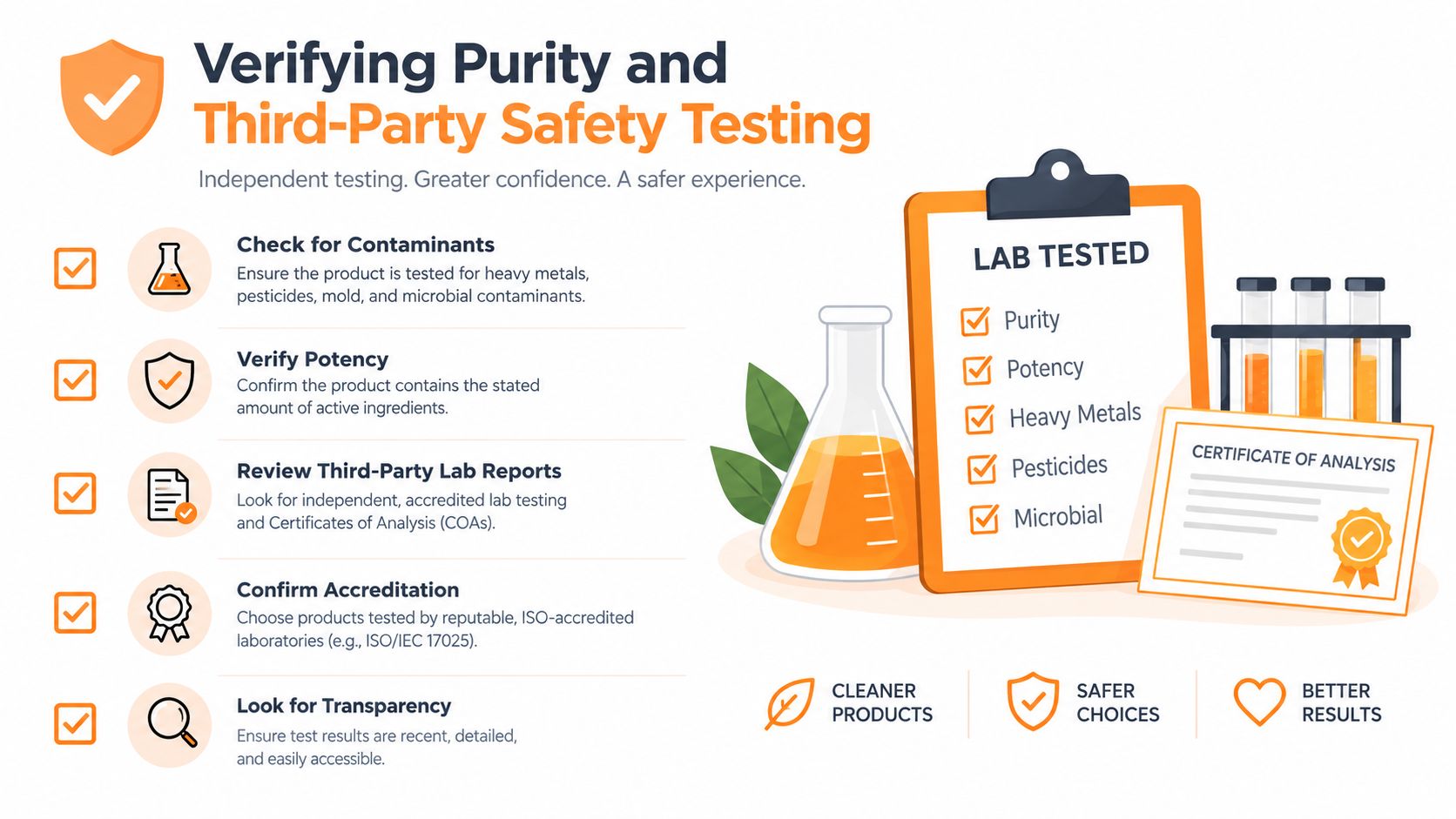
The cleanest-looking bottle is not automatically the safest one. cGMP manufacturing matters, but it is not the same as batch-level third-party testing for label accuracy and adulterants. Buyers need both, because manufacturing standards and finished-product verification answer different questions.
What genuine verification should cover
The first check is obvious but often skipped. If a company says it tests for purity, the buyer should verify whether that means microbials, heavy metals, pesticides, or undeclared pharmaceutical ingredients. Those categories are not interchangeable, and a lab report that covers only one of them leaves gaps.
The second check is traceability. Batch numbers, lot codes, and expiry dates let the buyer match a bottle to a specific production run. That matters because quality is not just a brand trait, it's a lot-by-lot issue.
The third check is dose honesty. A formula with a long marketing story but vague serving sizes is harder to trust than a simpler formula with exact quantities. Transparency matters more than blend length.
If a brand won't say what was screened, the buyer should assume the screening was incomplete.
For a supplement comparison guide, the right question is not whether a formula sounds premium. It's whether the product can show that the bottle contains only the ingredients listed on the label at the stated amounts. That is the practical difference between confidence and guesswork. For another verification checklist, see third-party verification guidance.
A strong label also helps readers avoid overbuying. Long formulas can look impressive while still leaving the buyer unsure about actual ingredient amounts. Simpler formulas can be easier to audit, but only if the testing is current and the label is complete.
Matching Supplement Profiles to Specific Use Cases
The right formula depends on the goal, not the hype. Men focused on semen volume and taste usually need a narrower ingredient set with clear dosing, while men chasing libido, energy, and day-to-day vitality may prefer a broader blend that includes botanicals. Men looking at fertility-related support should be stricter still, because individual sperm parameters are not the same thing as conception outcomes.
A good decision rule is to match the formula to the dominant need. If the priority is sensory and bedroom novelty, a volume-and-taste formula makes more sense than a large all-purpose men's pack. If the priority is broader vitality, a botanical blend can be reasonable, but only if it keeps claims in the maintenance-and-support lane.
The strongest formulas don't try to be everything at once. They state the main target, disclose exact amounts, and avoid implying that one product can raise volume, taste, libido, fertility, and clinical reproductive outcomes in a single move. That is how buyers avoid paying for ingredients they don't need.
The more outcomes a product promises, the more closely the label should be audited.
The research pattern points to a simple conclusion. Ingredient-level evidence can justify support language, but it rarely justifies sweeping claims about finished-product performance. A buyer who defines the target first is less likely to be misled by broad enhancement language.
How SEMEX Aligns with Modern Wellness Criteria
SEMEX fits the structure of a support-oriented formula because it combines zinc, L-arginine, sunflower lecithin, and bromelain with a broader men's wellness blend that includes maca root, Panax ginseng, ashwagandha, Tongkat Ali, saw palmetto, and horny goat weed. That ingredient mix maps cleanly onto the distinction between volume-focused support and vitality-focused support, as long as it is read as structure/function language rather than as a fertility promise.
The product's positioning also gives the buyer a straightforward evaluation checklist. It is described as vegan, non-GMO, made in the USA in a cGMP-registered facility, and third-party tested by Eurofins for microbials, heavy metals, and adulterants. Those details matter more than vague wellness slogans because they let the reader assess purity, label discipline, and lot-level quality.
How to think about a daily routine
Daily supplements rarely feel dramatic on day one. A better way to judge them is to watch for gradual changes in subjective volume, taste, and vitality across a consistent routine, then compare those impressions against the label rather than against exaggerated promises. That is the right place to be realistic, because the evidence discussed above supports ingredient-level signals, not guaranteed outcomes.
The most practical use case is simple. A man who wants a daily formula for semen-volume support and wellness support should prioritize exact dosing, transparent testing, and a label that doesn't overclaim. A formula that gives those three things is easier to trust than a louder product with a bigger marketing story.
Dosing Expectations and Final Recommendations
Daily use matters more than novelty use for a formula like this. The common routine is three capsules daily, and the practical comparison window is about 30 days of consistent use, not a single isolated trial at the end of the week. That timeline fits the way support supplements are normally judged, by gradual changes in routine rather than instant transformation.
What to watch for is specific and modest. Volume changes, taste changes, and general vitality are subjective signals, so they should be tracked consistently and compared with label transparency, not with sweeping enhancement claims. If the product does not disclose ingredient amounts, the buyer cannot connect experience back to composition.
A strong male supplement checklist is straightforward.
- Exact ingredient amounts: No proprietary blend hiding the dose.
- Third-party testing: Look for screening that covers adulterants, heavy metals, and microbials.
- Goal match: Volume support, taste support, or broader vitality support, not all three inflated into one promise.
- Safety discipline: Treat zinc as a nutrient with a real upper limit, not as a “more is better” ingredient.
The best recommendation is the one that keeps expectations honest. A good formula can support normal male wellness, but it should never be read as a guarantee of fertility, conception, or any medical outcome. The final test is still the same, clear labeling, credible testing, and a claim set that stays inside the evidence.
These statements have not been evaluated by the Food and Drug Administration. This product is not intended to diagnose, treat, cure, or prevent any disease.
If a man wants a daily supplement built around semen-volume support, taste support, and straightforward label transparency, SEMEX is the product to review first. Its ingredient structure and testing disclosures make it relevant to this topic without asking the reader to accept inflated claims. Visit SEMEX to inspect the formula and decide whether it matches the priorities outlined here.