

Best Male Sexual Health Supplements: What to Look For
The most popular advice about male sexual health supplements is also the least useful: choose the formula with the longest ingredient list. More ingredients don't automatically create a better product. A crowded label can conceal underdosed compounds, weak evidence, and manufacturing gaps, while a shorter formula may make its mechanisms and testing easier to verify.
The strongest buying framework asks four questions instead: What does each ingredient do? What human evidence supports it? Is the dose disclosed? Can the manufacturer demonstrate quality and purity? That framework shifts attention away from branding and toward the features that determine whether a supplement deserves consideration.
| Evaluation factor | What a buyer should look for | Why it matters |
|---|---|---|
| Mechanism | A defined role in reproductive, vascular, or general wellness support | A plausible mechanism gives the ingredient a rational purpose |
| Human evidence | Controlled trials, reviews, or meta-analyses involving people | Laboratory theory alone doesn't establish a practical outcome |
| Label transparency | Exact amounts for every active ingredient | Proprietary blends make underdosing difficult to detect |
| Manufacturing | cGMP production and independent testing | Ingredient quality depends on identity, purity, and consistency |
| Claim language | Support and maintenance language rather than disease promises | Structure/function claims aren't the same as medical treatment claims |
Table of Contents
- The Evidence Gap in Men's Wellness Marketing
- Foundational Ingredients for Volume and Blood Flow
- The Role of Adaptogens and Botanical Extracts
- Comparing Targeted Formulas Versus Broad Blends
- Auditing Quality and Third-Party Testing Standards
- Setting Realistic Timelines for Daily Supplementation
- Final Buyer Criteria and Safety Reminders
The Evidence Gap in Men's Wellness Marketing
A long ingredient list creates an impression of sophistication, but it doesn't answer the central question: which compounds have meaningful human evidence, and which are present mainly for marketing? Harvard Health notes that most supplements promoted for sexual function haven't been scientifically studied, with only a few exceptions, while the National Center for Complementary and Integrative Health states that no complementary approach has been shown to be safe and effective for sexual enhancement or erectile dysfunction. These conclusions don't mean every ingredient is useless. They mean that buyers need to separate limited promise from established evidence.
Why ingredient quantity misleads
A formula may contain nutrients, amino acids, adaptogens, and botanical extracts, yet still provide too little of each compound to resemble the amounts examined in human research. A proprietary blend makes that problem harder to identify because the label may disclose a combined total without showing the amount assigned to individual ingredients.
The more defensible approach is to evaluate each active independently:
- Mechanism: Does the compound have a credible role in blood flow, reproductive function, or general vitality?
- Human data: Have researchers studied it in people, rather than only in cells or animals?
- Outcome quality: Did the research measure a meaningful endpoint, or only a surrogate marker?
- Evidence limits: Were the studies small, inconsistent, or dependent on a particular population?
- Dose clarity: Does the label show the amount of the compound in the serving?
A product shouldn't be judged by how many ingredients it names. It should be judged by whether every ingredient has a clear purpose and whether the label allows that purpose to be assessed.
Practical rule: A transparent formula with modest, clearly explained claims is more informative than a proprietary blend promising universal sexual enhancement.
Marketing claims versus verifiable quality
The evidence problem becomes more serious when marketing turns nutrient repletion into a promise of dramatic enhancement. Zinc illustrates the distinction. Its relevance comes from a documented connection to normal male reproductive function, not from proof that adding more zinc produces unlimited improvements in sexual performance. A large randomized trial involving 2,370 couples found no improvement in live birth, sperm count, or sperm function from zinc plus folic acid compared with placebo, with live births of 34% versus 35% respectively, according to NIH and NICHD trial reporting.
That result doesn't erase zinc's biological importance. It shows why a supplement can support normal physiology without serving as a blanket fertility solution. A buyer should therefore reward precision, not confidence. The best male sexual health supplements, considered analytically rather than commercially, are those that connect ingredients to reasonable structure/function outcomes and disclose enough information for independent scrutiny.
Foundational Ingredients for Volume and Blood Flow
Two ingredients stand out because they address different biological questions. Zinc supports reproductive function and nutrient sufficiency, while L-arginine supports the nitric oxide pathway involved in vascular tone and blood flow. They shouldn't be treated as interchangeable, and neither should be framed as a universal answer to every sexual health concern.
| Ingredient | Primary mechanism | Evidence strength | Realistic outcome |
|---|---|---|---|
| Zinc | Supports normal reproductive function and participates in processes related to spermatogenesis and androgen status | Human reviews, controlled depletion research, and meta-analytic evidence | Helps maintain baseline reproductive parameters, especially when intake is inadequate |
| L-arginine | Precursor to nitric oxide, which helps regulate blood vessel dilation and blood flow | Human trials and reviews, though evidence remains limited and mixed | Provides vascular support that may contribute to erectile function in some contexts |
Zinc and reproductive baseline
Zinc is one of the most established ingredients in men's reproductive nutrition because it plays a direct role in male reproductive function. A 2021 review in PMC describes zinc as essential for normal fertilization and links low dietary zinc concentration with low sperm quality and idiopathic male infertility. The same review reports that reducing zinc to less than 5 to 7 ppm impaired reproductive function in cited studies involving males and females.
The practical interpretation is narrower than a typical advertisement. Zinc makes the most sense as a nutrient that helps maintain normal reproductive physiology, particularly where dietary status is poor. A meta-analysis found significant increases in semen volume, sperm motility, and the percentage of normal sperm morphology with zinc supplementation, with standardized mean differences of -0.99, -1.82, and -0.75, respectively, as reported in the referenced PMC analysis.
That evidence still doesn't justify unlimited dosing or fertility promises. In a controlled depletion study, reducing zinc intake from 10.4 mg per day to 1.4 mg per day lowered semen volume from 3.30 mL to 2.24 mL and reduced serum testosterone. The result supports a key distinction: correcting inadequate intake can affect measurable reproductive parameters, but that isn't the same as creating dramatic enhancement in men who already have adequate zinc status.
L-arginine and vascular support
L-arginine has a different role. It is a substrate for nitric oxide synthesis, and nitric oxide helps dilate blood vessels and facilitate blood flow. A 2025 review describes this pathway and summarizes human research, including a placebo-controlled trial in 50 men with erectile dysfunction. In that trial, 9 of 29 men taking 5 g per day of oral L-arginine for 2 weeks reported subjective improvement, compared with 2 of 17 receiving placebo.
Later evidence remains encouraging but doesn't justify certainty. A review of randomized research reports improvements in validated erectile function outcomes, including IIEF-6 and peak systolic velocity, with 6 g per day over a 3-month trial. A meta-analysis of 10 randomized trials involving 540 patients found significant improvements across several IIEF subdomains, a low adverse-event rate of 8.3%, and no serious side effects in the analyzed studies.
L-arginine therefore belongs in the category of promising vascular support, not guaranteed performance enhancement. Buyers evaluating nitric oxide ingredients can consult this explanation of nitric oxide and blood flow, then compare the disclosed amount with the evidence rather than treating label inclusion as proof of effectiveness.
The Role of Adaptogens and Botanical Extracts
Botanical ingredients often occupy the space between physical support and broader wellness. Maca root, Panax ginseng, ashwagandha, Tongkat Ali, and horny goat weed appear in many men's formulas because buyers associate them with energy, libido, stress resilience, or vitality. Those associations can make a formula feel comprehensive, but traditional use and marketing familiarity don't establish the same level of evidence as a controlled human trial.

A secondary tier of evidence
Adaptogens and botanical extracts should be assessed as a secondary layer, not as replacements for foundational ingredients with clearer reproductive or vascular mechanisms. Their potential value lies in addressing the wider context of sexual wellness, where energy, stress, confidence, and desire can influence a person's experience. The evidence for individual botanicals is uneven, and extract quality varies according to plant part, preparation method, standardization, and dose.
A buyer should ask whether a label identifies the botanical species and extract details. “Ginseng” alone tells less than a label that identifies the plant material and standardization. The same applies to ashwagandha, Tongkat Ali, maca, and horny goat weed. Without that information, two products carrying the same ingredient name may not be meaningfully comparable.
Why combinations need restraint
A broad formula can be rational when every ingredient has a defined role. Zinc may address reproductive nutrient support, L-arginine may address nitric oxide availability, and botanicals may contribute to a wider vitality strategy. But adding more extracts also increases the need for interaction review and makes it harder to identify which compound is responsible for an unwanted response.
The adaptogenic supplement perspective is most useful when it encourages buyers to ask better questions, not when it turns a collection of herbs into a single promise. A careful formula explains what each botanical is intended to support, discloses its amount, and avoids presenting traditional use as conclusive clinical evidence.
A botanical can be relevant without being proven, and a plausible mechanism can be useful without becoming a treatment claim.
Comparing Targeted Formulas Versus Broad Blends
Targeted formulas and broad blends solve different purchasing problems. A targeted product is easier to evaluate because it concentrates attention on one mechanism, such as nutrient repletion or nitric oxide support. A broad blend may appeal to a buyer who wants a daily wellness routine spanning reproductive nutrition, vascular support, and botanical vitality.
Neither format is automatically superior. The right choice depends on whether the buyer values diagnostic clarity or broader coverage.
Targeted formulas
A targeted formula can make sense when a buyer has a specific nutritional or physiological objective and wants to observe one intervention at a time. Zinc-focused supplementation, for example, offers a relatively clear rationale when dietary intake may be inadequate. An L-arginine-focused product makes a different argument, centered on nitric oxide production and blood flow.
The advantage is interpretability. If a buyer changes one variable, it becomes easier to track tolerance and perceived effects. The limitation is that sexual wellness involves more than one pathway, so a narrow formula may not match a buyer seeking general vitality.
Broad blends
A broad blend combines ingredients that operate in distinct categories. It may include zinc and L-arginine alongside botanicals, phospholipids, or digestive-support compounds. This approach can be convenient for a daily routine, but convenience shouldn't excuse hidden dosing.
A buyer considering a broad blend should look for:
- Exact amounts: Every active ingredient should have a listed dose.
- No proprietary hiding place: Combined totals shouldn't replace ingredient-level disclosure.
- A coherent rationale: Each compound should fit a defined support goal.
- Testing evidence: The manufacturer should explain how identity, purity, and contaminants are assessed.
- A manageable routine: The serving instructions should be practical enough to follow consistently.
The decision that matters most
The important comparison isn't targeted versus broad in the abstract. It's transparent versus opaque. A narrow formula with unclear sourcing remains difficult to trust, while a broad formula with explicit doses and independent testing can be evaluated ingredient by ingredient.
A practical buyer can begin with one priority, such as reproductive nutrient support or vascular support, then decide whether a wider blend adds useful coverage. This approach avoids the common mistake of treating a long label as evidence that every pathway receives a meaningful dose.
Auditing Quality and Third-Party Testing Standards
A scientifically interesting ingredient profile is of little value if the finished product contains contaminants, inconsistent amounts, or undeclared compounds. Quality assessment therefore belongs beside evidence assessment, not after it. The front label describes intention. Testing and manufacturing records provide evidence about what is in the capsule.
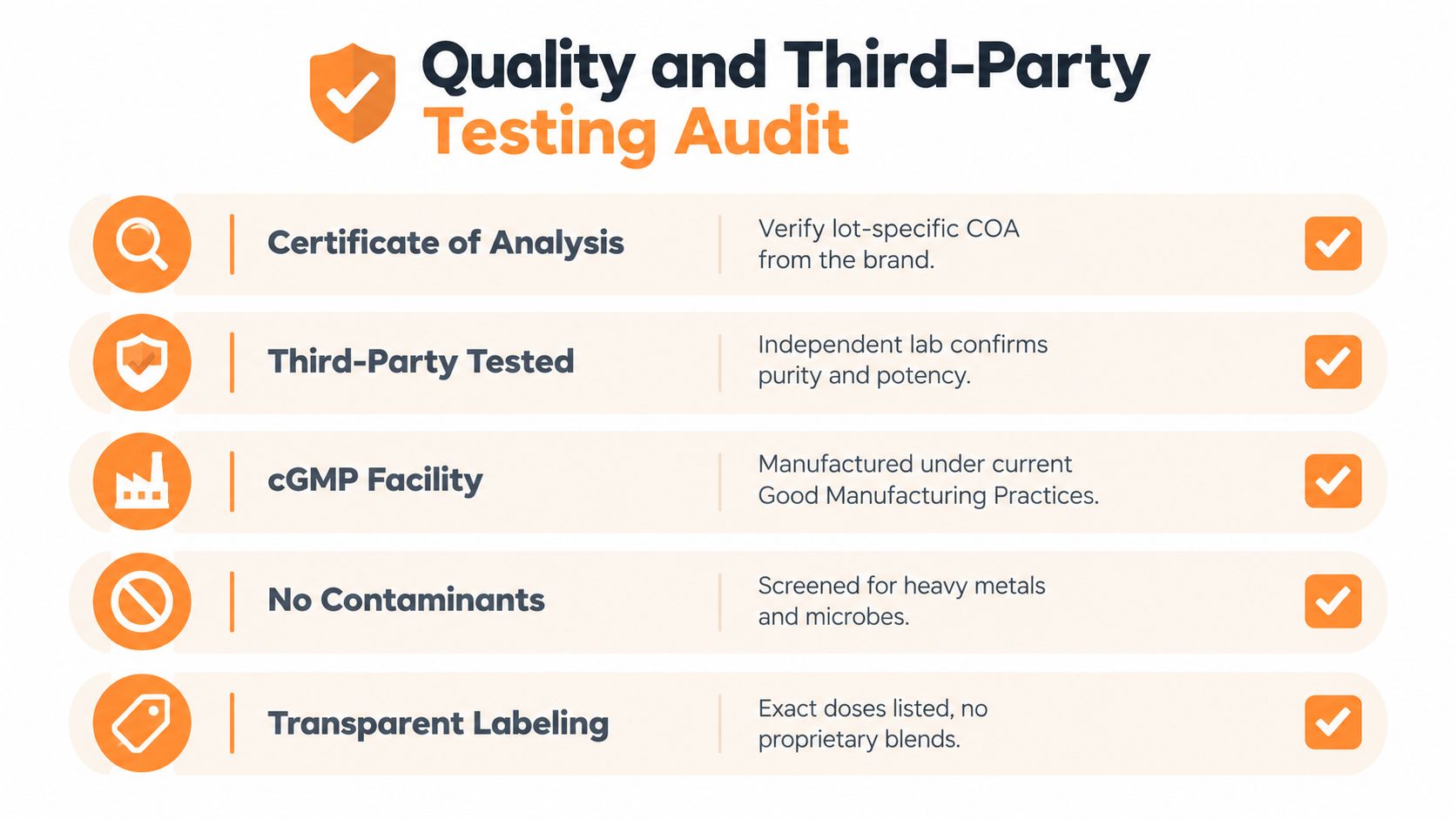
A five-part label audit
First, inspect the Certificate of Analysis. A credible brand should be able to provide a lot-specific COA, not merely a generic statement that products are tested. The document should identify the batch and show results for relevant purity and potency measures.
Second, identify the testing laboratory. Independent testing can provide additional assurance when the laboratory evaluates the finished product rather than only a raw material. The buyer should look for information about the lab's role, test scope, and acceptance thresholds.
Third, verify the manufacturing environment. Current Good Manufacturing Practices, commonly abbreviated as cGMP, address how dietary supplements are produced and controlled. A cGMP-registered facility is a useful quality signal, although facility status doesn't replace product-specific testing.
Fourth, check contaminant screening. Heavy metals, microbes, and adulterants represent different quality risks. A serious quality program explains which tests are performed and what limits apply instead of using “quality tested” as an unsupported slogan.
Finally, read the entire label. Exact doses, serving size, allergens, source materials, and certifications should be visible. Vegan and non-GMO claims may matter to a buyer's preferences, but they don't by themselves establish potency or purity.
The third-party tested supplement brands checklist can help organize this review, but the principle remains simple: a certification logo is less informative than accessible documentation.
Quality standard: A trustworthy label tells buyers what is present, how much is present, and how the manufacturer checked it.
Red flags that deserve caution
Proprietary blends deserve scrutiny because they prevent dose-level comparison. Aggressive claims about instant sexual enhancement also deserve caution, particularly when they avoid discussing study limits or manufacturing controls. A brand that emphasizes lifestyle imagery while withholding COAs, laboratory details, or exact ingredient amounts gives buyers less evidence to evaluate.
The strongest manufacturing story is specific. It identifies the facility standard, testing scope, laboratory relationship, and reporting thresholds. That specificity doesn't prove a supplement will produce a particular personal outcome, but it makes the product more accountable and the purchasing decision more rational.
Setting Realistic Timelines for Daily Supplementation
A daily supplement shouldn't be judged by the standard applied to an acute pharmaceutical intervention. Nutrient support depends on intake, absorption, baseline status, and consistent use. Botanical ingredients also require a stable routine if a buyer wants to assess tolerance and perceived changes without confusing the result with irregular use.
The publisher information for SEMEX describes a routine of 3 capsules daily and gradual benefit building over approximately 30 days. That product-specific schedule shouldn't be generalized to every supplement. Each formula has its own serving instructions, ingredient amounts, and evidence base.
A practical tracking method
A buyer can create a simple baseline before starting a new formula. The record might include perceived energy, libido, erection quality, semen volume, and any digestive or other unwanted effects. The goal isn't to manufacture precision. It's to reduce memory bias and distinguish a consistent pattern from a single unusually good or bad day.
A useful routine includes:
- Record the starting point: Note the main goal and current supplement use.
- Follow the stated serving: Don't increase the dose because an immediate effect doesn't appear.
- Take the product consistently: If the label recommends food, use that instruction.
- Change one major variable at a time: Multiple new products make results impossible to interpret.
- Review tolerance: Stop and seek professional guidance if concerning symptoms appear.
Why patience improves interpretation
A gradual timeline prevents two opposite errors. Some buyers abandon a product before its intended nutritional role can be assessed, while others continue indefinitely despite no meaningful benefit because marketing promised eventual transformation. A defined review point creates a better decision rule: continue only when the product is tolerated, the label is credible, and the buyer observes a worthwhile change that fits the product's stated support role.
Tracking rule: Consistency doesn't guarantee an outcome, but inconsistency makes the outcome harder to interpret.
No supplement should delay medical evaluation for persistent sexual difficulties, major changes in libido, or concerns about reproductive health. Symptoms can have causes that require diagnosis rather than self-directed supplementation, and a clinician can review medications, medical history, and potential interactions.
Final Buyer Criteria and Safety Reminders
The most defensible buying decision combines mechanism, evidence, transparency, and safety. Zinc has a documented role in normal male reproductive function, but controlled fertility research shows that zinc supplementation isn't a universal solution. L-arginine has a credible nitric oxide mechanism and human trial support, but its evidence remains context-dependent. Botanical extracts may complement a broader wellness formula, yet their presence doesn't remove the need for dose and quality scrutiny.

The buyer's final checklist
- Start with the mechanism: Determine whether the formula supports reproductive nutrition, blood flow, broader vitality, or several clearly defined goals.
- Prioritize human evidence: Give more weight to controlled human research and systematic reviews than to tradition, testimonials, or laboratory speculation.
- Demand exact doses: Reject labels that hide meaningful ingredients inside proprietary blends.
- Audit the manufacturer: Look for cGMP production, lot-specific COAs, independent laboratory testing, and screening for heavy metals, microbes, and adulterants.
- Match claims to evidence: “Supports” and “helps maintain” are appropriate structure/function concepts. Disease treatment promises are not.
- Review personal safety: A healthcare professional should assess a new regimen when a buyer has a medical condition, takes prescription medication, or plans to combine multiple supplements.
FDA labeling rules require a prominently displayed disclaimer for dietary supplement structure/function claims. The FDA dietary supplement labeling guide explains that the disclaimer must appear adjacent to the claim or elsewhere on the same panel or page under the applicable display requirements.
The final choice should feel less like selecting a flashy promise and more like reviewing a research-informed product file. A transparent formula cannot guarantee a personal result, but it gives a buyer a clearer basis for deciding whether the ingredients, doses, manufacturing standards, and intended use are reasonable.
SEMEX offers a daily men's supplement formulated to support semen volume and taste, combining zinc and L-arginine with sunflower lecithin, bromelain, and a broader men's wellness blend. Men comparing formulas can review SEMEX for its vegan, non-GMO, cGMP-registered USA manufacturing and Eurofins third-party testing information.
These statements have not been evaluated by the Food and Drug Administration. This product is not intended to diagnose, treat, cure, or prevent any disease.