

Ashwagandha vs Maca: Which Herb Fits Your Goals
The popular advice says to pick a winner in the ashwagandha vs maca debate, or take both because they're supposedly a perfect stack. Neither conclusion follows from the evidence. These herbs have different traditional roots and different research profiles, so the useful question is which outcome you want to support, not which ingredient wins a general-purpose contest.
Ashwagandha has comparatively stronger evidence for stress-related outcomes and some hormone-related biomarkers. Maca's human research is narrower, with its clearest signal around sexual desire. Neither has strong evidence for increasing semen volume specifically, and libido, testosterone, sperm measures, and semen volume aren't interchangeable outcomes.
| Goal | Ashwagandha | Maca |
|---|---|---|
| Stress-related outcomes | More studied; results vary by measure and extract | Limited evidence |
| Testosterone-related biomarkers | Some trial findings, not a treatment for low testosterone | Trials haven't consistently shown changes |
| Sexual desire | May be relevant when stress is part of the picture | More directly studied for desire |
| Sperm parameters | Evidence is limited | Evidence is insufficient to promise changes |
| Semen volume | No strong evidence for a specific increase | No strong evidence for a specific increase |
Table of Contents
- Why the Ashwagandha vs Maca Question Is the Wrong Question
- Origins, Mechanisms, and Active Compounds
- Evidence for Stress, Testosterone, Libido, and Sperm
- How the Two Herbs Actually Differ
- Dosing, Timing, and What to Look for on a Label
- Safety, Interactions, and Quality Signals
- Which Herb Fits Which Goal
- Can You Combine Them, and What to Expect Over Time
Why the Ashwagandha vs Maca Question Is the Wrong Question
Comparisons often put both herbs on one “male vitality” scoreboard, as if they compete to deliver the same result. That framing encourages broad promises and makes it easy to confuse a change in stress, a change in desire, and a change in reproductive measures. They're separate outcomes, and a supplement that has evidence for one shouldn't be treated as proven for the others.
The practical distinction is clearer: ashwagandha is the more relevant starting point for stress-related goals, while maca is the more relevant starting point for sexual desire. That doesn't mean either one will work for every man, or that one ingredient replaces the other. The studies vary in extract, dose, duration, and participant characteristics, so the product you choose matters as much as the plant name on the label. A clinical overview of ashwagandha research discusses that variability alongside the stress and hormone-related evidence.
Semen volume deserves its own line on the scoreboard. Men may search for either herb because they're interested in sexual confidence or reproductive health, but evidence about libido or hormone biomarkers doesn't establish an increase in semen volume. Sperm count, sperm quality, fertility outcomes, and the amount of ejaculate are distinct measures. Neither herb has strong evidence for increasing semen volume specifically.
Choose the outcome first. If stress is your main concern, assess ashwagandha on that basis. If desire is the main concern, maca is the more targeted candidate. If semen volume is the goal, don't assume either herb has demonstrated that result.
That's why “which is better?” isn't a useful final question. Ask what you want to change, whether the evidence measures that exact outcome, and whether you're comfortable with the limits of the research. That approach leads to a more honest decision than choosing whichever product makes the broadest claim.
Origins, Mechanisms, and Active Compounds
The two plants come from different traditions. Ashwagandha, or Withania somnifera, has been used in Ayurvedic medicine for more than 3,000 years and is traditionally classified as a rasayana, or rejuvenating tonic, associated with strength, vitality, resilience to stress, and sexual wellness. Historical descriptions connect it with strength, nourishment, libido, and reproductive support. Maca, or Lepidium meyenii, is native to the Peruvian Andes and was traditionally eaten as a nutrient-dense food as well as associated with fertility and vitality. That contrast reflects distinct cultural roles, not proof that every traditional use works by modern clinical standards. The National Center for Complementary and Integrative Health's ashwagandha overview provides context on the herb and the limits of available evidence.
Ashwagandha contains withanolides, plant compounds commonly used to characterize extracts. Researchers have proposed that it may affect the body's stress-response system, including the hypothalamic-pituitary-adrenal, or HPA, axis, and cortisol regulation. GABAergic signaling, which involves pathways associated with calming activity in the nervous system, is also discussed as a possible mechanism. These proposed actions help explain why researchers study ashwagandha in relation to stress, but they don't prove that a particular product will produce a specific result.
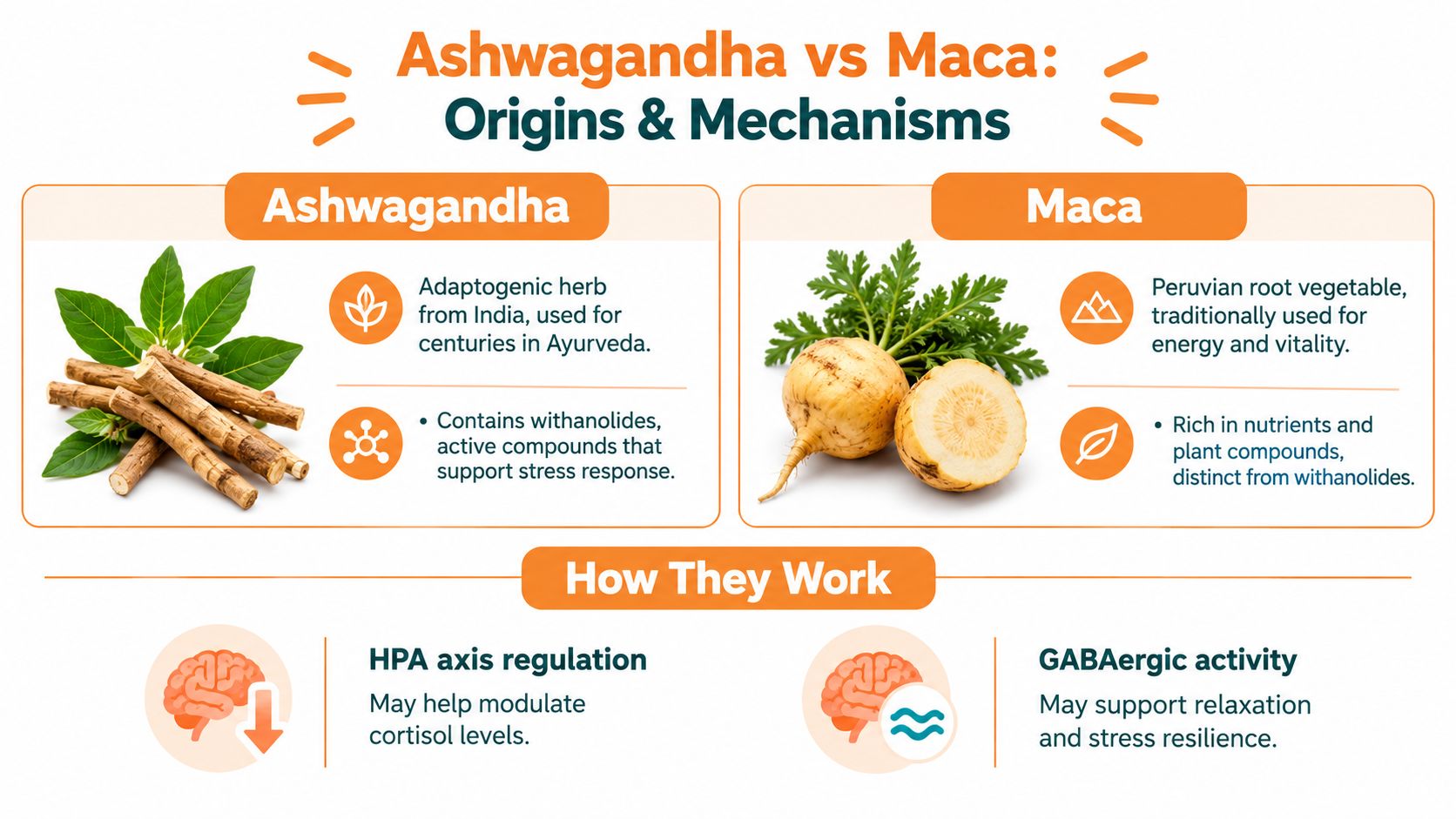
Maca contains macamides, macaenes, and glucosinolates, among other plant compounds. Its mechanism is less clearly defined. The human evidence doesn't support describing maca as a straightforward testosterone booster, and a libido-related effect may occur without a clear change in reproductive hormones. That makes a simple “hormone balancing” explanation too confident for the current evidence.
Why the label matters
A capsule labeled “ashwagandha” could contain root powder or an extract, and the composition may differ depending on the plant part and standardization. The same issue applies to maca, where preparation and extract type affect what the serving contains. The plant name alone doesn't tell you whether the product matches the form used in a study.
That's the main practical lesson from comparing their foundations: ashwagandha's history and modern research are more connected to stress and hormone-related questions, while maca's traditional food role and clinical research point more toward desire. Neither traditional history nor a proposed mechanism is a substitute for an outcome-specific clinical finding.
Evidence for Stress, Testosterone, Libido, and Sperm
The evidence isn't equally strong for every outcome. Ashwagandha has more quantitative findings for stress-related measures and hormone biomarkers, but a measured change in a biomarker doesn't guarantee that a person will notice a benefit. Maca's most relevant human signal is sexual desire, while claims about testosterone, sperm, and semen volume need greater restraint.
Stress and hormone-related measures
In a 12-week randomized, double-blind, placebo-controlled trial, men taking a standardized ashwagandha root extract had significant increases in free testosterone and luteinizing hormone. Their perceived stress scores fell 38.59% from baseline. That is a particular trial result, not a promise that another extract or another person will have the same response.
A separate 60-day trial using 240 mg per day found significant improvement on the Hamilton Anxiety Rating Scale, but the testosterone increase wasn't statistically significant compared with placebo. Reviews also describe standardized extracts in the approximate range of 250–500 mg per day for 4–13 weeks as reducing morning cortisol in adults experiencing high stress. A 2025 systematic review and meta-analysis found a significant reduction in cortisol, without establishing a corresponding improvement in perceived stress. In other words, a lab marker and a noticeable change in daily life aren't the same thing.
Desire, sperm, and semen volume
A systematic review identified only four qualifying randomized trials of maca for sexual function and judged the evidence limited because the studies were small and methodologically constrained. In one 12-week trial involving healthy men, 500 mg of gelatinized maca tablets was associated with increased sexual desire independent of changes in mood, serum testosterone, or estradiol. Another included trial found no benefit among healthy cyclists. Those results make maca a reasonable candidate to consider for desire, not a reliable fix for sexual concerns.
Neither those findings nor the stress and hormone studies establish a semen-volume benefit. The available evidence doesn't establish that maca increases semen volume, sperm count, or fertility outcomes. Maca also hasn't consistently changed testosterone, estradiol, or other reproductive hormones. For a broader discussion of ingredient-level evidence and men's health, see this guide to ashwagandha for men.
| Outcome | Ashwagandha evidence | Maca evidence | Best-documented dose |
|---|---|---|---|
| Stress measures | More studied, but subjective and biomarker results can differ | Limited evidence | Ashwagandha trials include 240 mg/day for 60 days and standardized extracts |
| Testosterone-related biomarkers | Some positive findings, with results varying by trial | No consistent change established | Trial-specific; not a treatment protocol |
| Sexual desire | Less directly focused on desire | Narrower evidence includes a positive trial | 500 mg/day gelatinized maca tablets in one 12-week trial |
| Sperm parameters | Limited evidence | Evidence doesn't establish a reliable benefit | No dose can be recommended for this outcome |
| Semen volume | No strong evidence of a specific increase | No strong evidence of a specific increase | No supported dose |
Use these results to match an ingredient to a goal, not to make a diagnosis. Persistent changes in libido, sexual function, or reproductive health deserve a conversation with a healthcare professional, especially when they're new or affecting your well-being.
How the Two Herbs Actually Differ
A quick side-by-side makes the distinction easier to use. The point isn't to declare a universal winner, but to see which ingredient's evidence is closer to your specific goal.
| Comparison point | Ashwagandha | Maca | What it means in practice |
|---|---|---|---|
| Traditional role | Ayurvedic medicinal herb associated with rejuvenation, strength, resilience, and sexual wellness | Andean food plant associated with vitality and fertility traditions | Their histories are different; neither history proves a modern clinical outcome |
| Most relevant evidence | Stress-related measures and some hormone-related biomarkers | Sexual desire and self-reported sexual function | Start with the outcome you care about, not a general “vitality” label |
| Proposed mechanism | Stress-response pathways, including HPA-axis and cortisol modulation; GABAergic activity is also proposed | Mechanism remains less clearly defined, and libido findings don't require a testosterone change | Don't assume both work as testosterone boosters |
| Evidence profile | Broader quantitative research, but results vary by extract and measure | Fewer trials and more variable findings | Treat maca claims more cautiously, particularly beyond desire |
| Semen volume | No strong evidence for a specific increase | No strong evidence for a specific increase | Neither is an evidence-backed semen-volume ingredient |
| Dosing context | Study results depend on extract, dose, and duration | Study results depend on preparation and dose | Compare the actual product with the form studied |
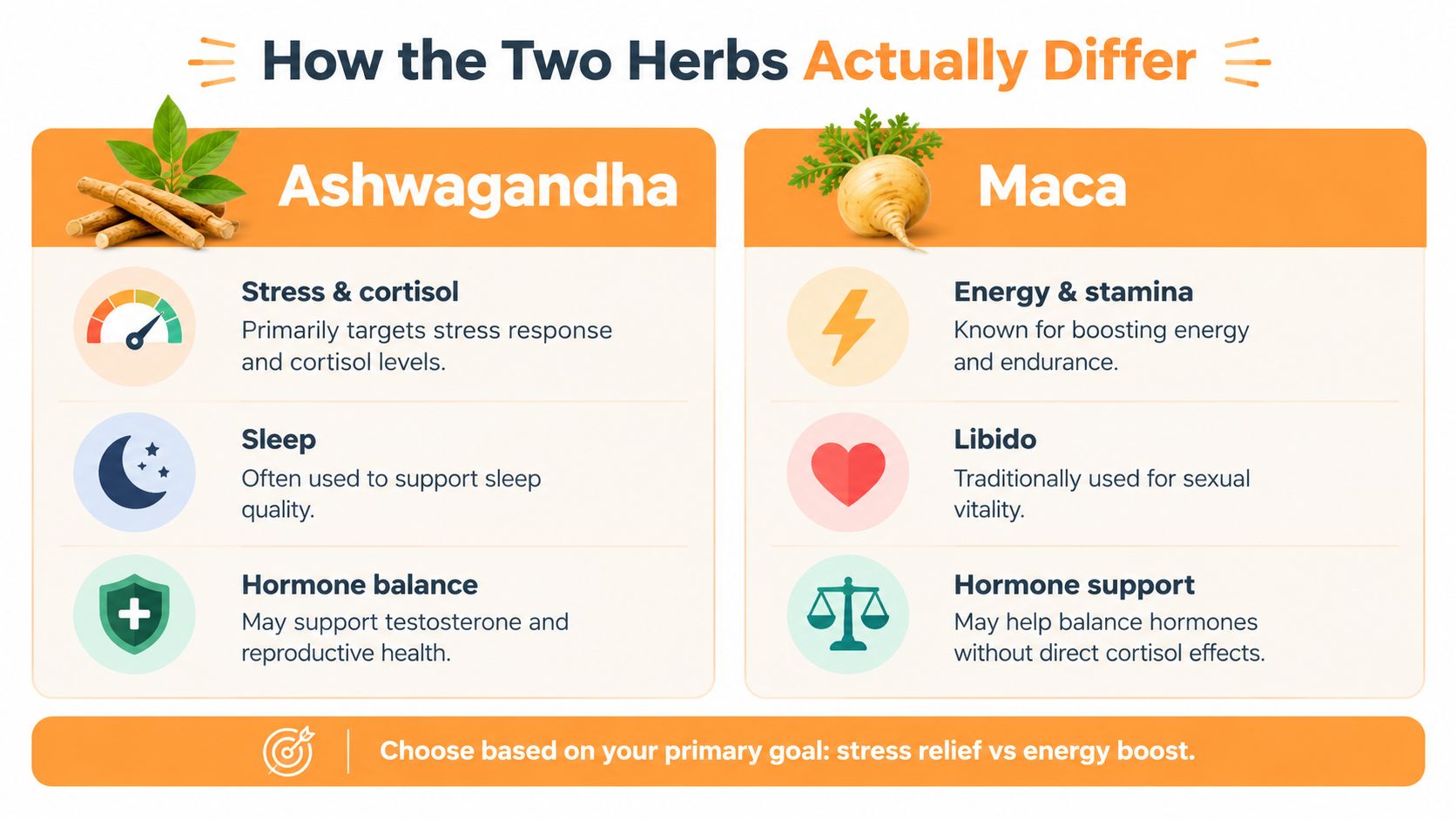
This table is a decision aid, not a substitute for reading the evidence. Ashwagandha has a more developed research profile for stress-related outcomes, but cortisol changes don't guarantee a change in how you feel. Maca has a more specific connection to desire in the human evidence, but its small and limited trial base doesn't justify promises about hormones or fertility.
Practical rule: If a product claims that either herb supports stress, libido, testosterone, sperm, and semen volume all at once, ask which study measured the exact outcome it advertises. One result doesn't validate the whole list.
The strongest takeaway is that the ingredients aren't interchangeable. For a closer look at maca's traditional use and the limits of its claims, consult this overview of maca root extract benefits. Use it as background, then check whether the product's formulation and stated goal match the evidence.
Dosing, Timing, and What to Look for on a Label
There isn't one universal protocol for either herb. Doses in studies depend on the extract, preparation, intended outcome, and study duration. The safest consumer approach is to use the research as context, follow the product label, and avoid assuming that a larger serving will work better.
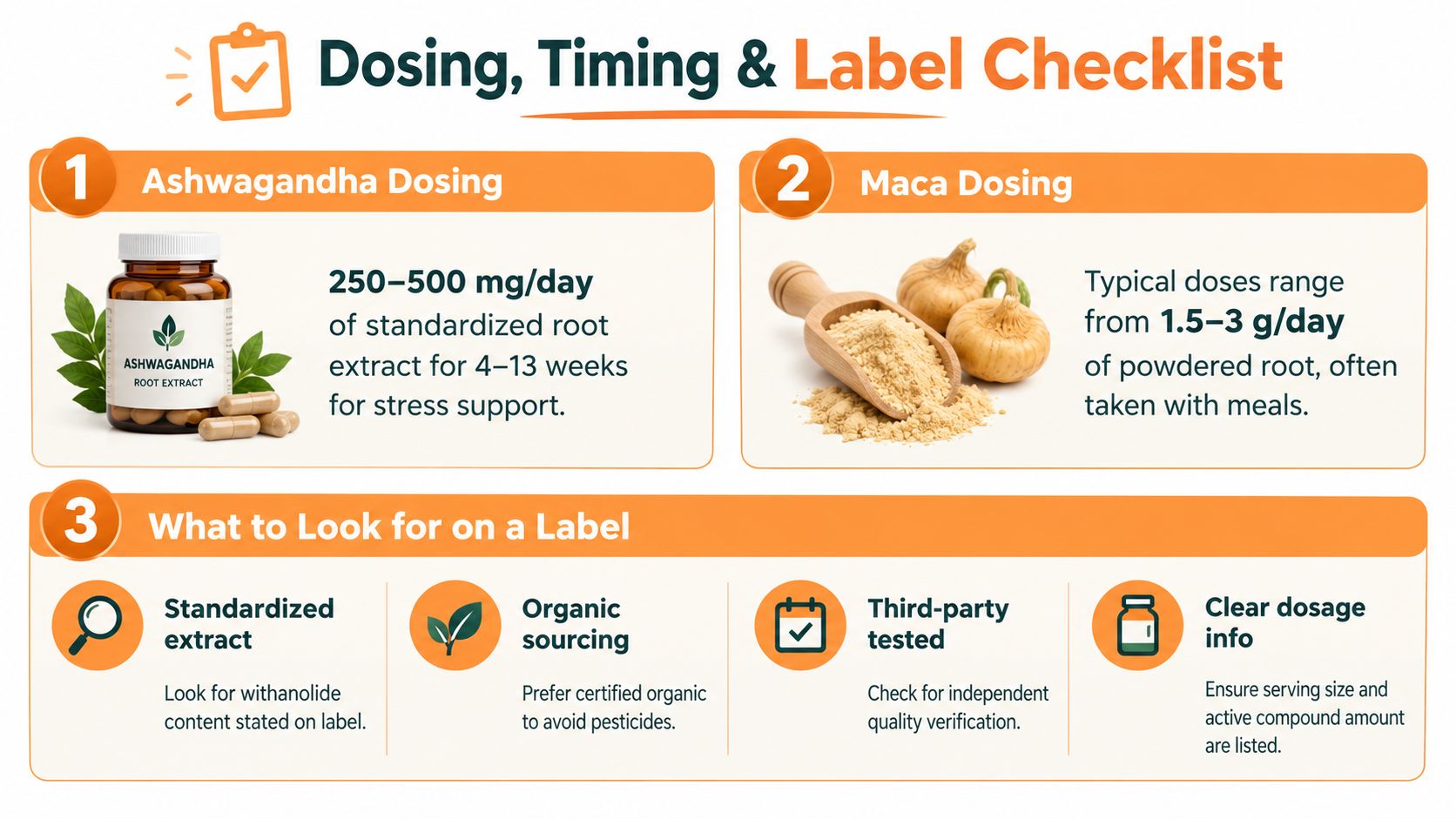
For stress-related outcomes, reviews discuss standardized ashwagandha extracts in the approximate range of 250–500 mg per day for 4–13 weeks. That range doesn't apply to every powder or extract, and it isn't a personal prescription. Maca's human evidence includes a 500 mg per day gelatinized-tablet trial focused on desire, while tolerability data includes a different preparation and dose. Those are not interchangeable formulations or recommendations for every product.
Read the ingredient panel, not just the front label
Check for the plant part, preparation, extract type, and serving size. If a label says “standardized,” it should make clear what compound is standardized and how much the serving provides. A proprietary blend that hides individual amounts makes it difficult to tell whether the formula resembles a studied product.
Timing can be practical rather than complicated. Take a supplement as directed on its label, and consider taking it with food if that suits the product instructions or your stomach. There's not enough evidence here to prescribe a specific morning-versus-evening schedule or a cycling routine for everyone.
| Label check | Why it matters |
|---|---|
| Named form and plant part | Helps distinguish root powder from an extract |
| Clear amount per serving | Lets you assess what you're actually taking |
| Standardization details | Shows whether active-compound content is specified |
| Independent quality information | Helps you assess identity, purity, and manufacturing transparency |
If you're comparing a multi-ingredient formula, make sure the label lists each ingredient's amount rather than hiding them in a blend. A detailed guide to reading supplement labels can help you spot missing dose information and vague claims. When the label doesn't tell you what's in the serving, you can't make a meaningful comparison with the research.
Safety, Interactions, and Quality Signals
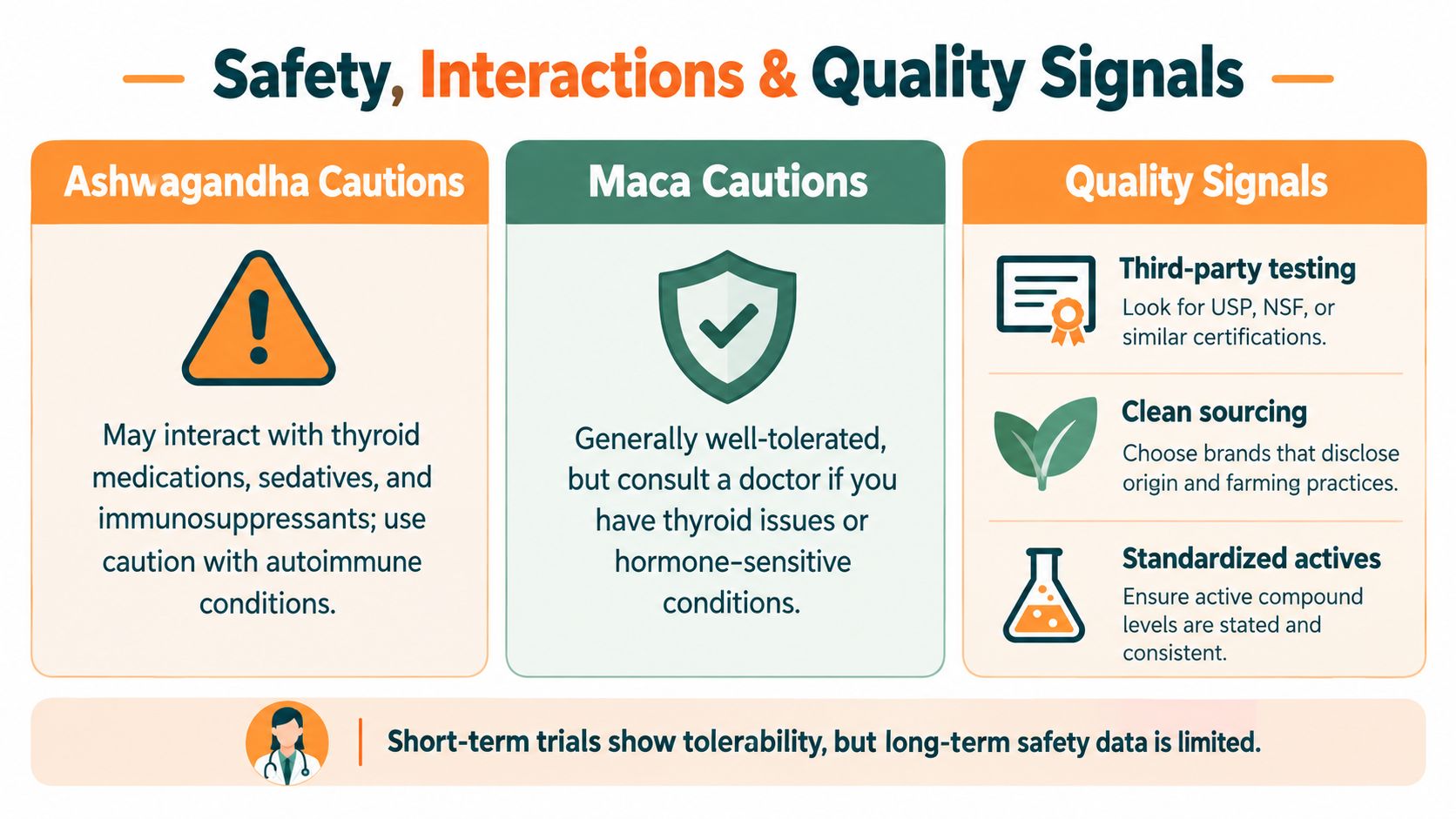
Short-term tolerability isn't proof of long-term safety. Maca was tolerated in a 175-person trial using 3 grams daily for 12 weeks, with no serious adverse effects reported. That's useful information about that trial period, but it can't answer questions about prolonged daily use, medication interactions, or variability in product quality.
Ashwagandha has a broader caution profile. Possible effects include drowsiness and gastrointestinal symptoms, and rare reports of liver injury have been noted. People with thyroid or autoimmune conditions, or those taking sedatives, blood-pressure medicines, blood-sugar medicines, immune-suppressing medicines, or thyroid medicines, should discuss use with a clinician before starting it. A clinician can account for your personal health history and medication list rather than relying on a general product description.
Combining them isn't a proven synergy
No randomized controlled trial has tested the ashwagandha-and-maca combination itself. That means confident claims that the herbs work better together aren't supported by a direct combination trial. If you're considering both, assess each ingredient separately, account for your medications and medical conditions, and ask a healthcare professional if you're unsure. Don't mistake the absence of a known interaction for proof that every combination is appropriate.
Product quality deserves the same scrutiny as the ingredients. Look for transparent amounts, clear information about the extract or preparation, and independent testing details. Manufacturing standards such as cGMP can offer useful context, but they don't prove that a product has the right ingredients or that it will deliver a particular result. Be cautious with sweeping claims, hidden doses, and labels that don't explain what the serving contains.
A sensible checklist is straightforward:
- Review your health context: Ask a clinician before use if you take medication or have a relevant medical condition.
- Check the full label: Confirm ingredient amounts and forms rather than relying on the front panel.
- Look for testing details: Seek clear information about independent quality testing and what it covers.
- Avoid synergy promises: The two-herb combination hasn't been established in a randomized trial.
For a practical overview of medication and supplement considerations, see this guide to supplement interactions. It's especially important to get individual advice when your medication or health history could change the risk.
Which Herb Fits Which Goal
My recommendation is simple: choose by the outcome you want to support. If chronic stress is the main issue, ashwagandha has the stronger evidence base of these two for stress-related measures. If low sexual desire is the central concern, maca is the more direct fit, with the clear caveat that its clinical evidence is limited.
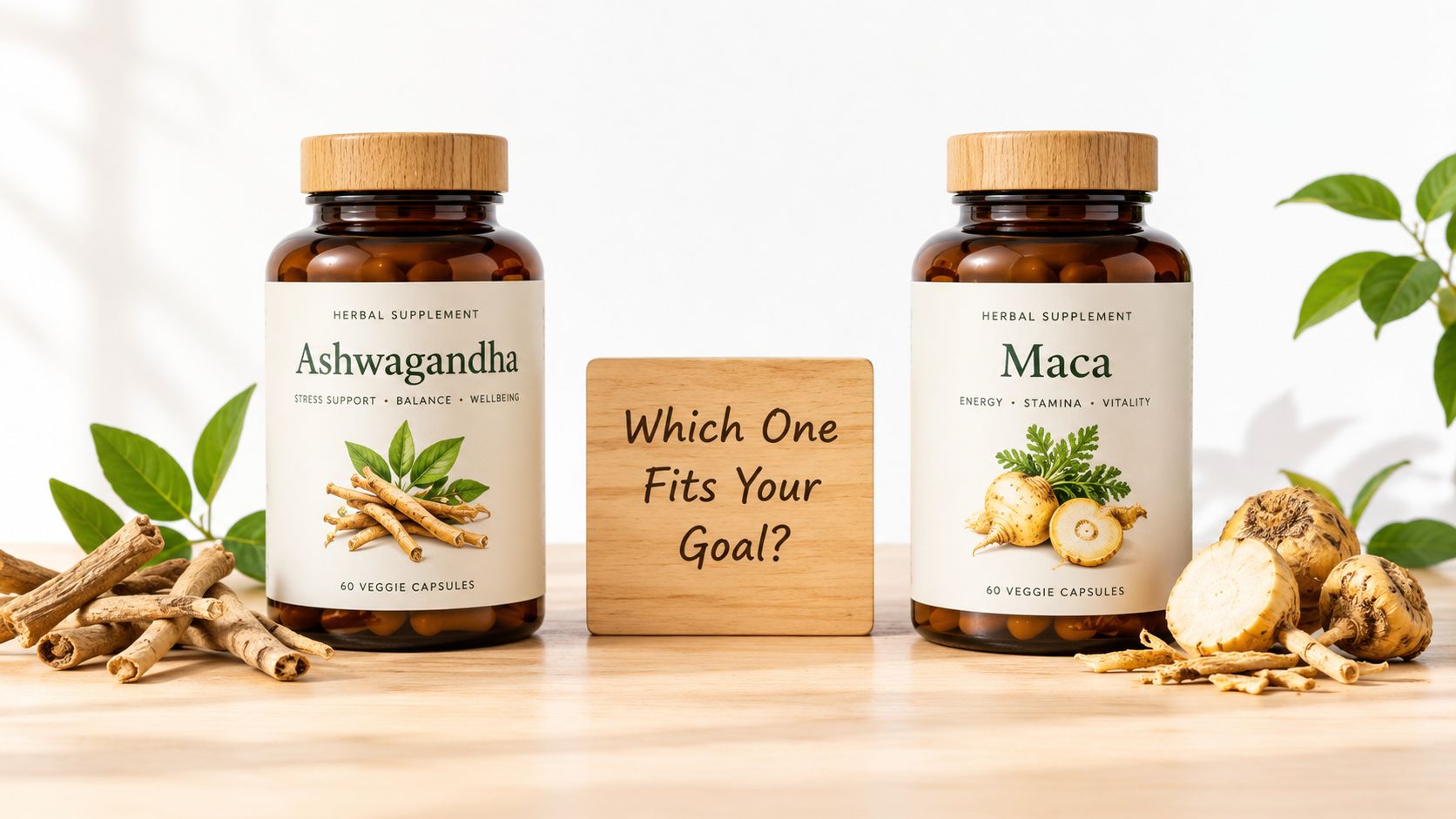
If your goal is sperm parameters, fertility, or semen volume, don't treat either herb as a proven solution. The evidence does not establish a strong direct benefit for semen volume, and it doesn't support promising reproductive changes from maca. A broader wellness formula may include these herbs alongside other ingredients, but every ingredient still needs to be judged on its own evidence and the specific outcome it supports.
SEMEX is a daily men's supplement that combines maca and ashwagandha with zinc, L-arginine, sunflower lecithin, bromelain, and other wellness ingredients; its formula is positioned around semen volume, taste, and overall vitality. That product description isn't proof that the formula will change semen volume or treat a reproductive concern. If you're weighing it or any multi-ingredient product, read the label, check the testing information, and decide whether its stated goals match what you want to support.
Can You Combine Them, and What to Expect Over Time
You can consider both, but don't assume the combination has proven synergy: no randomized controlled trial has tested the two-herb stack itself. Have a clinician review your medications and health conditions before combining supplements, especially if ashwagandha is part of the plan.
Study timelines differ by outcome and preparation. Ashwagandha stress research includes trials lasting 4–13 weeks, while maca libido research includes trials lasting 8–12 weeks. Those study periods don't guarantee when you'll notice an effect, and semen-volume or sperm-related changes shouldn't be assumed from either ingredient.
Food form and extract form matter because preparation changes what a serving contains. Gelatinized maca may be easier to digest than raw maca, while ashwagandha research depends on the extract and its standardization. Choose a clearly labeled product and evaluate it against one defined goal.
These statements have not been evaluated by the Food and Drug Administration. This product is not intended to diagnose, treat, cure, or prevent any disease.
If you're comparing ingredients for men's daily wellness, review the formula, serving directions, and testing details on SEMEX. Its formula includes both maca and ashwagandha alongside ingredients selected for semen-volume, taste, and general vitality support.