

Ashwagandha Men Benefits: What the Research Shows
A 22% drop in cortisol, not a definitive testosterone boost, is one of the most revealing findings in ashwagandha research. Among men in a 2019 randomized, double-blind, placebo-controlled trial, cortisol decreased by that amount with ashwagandha while rising 1% with placebo. The between-group difference was statistically significant, a stronger result than the trial's testosterone finding.
That distinction matters if you're searching for “ashwagandha men benefits” and encountering promises about hormones, bedroom performance, or gym gains. The useful question isn't whether this herb boosts masculinity. It's which outcomes researchers measured, how convincing the comparisons were, and whether the tested extract resembles the product you're considering.
Table of Contents
- What the Research Actually Shows
- Understanding Ashwagandha and Why It Differs from Other Adaptogens
- Stress Modulation and Cortisol
- Libido, Testosterone Markers, and Semen Parameters
- Athletic Recovery, Strength, and VO2 Max
- Recommended Dosing and What Actually Varies Between Products
- Safety, Interactions, and Who Should Be Cautious
- Putting It All Together
What the Research Actually Shows
Ashwagandha's reputation often combines several different possibilities into one sweeping claim. Stress management, sexual desire, semen characteristics, and testosterone measurements become interchangeable benefits, even though researchers assess them separately.
The cortisol finding above provides a better starting point. Researchers measured a specific biomarker under controlled conditions. That supports a measured interpretation: ashwagandha may help the body manage stress. It doesn't establish that every man will feel calmer, recover faster, or experience a meaningful hormonal change.
Read the endpoint before the headline
A useful reading order is outcome, comparison, population, formulation. First identify what changed. Then ask whether the change differed from placebo, who participated, and exactly what they took.
For example, a blood-test result doesn't establish improved sexual satisfaction. A semen-analysis result doesn't establish increased conception rates. Even a statistically significant difference needs context before it becomes a practical recommendation.
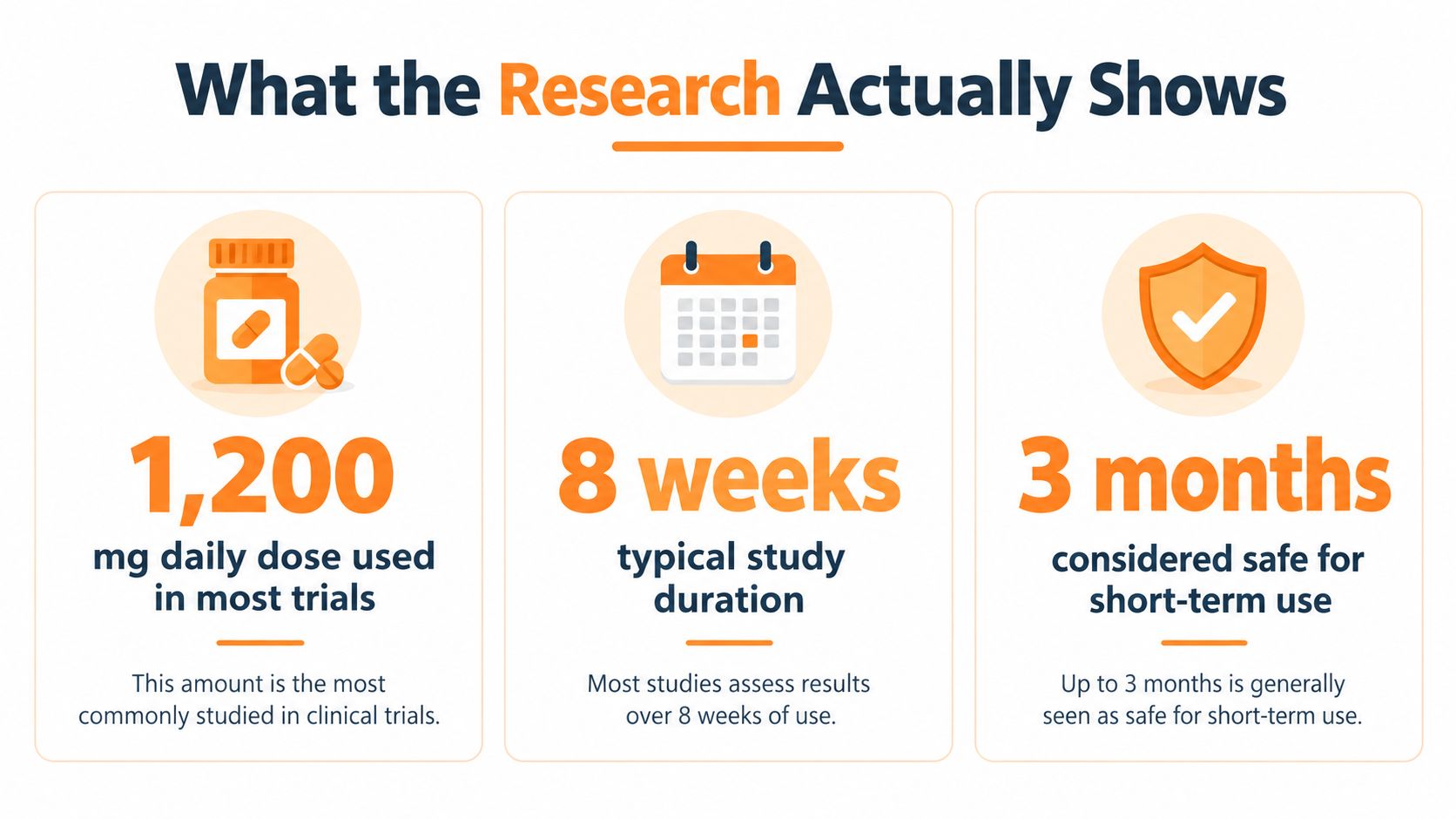
Interpret the graphic cautiously: its dose card shouldn't be treated as a standard recommendation or a summary of most trials. The protocols discussed below vary, and short-term safety is conditional rather than universal.
A supplement can influence a measured biological marker without delivering every benefit associated with that marker.
That's also why structure/function language matters. “May support a healthy stress response” describes a possible effect on normal function. “Treats low testosterone” claims treatment of a medical condition, which these findings don't establish.
The same discipline applies to performance claims. Cortisol, libido, semen analysis, strength, and cardiorespiratory fitness require their own evidence. Confidence in one endpoint shouldn't automatically extend to another.
Understanding Ashwagandha and Why It Differs from Other Adaptogens
Ashwagandha, botanically known as Withania somnifera, is associated with Ayurvedic practice and is commonly discussed as an adaptogen. That term describes the idea of supporting the body's response to stress, not a guarantee that a supplement will normalize every hormone or improve every aspect of wellness.
A thermostat offers a useful analogy for the concept: regulation rather than indiscriminate stimulation. But it's only an analogy. It shouldn't imply that ashwagandha reliably detects a hormonal imbalance and corrects it.
The extract matters more than the category
Calling a product an adaptogen doesn't identify its composition. Our guide to an adaptogenic supplement offers broader context, but product evaluation still needs to return to the label and the relevant trial.
Extract names such as KSM-66, a full-spectrum root extract, and Sensoril, a root-plus-leaf extract, illustrate why the plant name alone isn't enough. They shouldn't be treated as interchangeable formulations or ranked solely by capsule weight.
- Plant part: Root-only material isn't automatically equivalent to a preparation containing leaves.
- Extraction method: A concentrated extract and unextracted plant powder aren't the same preparation.
- Standardization: Withanolide content helps characterize an extract, but doesn't establish that every similarly labeled product produces identical outcomes.
- Trial match: The most useful comparison is between the actual study preparation and the actual product, not between their marketing categories.
The National Center for Complementary and Integrative Health's ashwagandha overview characterizes evidence for testosterone and sperm-quality benefits as limited. That's an important restraint on claims that the ingredient name itself guarantees a predictable response.
The broader lesson is that “adaptogen” describes a proposed role, while an extract specification describes what you're taking. Neither substitutes for controlled evidence. A product can use familiar terminology and still provide too little information to determine whether its formulation resembles a studied preparation.
Stress Modulation and Cortisol
The stress evidence is particularly useful because it exposes the gap between a promising headline and a defensible conclusion. In the trial introduced above, researchers found a clearer between-group result for cortisol than for testosterone.
Cortisol is a stress-related hormone, but a change in its measured level isn't a complete assessment of a man's mood, recovery, or daily functioning. The appropriate interpretation stays close to the endpoint rather than extending into outcomes the measurement cannot establish.
Why the placebo comparison matters
In that same trial, testosterone increased 11.4% among men taking ashwagandha, compared with 0.1% in the placebo group. However, the testosterone comparison didn't reach statistical significance, P = 0.158, whereas the cortisol comparison did, P = 0.007, as reported in the study linked in the introduction.
Those results shouldn't receive identical wording. The cortisol finding supports a more confident statement about the measured stress-related response. The testosterone result remains uncertain despite its apparently attractive percentage.
Practical rule: An increase within the supplement group isn't enough. Ask whether the researchers demonstrated a convincing difference from placebo.
Statistical significance also doesn't tell you whether an individual will notice a worthwhile change. It addresses the comparison within the study, not a promise about personal experience.
Stress support isn't stress treatment
“May support the body's ability to manage stress” is appropriately restrained. Claims about treating an anxiety disorder, correcting endocrine dysfunction, or eliminating stress would go beyond this evidence.
It's equally important not to assume a proven chain reaction. A plausible connection between stress-related signaling and reproductive hormones doesn't establish that cortisol reduction caused better libido, improved semen characteristics, or stronger training performance.
My interpretation is that stress modulation offers a more defensible starting point than the blanket “testosterone booster” label. That conclusion follows from the contrast between the trial's endpoints, not from assuming that lower cortisol is always desirable or that every man needs a supplement to change it.
Libido, Testosterone Markers, and Semen Parameters
A man can want greater desire, more ejaculate, improved sperm measurements, or reassurance about fertility. Those goals aren't interchangeable, and a study addressing one cannot automatically answer the others.
Serum testosterone is a laboratory measurement. Libido and sexual function concern desire and experience. Semen volume measures ejaculate quantity, while sperm quality includes characteristics such as count, movement, concentration, and morphology.
Key Trial Outcomes for Male Sexual and Reproductive Markers
| Trial | Population | Dose | Duration | Reported Outcome |
|---|---|---|---|---|
| Reduced-desire randomized trial | 50 men with reduced sexual desire | 300 mg standardized root extract twice daily | 8 weeks | Testosterone increased approximately 17%, about 72 ng/dL, versus roughly 2%, or 5.48 ng/dL, with placebo. |
| Healthy-men semen-analysis trial | 76 healthy men aged 30–50 | 300 mg root extract twice daily | 8 weeks | Reported increases of 36% in ejaculate volume, 38% in total sperm count, and 87% in total sperm motility. Testosterone changes weren't statistically significant. |
| Male reproductive-parameter trial | 100 healthy men aged 30–50 | 300 mg root extract twice daily | 8 weeks | Improvements versus placebo in semen volume, sperm number, concentration, and morphology, with respective significance values of p = 0.005, 0.006, 0.007, and 0.007. |
The reduced-desire trial supports interest in hormonal and sexual wellness, but it doesn't establish testosterone elevation as the sole explanation for improved function. A laboratory change and a subjective sexual experience remain distinct outcomes.
Likewise, the percentage changes in the semen-analysis trial describe reported study outcomes. They aren't guaranteed improvements for an individual, and they shouldn't be presented as placebo-adjusted effects without the relevant comparison.
What these findings don't establish
None of these endpoints should be relabeled as proof of improved fertility. Better semen measurements don't, by themselves, demonstrate higher conception rates or a successful pregnancy.
- Volume isn't sperm quality: More fluid doesn't establish better concentration, motility, or morphology.
- Sperm quality isn't sexual satisfaction: Laboratory characteristics don't measure bedroom intensity or a partner's experience.
- Desire isn't a testosterone diagnosis: A change in libido doesn't establish the presence or correction of a hormonal disorder.
The most defensible conclusion is promising, formulation-specific support for selected sexual and reproductive markers. That's meaningful, but narrower than claims that ashwagandha fixes infertility, treats low sperm count, or guarantees greater ejaculate volume.
Athletic Recovery, Strength, and VO2 Max
The stress and reproductive trials discussed here don't establish gains in strength, muscle size, or VO2 max. Men evaluating ashwagandha for training should resist transferring a hormone result into a performance promise.
A plausible mechanism isn't a demonstrated outcome. Even if an ingredient influences stress-related endocrine signaling, researchers still need to measure training adaptation or cardiorespiratory fitness directly before making a corresponding claim.
Separate a recovery hypothesis from a training result
For gym-focused readers, the useful distinction is between a possible supporting role and a measured performance benefit. The former is a hypothesis worth investigating. The latter requires a trial that evaluates the desired outcome.
| Training question | Evidence needed before accepting the claim |
|---|---|
| Will it improve strength? | Resistance-training outcomes compared with an appropriate control |
| Will it improve recovery? | Direct recovery measurements, not cortisol alone |
| Will it increase VO2 max? | Cardiorespiratory testing rather than hormone or semen results |
The protocols used in men's sexual-wellness research can help identify what investigators tested, but they aren't automatically athletic-performance prescriptions. A matching dose doesn't make an unmatched endpoint relevant.
For practical planning, use a post-workout recovery framework to distinguish your training goals from your supplement expectations. Decide whether you're trying to address perceived stress, training fatigue, or a measurable performance target before judging any ingredient.
The analytical mistake to avoid is stacking assumptions: ashwagandha changes cortisol, therefore testosterone rises, therefore muscle growth improves. Each step needs independent support. Without that support, “builds muscle” overstates what the evidence presented here can establish.
Recommended Dosing and What Actually Varies Between Products
There isn't a universal ashwagandha dose that makes every extract equivalent. The protocol in a successful trial belongs to that preparation, population, and study duration.
Several trials above used the same divided-dose root-extract regimen. That repetition makes it a useful research reference, not permission to substitute any powder, concentrated extract, or multi-ingredient blend.
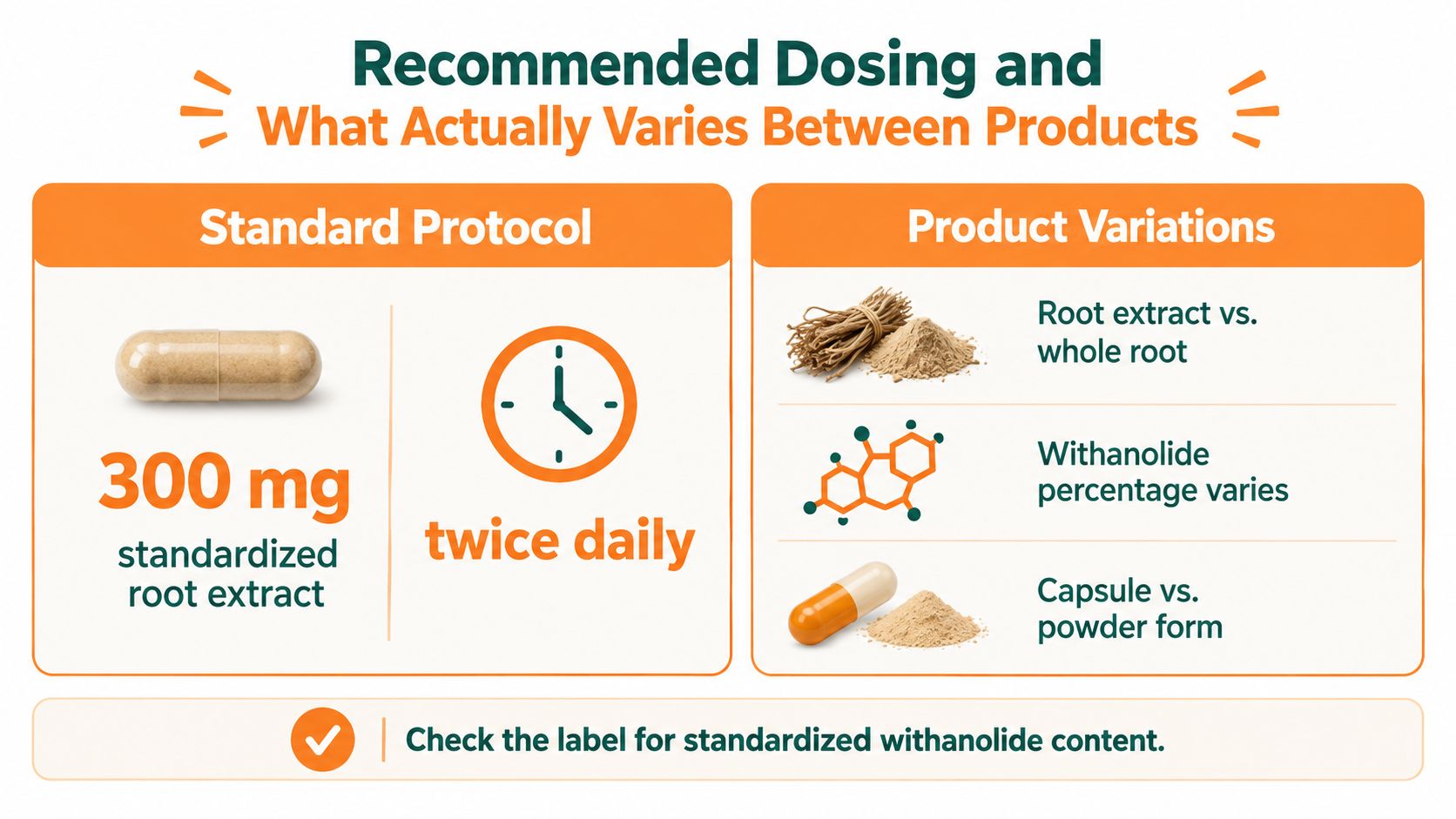
Common Ashwagandha Dosing Protocols Used in Trials
| Daily Dose | Duration | Population | Source |
|---|---|---|---|
| Divided-dose standardized root-extract protocol described above | Short controlled-trial period | Healthy men and men with reduced sexual desire | Individual trials in the sexual and reproductive outcomes table |
| 675 mg daily | Three months | 68 men described as infertile | Systematic review of human reproductive studies |
| 5 g daily | Three months | 75 healthy fertile men | Same systematic review, which describes differing preparations and study populations |
The review illustrates why dose weight alone is a poor comparison tool. A larger quantity of plant material doesn't necessarily mean a stronger or better-supported product than a smaller amount of concentrated extract.
Check the formulation before choosing the amount
Look for the plant part, named extract or preparation, withanolide standardization, and disclosed ingredient quantity. A capsule-versus-powder distinction is less informative than knowing what material the capsule or powder contains.
- Don't infer a personal dose from body weight: The evidence discussed here doesn't establish a weight-based dosing formula.
- Don't increase intake because stress feels severe: Greater perceived need doesn't demonstrate that a higher dose is appropriate.
- Don't equate ingredient presence with trial matching: A blend can contain ashwagandha without reproducing a standalone extract protocol.
Our ashwagandha daily dosage guide provides additional context for reading those differences. The decision should still begin with the actual label and, where needed, a clinician's review.
Finally, the studies concern sustained supplementation rather than an immediate, single-dose effect. They don't establish that escalating the dose produces faster results, or that indefinite use preserves any observed benefit.
Safety, Interactions, and Who Should Be Cautious
“Natural testosterone support” isn't an adequate safety assessment. Ashwagandha can affect biological systems beyond the outcome a man hopes to improve.
The NIH Office of Dietary Supplements safety review describes a trial involving 50 people with subclinical hypothyroidism who received 300 mg of root extract twice daily for eight weeks. Compared with placebo, thyroid-stimulating hormone decreased while triiodothyronine and thyroxine increased. That finding is a reason for caution, not a rationale for self-treating a thyroid disorder.
Short-term reassurance has limits
NIH guidance indicates that use for up to about three months may be safe for some adults, while long-term safety remains insufficiently established. It also notes reports linking ashwagandha to liver injury and potential medication interactions.
The words “may” and “some” matter. A general short-term assessment doesn't override an individual's liver history, thyroid status, or prescriptions.
- Thyroid considerations: Discuss thyroid disorders and thyroid medication with a healthcare professional before use.
- Liver considerations: A history of liver disease warrants medical review rather than self-directed supplementation.
- Medication considerations: Ask a clinician or pharmacist to check sedatives, immunosuppressants, and blood-pressure or blood-glucose drugs alongside thyroid medication.
Safety checkpoint: Bring the complete supplement label and medication list to the conversation, not just the ingredient name.
A practical supplement interactions review can help organize that discussion. It cannot replace an individualized assessment.
The thyroid finding also changes how “hormonal balance” should be understood. A measurable hormone effect isn't automatically beneficial for every user. The same reason an ingredient attracts research interest can be the reason a particular man should avoid it or use it only with professional guidance.
Putting It All Together
The most useful conclusion isn't that ashwagandha works or doesn't work. It's that the strength of the conclusion depends on the endpoint and the preparation.
Stress-related findings offer a credible reason to consider the ingredient without turning it into a universal hormone intervention. Sexual and semen-related findings justify continued research, but they don't support promises about fertility, guaranteed volume changes, or equivalent effects across products.
Make the decision match the evidence
Start with your goal. If you're evaluating stress support, don't let a semen-volume headline determine your choice. If you're concerned about reproductive health, don't substitute a supplement purchase for an appropriate medical assessment.
Then examine whether the product gives you enough information to make a meaningful comparison:
- Identify the preparation: Look beyond the word ashwagandha to its plant part, extract specification, and disclosed amount.
- Check the relevant outcome: A convincing result for one measurement doesn't validate an unrelated benefit.
- Review personal suitability: Medical history and medication use can matter more than an appealing headline.
- Keep product claims separate: Research on an individual ingredient isn't a clinical trial of every formula containing it.
There's also a difference between realistic patience and an open-ended commitment. Controlled studies don't establish that everyone should continue indefinitely, increase intake when results disappoint, or interpret every subjective change as proof of effectiveness.
For dietary supplement formulas, appropriate language describes support for normal structure and function. It doesn't claim to diagnose, treat, cure, or prevent disease. Ingredient research is context for a decision, not a substitute for product-specific evidence.
Treat ashwagandha as a possible supporting ingredient within a broader wellness routine, with a defined goal and a formulation you can evaluate. That approach is less dramatic than the testosterone-booster framing, but considerably more useful.
For a daily men's supplement formulated to support semen volume and taste, visit SEMEX to review its ingredients, including ashwagandha. Compare the disclosed formulation with the research discussed here, and review suitability with a healthcare professional if you take medication or have thyroid or liver concerns.
These statements have not been evaluated by the Food and Drug Administration. This product is not intended to diagnose, treat, cure, or prevent any disease.