

Ashwagandha Libido Men: What the Research Shows
An 8-week randomized, double-blind, placebo-controlled trial found that men taking 300 mg of standardized ashwagandha root extract twice daily had a statistically significant improvement in total male sexual-function scores, with a DISF-M mean difference of −9.8 points versus placebo, a 95% confidence interval of −10.73 to −8.87, and p < 0.0001 (published trial). That result reframes the “ashwagandha libido men” question. The relevant evidence isn't an instant aphrodisiac effect or a marketing promise. It's a short-term clinical signal measured with validated tools, alongside evidence that the extract can influence testosterone-related outcomes.
The evidence remains limited by small samples, short study windows, and extract-specific protocols. Still, the findings are more informative than anecdotal reports because researchers compared ashwagandha with placebo and assessed distinct aspects of sexual well-being. The most useful interpretation is cautious: ashwagandha may support sexual desire and related function, particularly when stress and hormonal balance are relevant factors, but it shouldn't be treated as a universal answer to every change in libido.
Table of Contents
- The Clinical Evidence for Ashwagandha and Male Libido
- How Adaptogens Influence Hormones and Stress Pathways
- Measuring Improvements in Sexual Function and Satisfaction
- Dosing Protocols and Reproductive Endpoints
- The Role of Multi-Ingredient Men's Wellness Blends
- Quality Standards and Regulatory Compliance
The Clinical Evidence for Ashwagandha and Male Libido
Two controlled trials provide the main human evidence for ashwagandha and male sexual function. The earlier study followed 50 adult men with lower sexual desire for 8 weeks. Participants received standardized root extract or placebo, and the treatment group improved on the validated DISF-M sexual-function scale (Health Science Reports trial). Improvements extended across sexual fantasy, arousal, behavior, orgasm, and sexual drive, rather than reflecting a single general rating of interest in sex.
That breadth matters clinically. Libido includes motivation, arousal, sexual behavior, orgasmic experience, and satisfaction, so a validated questionnaire offers a more structured comparison than an isolated subjective impression. It cannot represent every dimension of an individual's sexual experience, but it can show whether changes appear across several measured domains.
What the trial design tells men
The study methods reduce several common sources of bias:
- Randomized assignment limits the influence of baseline differences between participants.
- Double blinding reduces expectation effects among participants and investigators.
- Placebo control helps distinguish the supplement's possible effect from the effect of taking a new product.
- Validated scoring defines how sexual-function changes are measured.
The trial also reported a significant rise in serum testosterone, with a mean difference of −66.52, a 95% confidence interval of −80.70 to −52.34, and p < 0.0001 (hormonal outcome report). The negative sign reflects the direction of the statistical comparison. It does not mean testosterone fell in the ashwagandha group. Under the study's analysis, testosterone was higher relative to placebo.
A later 8-week randomized, double-blind, placebo-controlled trial included 76 healthy men aged 30 to 50. Compared with placebo, participants showed significant improvements in SDI-2 scores, orgasm and sexual-desire domains of the IIEF, and overall sexual satisfaction. Reported significance levels ranged from p < 0.05 to p < 0.0001, depending on the outcome (later male sexual-health trial).
Together, the findings indicate a consistent short-term signal across validated sexual-function measures. They do not establish a guaranteed effect for every man, and the trial durations do not answer whether benefits persist over longer use. The strongest conclusion is narrower: standardized ashwagandha extracts warrant further study as a possible support for male libido, particularly when sexual symptoms occur alongside stress or hormone-related factors.
How Adaptogens Influence Hormones and Stress Pathways
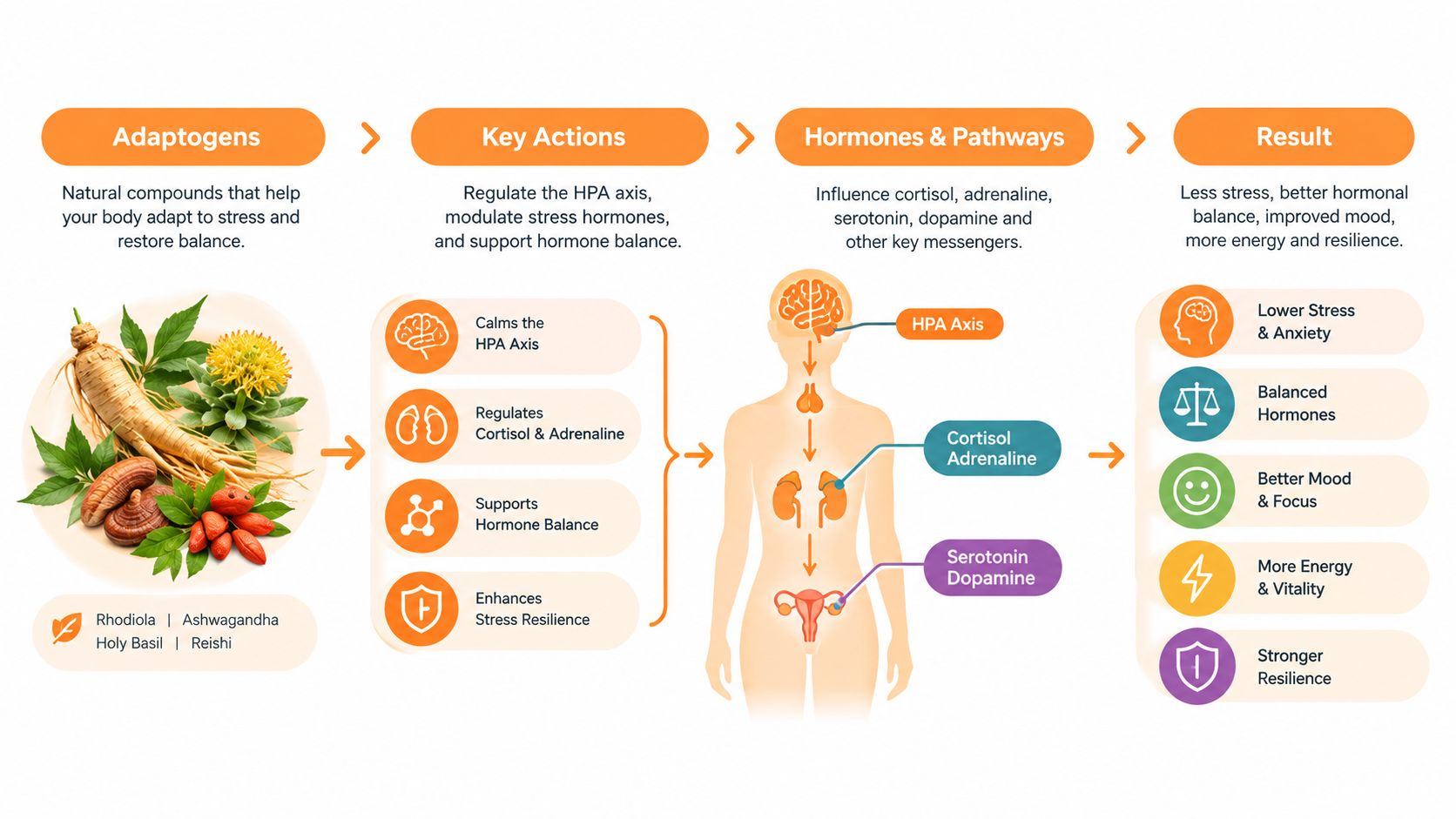
Stress-related physiology may account for part of ashwagandha's proposed effect on male libido. The ingredient is not an on-demand stimulant. Its potential role is to modify the body's response to stress, which can influence hormonal conditions associated with sexual desire. The main system involved is the hypothalamic-pituitary-adrenal axis, or HPA axis.
The HPA axis coordinates communication between the hypothalamus, pituitary gland, and adrenal glands. This pathway helps regulate cortisol, a hormone required for normal stress responses. Persistent physiological stress can interfere with recovery, reproductive signaling, and sexual interest. It does not mean that every stressed man has low testosterone or reduced libido. Stress becomes a plausible contributor when lower desire appears with fatigue, poor recovery, or sustained tension.
The bridge between stress and androgen support
Ashwagandha is classified as an adaptogen, a term used for ingredients that may help the body respond to stress. The relevant hypothesis is not indiscriminate testosterone elevation. A more defensible interpretation is that reduced stress-related interference could allow normal endocrine signaling to function more effectively.
A 2019 randomized crossover study in healthy males aged 40 to 70 used 600 mg daily for 8 weeks. It reported increased salivary DHEA-S and testosterone, but no significant change in sexual well-being, as summarized in the hormonal study summarized in the later clinical review. This separation limits the conclusion. A hormonal change does not automatically produce a noticeable improvement in sexual satisfaction.
DHEA-S is an adrenal androgen precursor, not another name for testosterone. An increase in DHEA-S therefore cannot serve as proof that libido improved. It does, however, provide a physiological reason to examine interactions between adrenal activity, reproductive hormones, and sexual function.
Why stress relief isn't the whole explanation
Low desire can also reflect medication effects, relationship strain, mood changes, disrupted sleep, endocrine disorders, or vascular problems. Ashwagandha's stress-related pathway may matter most when stress is one part of the clinical picture. The available trials do not identify a single cause for every participant's improvement.
A practical explanation of this mechanism appears in this guide to ashwagandha and stress support. The evidence is best read in two layers: sexual-function trials indicate improvement in particular groups, while hormonal studies suggest a possible physiological bridge. That bridge remains plausible rather than proven as a universal treatment, and it does not replace evaluation of persistent sexual or endocrine symptoms.
Measuring Improvements in Sexual Function and Satisfaction
“Better libido” describes several outcomes that should be measured separately. Clinical trials are more informative when their validated scales and domains are examined rather than reduced to a single headline. The DISF-M, or Derogatis Interview for Sexual Functioning in Men, assesses fantasy, arousal, sexual behavior, orgasm, and drive. In the earlier trial, the total score improved significantly versus placebo, with changes across domains rather than only one desire-related question. This was the finding reported in the DISF-M trial.
The later trial used the Sexual Desire Inventory 2, or SDI-2, alongside the International Index of Erectile Function, or IIEF. SDI-2 centers on sexual desire and motivation. The IIEF separates erectile function, orgasmic function, intercourse satisfaction, and overall satisfaction, allowing researchers to distinguish interest in sex from performance-related outcomes.
Reading the domains instead of the headline
The 2025 randomized trial found significant improvements in SDI-2 scores, IIEF orgasm and sexual-desire domains, and overall sexual satisfaction compared with placebo. These results support a more specific interpretation than the broad statement that ashwagandha “boosts performance.” The signal appeared across selected measures, not necessarily every aspect of sexual function.
| Measure | What it helps assess | Reported trial signal |
|---|---|---|
| DISF-M | Fantasy, arousal, behavior, orgasm, and sexual drive | Significant improvement versus placebo |
| SDI-2 | Sexual desire and motivation | Significant improvement versus placebo |
| IIEF domains | Desire, orgasmic function, erectile function, and satisfaction | Significant gains in selected domains |
| Overall satisfaction | Broader personal and partner-related sexual experience | Significant improvement in the later trial |
Libido and erectile function are related but distinct endpoints. A man can want sexual activity while experiencing erection difficulties, or have adequate erections with limited interest. A stress-related or androgen-related effect could therefore influence one domain more than another. The trial design reflects this distinction by reporting separate scores rather than treating sexual health as a single outcome.
What a statistically significant result doesn't guarantee
A statistically significant group difference means the result crossed the study's predefined statistical threshold. It does not show how noticeable the change will be for every individual, whether it will continue after the study period, or whether another extract will produce the same result.
The earlier trial was short-term and relatively small. The later study also measured outcomes over an 8-week period. These limitations narrow how the findings should be applied, rather than eliminating them. The evidence supports a measured expectation of gradual improvement in desire and sexual well-being, not an immediate effect before sexual activity or a guaranteed change in relationship satisfaction.
Interpretation rule: A validated score can establish that groups differed, but it cannot predict the exact experience of an individual man.
Dosing Protocols and Reproductive Endpoints
The clearest libido protocol used 300 mg of standardized ashwagandha root extract twice daily, or 600 mg per day, for 8 weeks. A later study tested a standardized root extract for 8 weeks in healthy men aged 30 to 50 and reported significant sexual-health outcomes compared with placebo. These findings establish the studied conditions, not a universal dosing instruction.
Extract identity and standardization affect how closely a product matches the research preparation. Medical history, manufacturing quality, and concurrent medications also influence whether supplementation is appropriate. A label that says only “ashwagandha” does not establish that it contains the same extract used in a trial. For product-specific administration details, consult this ashwagandha daily dosage guide.
A practical evidence filter
Men comparing products can assess four details:
- Identify the extract. Confirm the plant part and the stated standardization. The studied preparation was a standardized root extract.
- Compare the serving pattern. The trial dose was divided into two administrations, not used as an occasional single serving.
- Match the evaluation window. Controlled sexual-health outcomes were assessed after 8 weeks. Immediate changes should not be assumed.
- Separate endpoints. Sexual desire and reproductive measurements answer different clinical questions.
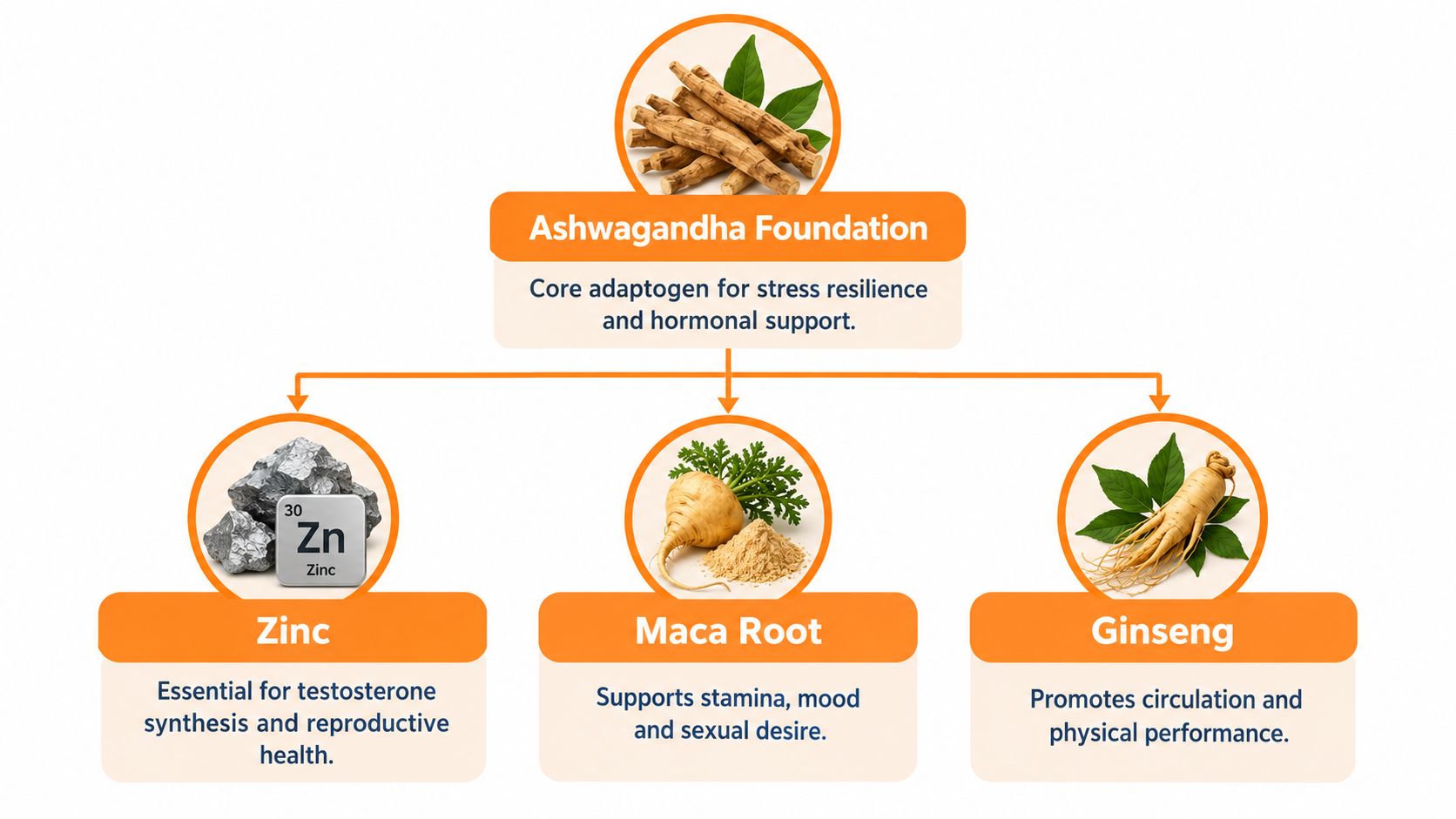
The reproductive findings add a separate line of evidence. In the 76-man, 8-week trial, ejaculate volume increased 36%, total sperm count increased 38%, and total sperm motility improved 87% after supplementation, according to the reported reproductive outcomes (semen and sperm endpoint report). These results came from a specific study population and preparation. They do not establish improved fertility for every man.
Why endpoint selection changes the conclusion
A libido score captures reported sexual experience. Semen volume, sperm count, and motility are collection-based or laboratory endpoints. Changes in both categories can occur without demonstrating that one caused the other.
The defensible conclusion is limited but useful. Small controlled trials have examined ashwagandha through subjective sexual-function scales and measurable reproductive outcomes, with encouraging findings. A libido protocol should not be treated automatically as a fertility protocol, and a reproductive result does not show that an extract suits an individual medical concern.
The Role of Multi-Ingredient Men's Wellness Blends
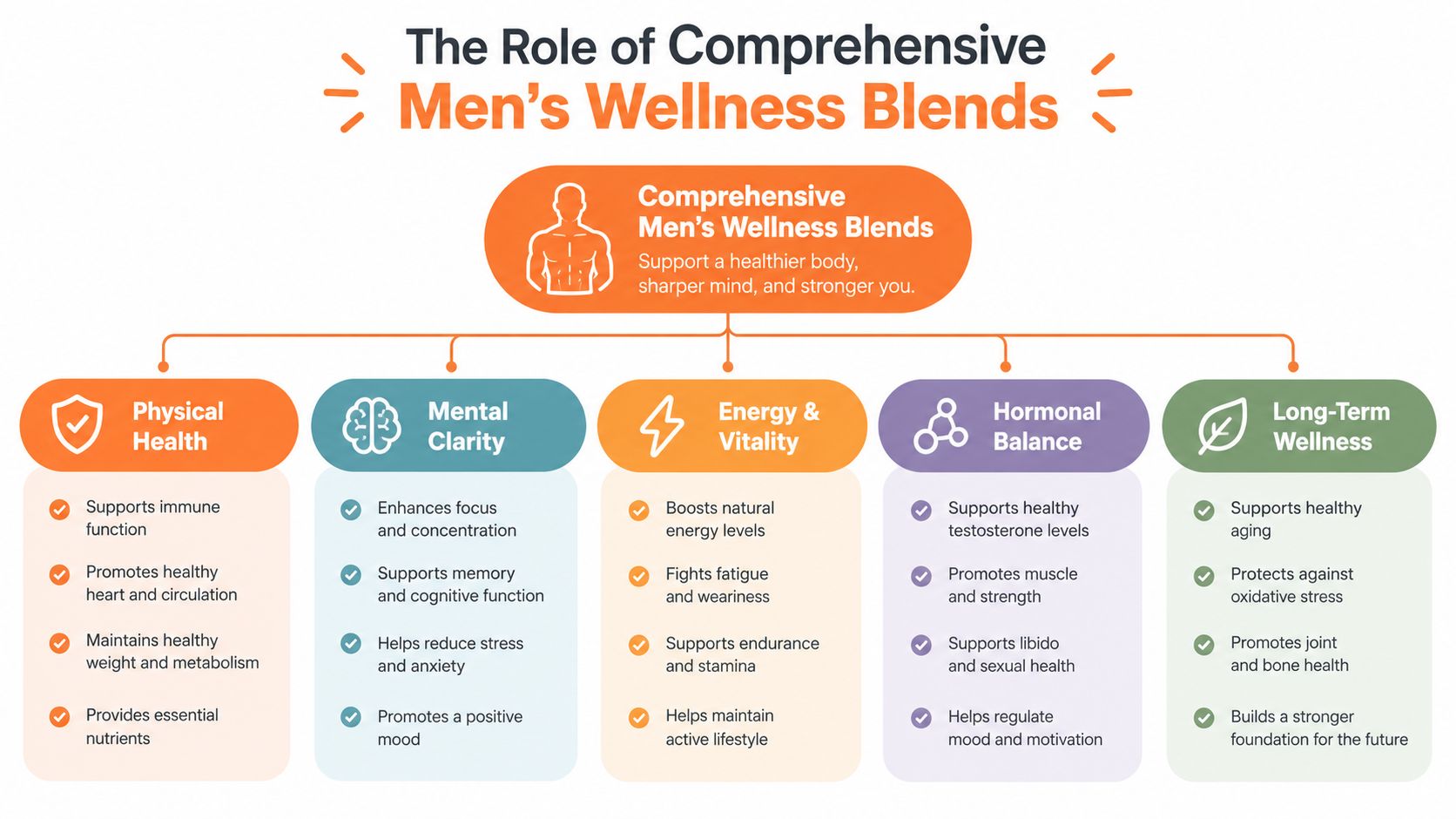
Standalone ashwagandha addresses a focused biological question: whether a stress-adaptogen and root extract can support stress resilience, hormonal markers, and sexual-function outcomes. A men's wellness blend combines ingredients linked to different physiological roles. This may suit men who want to address libido alongside circulation, reproductive nutrition, and general vitality, although a wider ingredient list does not establish a stronger clinical effect.
The rationale must remain ingredient-specific. Zinc contributes to normal reproductive function and testosterone synthesis. L-arginine is a precursor in nitric oxide pathways and therefore relates to blood-flow physiology. Maca root is commonly included for stamina, mood, and sexual-desire support, while Panax ginseng appears in formulas intended to support physical performance and circulation. These mechanisms do not show that a combination outperforms ashwagandha alone.
Comparing a single ingredient with a multi-target formula
| Approach | Primary rationale | Main limitation |
|---|---|---|
| Ashwagandha alone | Focuses on stress resilience and hormonal support | Does not address every nutritional or circulation-related target |
| Ashwagandha plus zinc | Pairs adaptogen support with a mineral involved in normal reproductive function | The added zinc may not be appropriate for every man |
| Ashwagandha plus L-arginine | Combines stress and hormonal support with a nitric-oxide-related pathway | Ingredient mechanisms are not proof of combination outcomes |
| Broader men's blend | Addresses several wellness targets within one routine | It becomes harder to identify which ingredient drives an individual response |
A blend may improve adherence by reducing the number of bottles and daily routines. That convenience is separate from pharmacological synergy. Synergy requires direct testing of the combination, and ashwagandha libido trials do not establish that every multi-ingredient product produces additive or superior effects.
Choosing the target before choosing the formula
Men should define the intended outcome first. Someone with stress-linked changes in desire may prioritize a standardized ashwagandha extract. Someone seeking broader support for semen volume, taste, circulation, and vitality may assess a formula containing zinc, L-arginine, sunflower lecithin, bromelain, maca root, Panax ginseng, and ashwagandha, while confirming that each ingredient is presented as support rather than treatment.
This avoids assuming that more ingredients automatically produce more benefit. A broader formula creates more possible targets, but also more variables, including tolerability, dose transparency, and interaction considerations. The stronger purchasing decision matches the documented ingredients and testing with the man's specific priorities.
Quality Standards and Regulatory Compliance
Clinical evidence only applies cleanly when a product resembles the preparation used in the research. For ashwagandha, that means checking the plant part, extract description, serving amount, and standardization details. A label should make it possible to distinguish a studied root extract from an unspecified powder or proprietary mixture.
Manufacturing controls matter just as much. Men evaluating a supplement should look for clear information about cGMP manufacturing, identity testing, contaminant controls, and independent verification. Vegan and non-GMO sourcing can matter for personal preferences, but neither label alone proves potency or purity.
The regulatory boundary
The FDA permits dietary-supplement structure/function claims when they describe an ingredient's role in maintaining normal body structure or function, or a documented mechanism of action, without making a disease claim (FDA structure/function guidance). That is why responsible wording uses terms such as supports, helps maintain, and plays a role in.
The required disclaimer must accompany relevant claims, and the FDA states that it must read: “This statement has not been evaluated by the Food and Drug Administration. This product is not intended to diagnose, treat, cure, or prevent any disease.” (FDA labeling requirements)
Quality rule: A credible supplement label should make the ingredient, amount, manufacturing standard, and testing approach easier to verify, not harder.
A third-party report should also identify what was tested. For men concerned about contamination or adulteration, useful documentation includes checks for microbials, heavy metals, and adulterants, along with published acceptance thresholds. These details don't prove that a product will improve libido. They show that the manufacturer has addressed basic quality questions before the product reaches the consumer.
Men can use this supplement quality standards resource as a purchasing checklist. The decision should then remain evidence-based: match the extract and dose to the available research, avoid disease language, and consult a qualified healthcare professional when libido changes suddenly, persists, or occurs alongside other concerning symptoms.
SEMEX combines ashwagandha with zinc, L-arginine, sunflower lecithin, bromelain, maca root, and Panax ginseng in a daily men's wellness formula focused on semen volume, taste, circulation, and vitality support. Men interested in comparing a broader routine with standalone ashwagandha can visit SEMEX to review the ingredient panel, manufacturing details, third-party testing information, and usage guidance.
These statements have not been evaluated by the Food and Drug Administration. This product is not intended to diagnose, treat, cure, or prevent any disease.