

Ashwagandha Benefits Libido
Ashwagandha is often marketed as a fast, reliable libido booster. The clinical picture is narrower. Human trials suggest that standardized ashwagandha may support sexual desire and broader sexual function in some populations, particularly when lower desire overlaps with stress or fatigue, but the evidence doesn't establish a universal or immediate effect.
That distinction matters because “libido” can mean spontaneous desire, while sexual-function questionnaires may also measure arousal, satisfaction, orgasm, activity frequency, partner-related outcomes, and erectile function. An evidence-focused reading of ashwagandha benefits for libido therefore requires attention to the participants, dose, duration, and exact outcome measured.
Table of Contents
- Setting Realistic Expectations for Ashwagandha and Libido
- How Ashwagandha May Influence Sexual Wellness
- What Human Trials Found About Libido
- Who May Respond and What Results to Expect
- Typical Dosage Timing and Product Quality
- Comparing Ashwagandha With Other Men's Wellness Ingredients
- Safety Limits and Common Misconceptions
- A Practical Takeaway for Men's Wellness
Setting Realistic Expectations for Ashwagandha and Libido
The most popular advice reduces the question to a simple promise: take ashwagandha, and sexual desire will rise quickly. Randomized trials don't support that level of certainty. The available research generally evaluates a broader package of sexual wellness outcomes, and the strongest signals appear in particular groups rather than across every adult.
One 8-week randomized, double-blind, placebo-controlled trial published in 2022 enrolled 50 adult men with lower sexual desire. Participants received 300 mg of standardized ashwagandha root extract twice daily or placebo. The ashwagandha group showed a statistically significant improvement in total sexual function scores, with a reported mean difference of -9.8 on the DISF-M scale, a 95% confidence interval of -10.73 to -8.87, and p<0.0001 versus placebo (the published 2022 male trial).
That result is meaningful, but it doesn't prove that every man will experience a noticeable libido lift. The participants already had lower sexual desire, the treatment lasted eight weeks, and the primary result came from a questionnaire measuring total sexual function rather than a single momentary measure of spontaneous interest.
The outcome matters as much as the ingredient
A supplement may support sexual satisfaction without producing an erection-style effect. It may help a stressed person feel more available for intimacy without changing desire in someone whose sleep, mood, hormones, relationship context, or medication use is already well managed.
Practical rule: A libido claim should always be matched to the population studied and the outcome actually measured.
The useful framework is simple. First, separate direct desire findings from broader sexual-function findings. Second, compare the reader's situation with the trial population. Third, treat duration and consistency as part of the evidence, not as optional details. That approach makes the potential benefits more realistic and helps prevent spending decisions based on exaggerated marketing.
How Ashwagandha May Influence Sexual Wellness
Ashwagandha is commonly described as an adaptogenic root, but proposed mechanisms shouldn't be confused with confirmed clinical effects. Researchers and supplement formulators often discuss several pathways that could connect the ingredient with sexual wellness, yet human studies don't establish that each pathway causes the observed questionnaire changes.
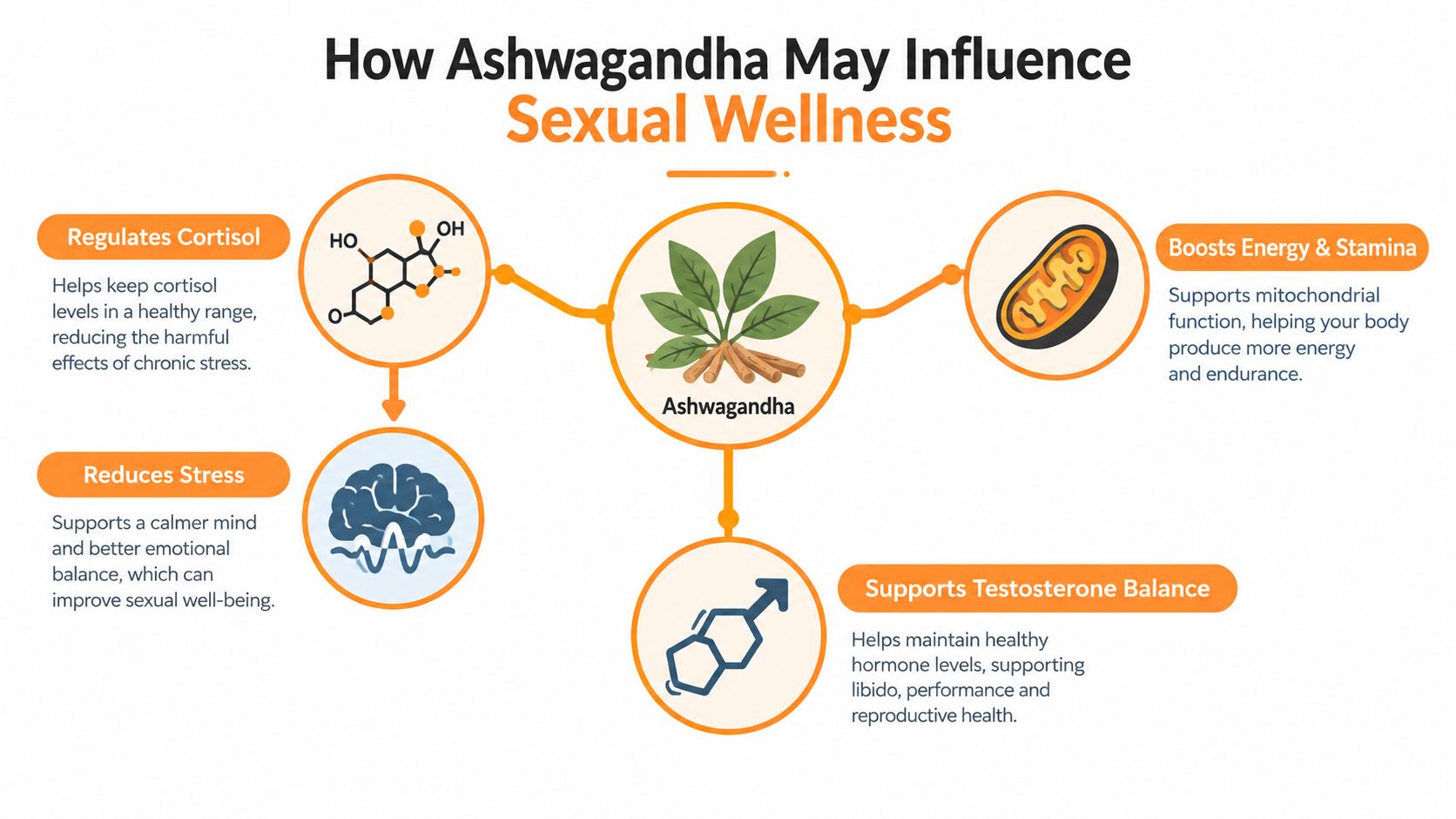
Stress and cortisol are the most plausible bridge
A proposed mechanism is stress modulation. Persistent psychological strain can compete with sexual attention, reduce relaxation, and make desire less accessible. If ashwagandha helps a person manage stress, the resulting improvement in sexual interest may be indirect rather than an aphrodisiac effect.
This interpretation fits the population-specific evidence. The 2022 trial enrolled men with lower sexual desire, while the broader clinical context includes research on stressed or otherwise burdened adults. A stressed person may have more room to notice a change than someone whose desire is already high and whose recovery is stable.
Hormones and energy remain hypotheses
Another proposed pathway involves hormone balance, including testosterone within normal ranges. The verified male trial context is important here because improved libido was reported in men with normal testosterone and prolactin, which suggests that any signal isn't limited to men with an obvious hormone deficiency. It also doesn't prove that ashwagandha raises testosterone enough to explain every sexual outcome (the clinical-use review).
Energy balance is a further proposed explanation. Fatigue can reduce interest in sex, while better perceived vitality may make intimacy more appealing. Thyroid-related effects are sometimes discussed in supplement content, but they should be treated cautiously, especially for people using thyroid medication. Human libido trials measure outcomes such as desire, satisfaction, and sexual function. They don't confirm that a specific thyroid or mitochondrial pathway caused the result.
Blood flow is also frequently included in sexual-wellness discussions. Nitric oxide and vascular function are more directly relevant to erection physiology than to desire itself, so they belong in a separate category from libido. Readers evaluating that distinction can review the explanation of nitric oxide and blood flow.
What Human Trials Found About Libido
Human trials support a narrower conclusion than typical supplement marketing. Standardized ashwagandha root extract has improved libido-related and broader sexual-function measures in selected participants over eight weeks. The evidence does not establish an immediate aphrodisiac effect or a universal response.
A 2025 prospective, randomized, placebo-controlled study followed 76 healthy men aged 30 to 50 years for 8 weeks. Compared with placebo, the ashwagandha group improved on SDI-2 scores, sexual desire, and overall IIEF outcomes, with reported significance of p≤0.001 (the 2025 prospective study and research context). A separate report on an 8-week randomized controlled study in 76 healthy males found improvements in sexual desire, SDI-2, sexual activity frequency, orgasmic function, and partner-related sexual outcomes. By week eight, SDI-2 was 27.87 ± 12.40 with ashwagandha versus 13.63 ± 5.86 with placebo. The between-group mean change was 10.66 ± 8.48 versus -3.61 ± 11.47, with p<0.001 (the male sexual-function study).
The healthy-male populations matter. They show that a benefit signal can occur without diagnosed sexual dysfunction, while also leaving open the question of how much improvement men with already strong sexual function can expect. Self-reported outcomes may also reflect expectations, relationships, stress, and normal day-to-day variation.
Key Ashwagandha Trials on Libido and Sexual Function
| Study Population | Daily Dose | Duration | Measured Outcomes | Key Findings |
|---|---|---|---|---|
| Adult men with lower sexual desire | 300 mg twice daily | 8 weeks | DISF-M total sexual function score | Significant improvement versus placebo, mean difference -9.8, 95% CI -10.73 to -8.87, p<0.0001 (2022 trial) |
| Healthy men aged 30-50 years | Not reported | 8 weeks | SDI-2, sexual desire, overall IIEF outcomes | Significant improvement versus placebo, p≤0.001 |
| Healthy males | Not reported | 8 weeks | SDI-2, activity frequency, orgasmic function, partner-related outcomes | Significant improvement versus placebo, p<0.001 |
| Women with hypoactive sexual desire disorder | 300 mg twice daily | 8 weeks | FSFI desire, arousal, lubrication, orgasm, satisfaction, and pain domains | FSFI improved across measured domains (women's trial) |
The women's trial does not establish an effect on male libido. It does show why total sexual-function scores require careful interpretation: improvement may span desire, arousal, lubrication, orgasm, satisfaction, and pain rather than reflect a single change in sexual interest.
The clearest conclusion is therefore measurable sexual-function improvement in selected participants over a sustained study period. Evidence remains weaker for instant effects, universal benefits, and direct treatment of erectile problems.
Who May Respond and What Results to Expect
The likely responder profile is more specific than supplement advertising suggests. A man whose reduced desire appears alongside high stress, poor recovery, or fatigue resembles the populations in which the clearest signals have appeared. A man with no meaningful stress burden and already strong sexual function has less obvious room for improvement.
The evidence also supports a distinction between desire and performance. The male studies reported changes in sexual desire and broader questionnaires, including activity frequency, orgasmic function, and partner-related outcomes. That doesn't mean ashwagandha should be expected to create an immediate erection or replace targeted evaluation for persistent erectile concerns.
A practical responder profile
More plausible fit: Men with lower baseline desire who also report stress, tiredness, or difficulty shifting attention toward intimacy may find the research more relevant. The 2022 trial specifically studied men with lower sexual desire, while the healthy-male research indicates that a signal can also appear without diagnosed sexual dysfunction.
Less predictable fit: Men with diagnosed hypogonadism, advanced erectile dysfunction, or medication-related sexual problems shouldn't assume an herbal supplement addresses the primary cause. The available evidence doesn't establish ashwagandha as a replacement for clinical assessment in those situations.
Realistic timing: The verified libido-related protocols used 8 weeks, not a single serving. A gradual assessment is more defensible than an overnight expectation. Desire, satisfaction, activity interest, sleep quality, and recovery can be tracked separately because an improvement in one area may not appear in another.
The most useful question isn't “Will ashwagandha boost libido?” It's “Does the reader's starting profile resemble the people studied, and is the desired outcome one the trials measured?” That question sharply reduces overinterpretation.
Typical Dosage Timing and Product Quality
Research protocols for libido-related outcomes usually divide the daily amount into two servings. The male and female studies used 300 mg of standardized root extract twice daily, and the registered male sexual-health protocol used the same schedule for 8 weeks. These details describe study designs, not individualized medical advice. For a fuller breakdown of serving sizes, see the guide to ashwagandha daily dosage.
Across the three protocols, the practical pattern is 600 mg daily in divided doses over 8 weeks. The 2022 trial involved men with lower sexual desire, the women's trial involved women with hypoactive sexual desire disorder, and the registered protocol focused on male sexual health. Their populations and outcomes differ, so the shared dosing pattern should not be treated as proof that every user will experience the same result. The trial reports and protocol record are cited here for readers who want to inspect the source material, including the 2022 trial, the women's trial, and the registered ClinicalTrials.gov study.
What to check before purchase
A label should identify the extract clearly. Root extract, the manufacturer's standardization details, and the amount per serving are more useful than a proprietary blend that lists only a combined botanical weight. Unclear quantities make it difficult to compare a product with the material used in research.
- Extract identity: Look for a named root extract rather than an unlabeled mixture of root and leaf material.
- Standardization: Check for the manufacturer's stated standardization information, including withanolide content when available.
- Testing: Third-party testing may add information about identity and contamination controls, but certification does not guarantee a libido outcome.
- Serving clarity: The amount per capsule and suggested daily serving should be easy to calculate.
- Consistency: Take the product at a repeatable time, potentially with food if the label permits, rather than searching for a perfect hour.
An inconsistent, short trial will not closely match the available protocols. Higher intake is not automatically better. Medication use, health conditions, and clinician guidance should shape any dosing decision.
Comparing Ashwagandha With Other Men's Wellness Ingredients
Ashwagandha doesn't occupy the same research role as every ingredient placed beside it in a men's wellness formula. Its most relevant positioning is stress, perceived vitality, and desire. Other ingredients are more closely associated with nutrient sufficiency, vascular function, prostate symptoms, or general reproductive support.
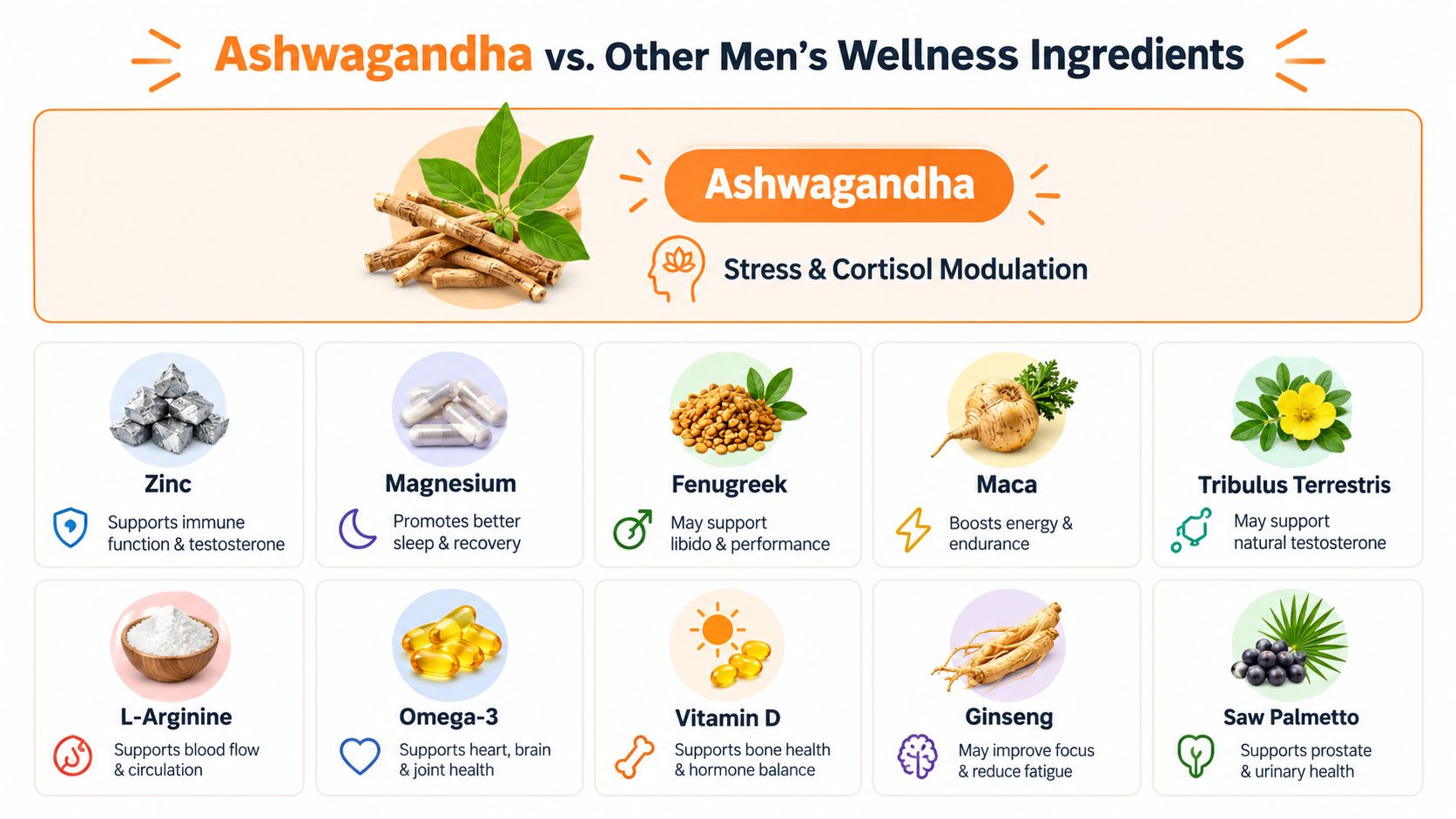
Different ingredients answer different questions
Zinc is most relevant to normal reproductive function when intake is inadequate. It shouldn't be treated as a universal testosterone or libido enhancer for men who already meet nutritional needs.
L-arginine is commonly studied in relation to nitric oxide and blood flow. That makes it more relevant to vascular aspects of sexual function than to spontaneous desire itself.
Maca root has been researched for subjective desire and energy. Its role differs from ashwagandha's stress-oriented positioning, so the two shouldn't be described as interchangeable. A separate review of maca root extract benefits can help readers evaluate that ingredient on its own terms.
Panax ginseng has evidence connected with erectile-function outcomes. That research question is distinct from whether a person feels more sexual interest during a stressful period.
Tongkat Ali has testosterone-related signals in stressed or lower-testosterone men. The relevance depends on baseline status, extract quality, and the outcome being measured.
Ingredients with narrower or limited libido relevance
Saw palmetto is generally positioned around prostate and urinary symptoms, not as a direct libido ingredient. Horny goat weed contains icariin, a compound studied for PDE5 inhibition, but that mechanistic research shouldn't be converted into a guaranteed human erection outcome.
Sunflower lecithin and bromelain have minimal direct evidence for libido. Their inclusion in a men's wellness product may reflect other formulation goals, but they shouldn't be presented as equivalent to ashwagandha's sexual-function research.
A formula combining several ingredients can be convenient, but it also complicates attribution. If desire changes, the user may not know which ingredient mattered, and if side effects appear, isolating the cause becomes harder. SEMEX is one example of a men's supplement formula that combines zinc, L-arginine, sunflower lecithin, bromelain, maca root, Panax ginseng, ashwagandha, Tongkat Ali, saw palmetto, and horny goat weed. Its inclusion of ashwagandha should be understood through the ingredient's stress and sexual-function evidence, not as proof that the complete product produces a specific libido result.
Safety Limits and Common Misconceptions
Ashwagandha is not a PDE5 inhibitor or a fast-acting erectile treatment. Human male research has focused more on desire and broader sexual-function questionnaires than on immediate erection quality. An independent clinical-use review, cited earlier, notes that aphrodisiac evidence in men remains scarce and describes a male erectile-dysfunction study that found no advantage over placebo across multiple measures. Expecting an instant performance effect therefore exceeds the available evidence.
The likely benefit is also population-dependent. Men experiencing stress, fatigue, or lower baseline desire may have more room to notice improvement than men seeking a rapid change in erection performance. Combining ashwagandha with several testosterone- or cortisol-modulating supplements further complicates interpretation and may raise questions about hormonal effects, thyroid function, or sedation. A change in libido cannot be confidently attributed to one ingredient when several are started together.
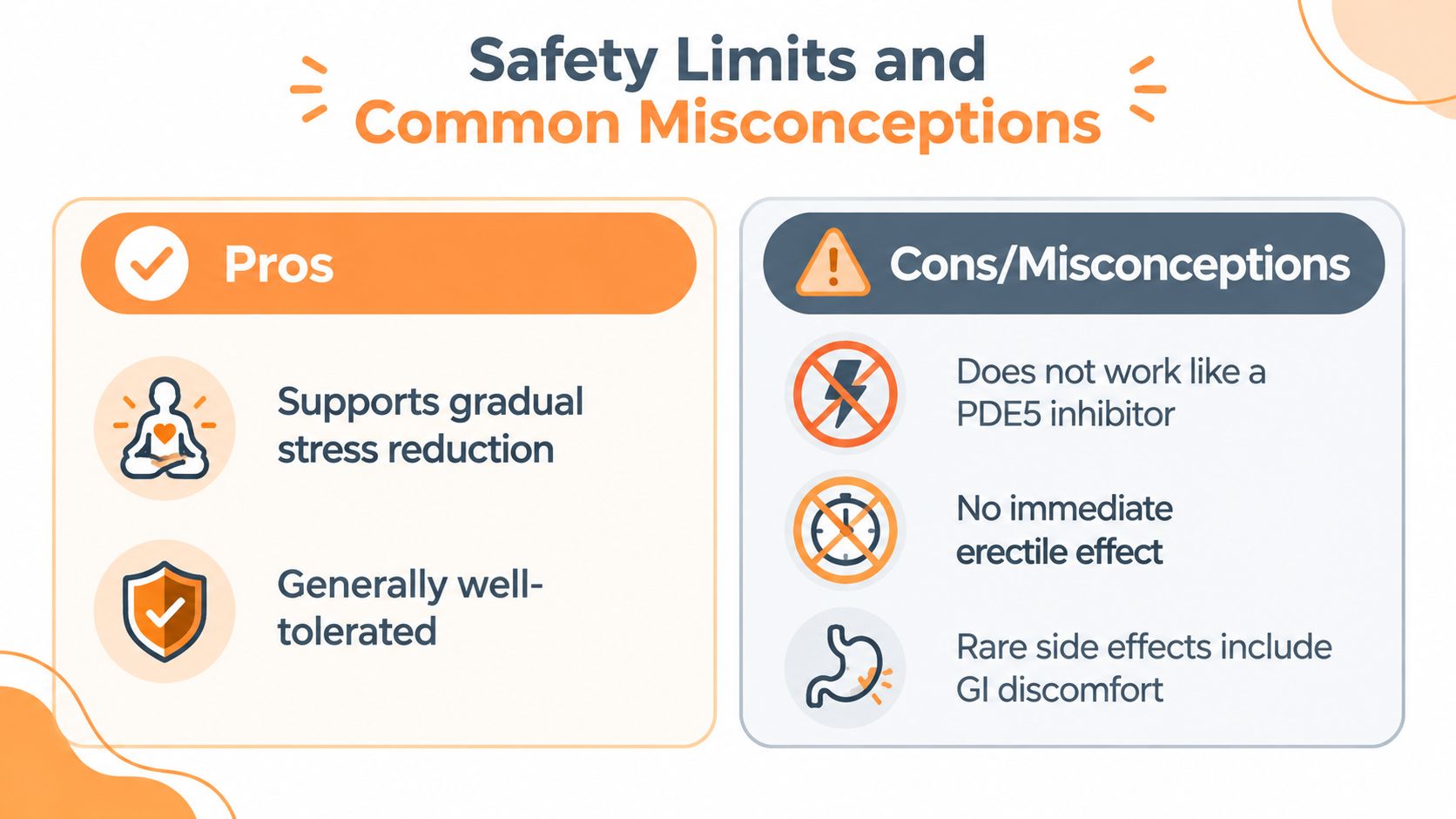
Safer decision points
- Review medications first: Alcohol, sedatives, and thyroid medication may create interaction concerns. A clinician or pharmacist can assess the combination more safely than a generic label.
- Don't escalate automatically: A larger dose is not automatically more effective and may increase unwanted effects.
- Stop for concerning symptoms: Gastrointestinal upset, persistent drowsiness, mood changes, or skin reactions warrant stopping the product and seeking clinical advice.
- Avoid specific situations: Avoid ashwagandha during pregnancy and with immunosuppressants unless a qualified clinician provides individualized guidance.
- Separate supplement use from diagnosis: Persistent low desire, erectile difficulty, or sudden sexual changes may reflect medical, psychological, relationship, or medication-related factors that require evaluation.
The benefit-risk decision depends on the individual, product labeling, medication profile, and intended outcome. A cautious trial is more appropriate when expectations center on gradual support rather than instant sexual performance.
A Practical Takeaway for Men's Wellness
The most defensible interpretation of ashwagandha benefits for libido is modest and conditional. Ashwagandha may support desire and broader sexual function in some men, especially when stress or low energy overlaps with reduced interest. It isn't established as a universal libido enhancer, a rapid erectile aid, or a substitute for evaluating hormonal, cardiovascular, medication-related, or psychological factors.
A practical framework is straightforward:
- Identify the overlap: Note whether lower desire appears alongside stress, fatigue, or poor recovery.
- Match the evidence: Standardized root extract regimens studied for sexual wellness commonly use 300 mg twice daily, or 600 mg daily, over 8 weeks. Those are research patterns, not individualized prescriptions.
- Track more than desire: Record subjective interest, satisfaction, sleep, and recovery separately.
- Review safety: Check medications and health conditions before adding a supplement, particularly thyroid medication, sedatives, alcohol use, or immunosuppressants.
- Build the routine: Sleep, resistance training, stress management, and clinician-guided screening remain relevant regardless of supplement choice.
SEMEX offers a multi-ingredient men's wellness formula that includes ashwagandha alongside ingredients such as zinc, L-arginine, maca root, Panax ginseng, Tongkat Ali, saw palmetto, horny goat weed, sunflower lecithin, and bromelain. It can be evaluated as one option within a broader routine, while the evidence for each ingredient remains specific to that ingredient and its studied role.
These statements have not been evaluated by the Food and Drug Administration. This product is not intended to diagnose, treat, cure, or prevent any disease.
Men evaluating ashwagandha for libido can compare SEMEX's ingredient profile and product information with their own wellness goals, medication considerations, and expectations for gradual support. Visit SEMEX to review the formula and decide whether it fits a consistent, evidence-informed men's wellness routine.