

Ashwagandha Benefits Blood Pressure: What Science Shows
Can ashwagandha lower blood pressure, or does the answer depend more on why someone's blood pressure is high than on the herb itself? That question exposes a common gap in supplement discussions. Positive studies are often highlighted as proof of a cardiovascular benefit, while null trials disappear from the conversation.
The fuller picture is less dramatic and more useful. Some research in stressed or hypertensive adults has reported modest reductions in blood-pressure readings, while other controlled trials found no significant change. The differences may reflect the extract used, dose, starting blood pressure, stress level, study duration, and participant health.
Ashwagandha is better understood as an adaptogenic herb associated primarily with stress support, not as a substitute for prescribed antihypertensive treatment. The evidence below maps positive, neutral, and safety findings together so readers can discuss the ingredient responsibly with a healthcare professional.
Table of Contents
- What Readers Should Know Before Starting
- Understanding Ashwagandha as an Adaptogen
- What the Clinical Trials Actually Found
- How Ashwagandha May Affect Blood Pressure
- Dosing Forms and Practical Considerations
- Safety Interactions and Who Should Be Careful
- Putting the Evidence Together
What Readers Should Know Before Starting
The central question has a mixed answer
Ashwagandha may influence blood pressure in some people, particularly when psychological stress forms part of the picture. That doesn't mean it works like a direct vasodilator or like a medication designed specifically to lower pressure. A person with persistent hypertension shouldn't stop or reduce prescribed treatment because a supplement appears promising.
One recent controlled trial illustrates why a single favorable headline can mislead. In a 2023 randomized, double-blind, placebo-controlled trial, adults with high stress and fatigue took 200 mg of standardized ashwagandha root extract twice daily for 12 weeks. Blood pressure didn't change significantly compared with placebo. Mean systolic pressure was 133.85 mmHg in the ashwagandha group and 132.08 mmHg in the placebo group, with p = 0.493 (published clinical trial).
That result doesn't prove ashwagandha has no value. It shows that stress-related benefits and blood-pressure benefits aren't interchangeable. A supplement can help someone feel calmer without producing a reliable antihypertensive effect.
Four variables shape the result
Readers evaluating ashwagandha benefits for blood pressure should examine:
- Baseline pressure: People with elevated readings may respond differently from healthy adults whose pressure already falls within a typical range.
- Stress burden: If sympathetic activation and poor stress regulation contribute to higher readings, stress support may matter more.
- Extract identity: Root-only and root-plus-leaf products can contain different concentrations and chemical profiles.
- Dose and duration: Controlled trials have used different preparations, schedules, and treatment periods.
Practical rule: A blood-pressure supplement claim is incomplete unless it identifies the extract, dose, participant population, and comparison group.
The sensible starting point is therefore not “Does ashwagandha lower blood pressure for everyone?” A better question is “Could this specific preparation support stress regulation in this specific health context, and could it interact with existing treatment?” That framing keeps the potential benefit in proportion to the uncertainty.
Understanding Ashwagandha as an Adaptogen
An adaptogen is commonly described as a botanical that helps the body respond to physical or mental stress without pushing every system in one fixed direction. In everyday terms, it resembles a thermostat more than a switch. A switch is either on or off, while a thermostat adjusts the response to the conditions around it.
Ashwagandha, or Withania somnifera, is traditionally associated with Ayurvedic medicine and is discussed alongside herbs such as rhodiola and holy basil. Its modern relevance comes from compounds called withanolides, which researchers study for their effects on stress-related pathways. A broader overview of adaptogenic supplements is available in this adaptogenic supplement guide.
Why stress enters the blood-pressure conversation
Chronic stress can keep the body's alerting systems active. That state may increase sympathetic nervous system output, the network involved in the “fight or flight” response. Stress also affects sleep, activity, eating patterns, and recovery, all of which can influence cardiovascular regulation.
Cortisol is one part of that network. It helps coordinate energy availability and the stress response, but a persistently strained stress system may place additional demands on the heart and blood vessels. Ashwagandha is studied largely because it may modulate the hypothalamic-pituitary-adrenal axis, often called the HPA axis, rather than because it directly relaxes arteries.
That distinction explains why the blood-pressure signal may differ between populations. A chronically stressed adult with readings on the higher side has a different physiological starting point from a healthy normotensive adult. If stress contributes little to the second person's blood pressure, reducing perceived stress may not produce a noticeable change in the measurement.
Adaptation is not the same as treatment
The adaptogen label doesn't establish a regulated medical category, and it doesn't guarantee a particular outcome. It describes a proposed pattern of biological activity. The most defensible interpretation is that ashwagandha may support the body's handling of stress, with any blood-pressure effect occurring indirectly and varying by individual.
That's why blood pressure shouldn't be used as the only measure of whether the herb is helping. A healthcare professional may consider symptoms, home readings, medications, sleep, thyroid status, and other cardiovascular factors together. A calmer subjective response can be meaningful, but it isn't evidence that hypertension has been controlled.
What the Clinical Trials Actually Found
The human evidence becomes clearer when positive and null findings appear side by side. One 2019 randomized, double-blind, placebo-controlled trial using KSM-66 root extract at 300 mg twice daily for eight weeks reported an 8.8 mmHg reduction in systolic blood pressure, compared with a 4.1 mmHg reduction with placebo (clinical summary of the trial). That result helps explain why ashwagandha is discussed in cardiometabolic contexts, but it doesn't establish a consistent drug-like effect across all users.
An older report involving 51 stress-oriented hypertensive subjects aged 40 to 70 years found that systolic blood pressure decreased over three months, although the overall reduction was non-significant. The report described a significant systolic reduction in one group and significant diastolic reductions in both groups. Mean diastolic pressure reached 85 mmHg in group I and 92 mmHg in group II after supplementation (older clinical report).
The opposing evidence comes from controlled studies in populations with less obvious blood-pressure dysregulation. In the 2023 trial described earlier, adults with high stress and fatigue received 200 mg twice daily for 12 weeks, yet systolic pressure didn't differ significantly from placebo (trial report). Another eight-week randomized, double-blind, placebo-controlled safety study in 80 healthy adults found no significant systolic or diastolic blood-pressure change versus placebo when participants took 300 mg twice daily (safety study).
Key Ashwagandha Blood Pressure Trials Compared
| Study (Year) | Population | Extract & Dose | Duration | BP Outcome |
|---|---|---|---|---|
| Older clinical report | Stress-oriented hypertensive subjects aged 40 to 70 years | Ashwagandha preparation, dose details not specified in the verified summary | Three months | Overall systolic reduction was non-significant; diastolic reductions were reported in both groups |
| 2019 randomized trial | Adults in a controlled clinical trial | KSM-66 root extract, 300 mg twice daily | Eight weeks | Systolic pressure fell 8.8 mmHg with ashwagandha versus 4.1 mmHg with placebo (trial summary) |
| 2023 randomized trial | Adults with high stress and fatigue | Standardized root extract, 200 mg twice daily | 12 weeks | No significant difference versus placebo; mean systolic pressure was 133.85 mmHg versus 132.08 mmHg, p = 0.493 (trial report) |
| Eight-week safety study | 80 healthy adults | Root extract, 300 mg twice daily | Eight weeks | No significant systolic or diastolic change versus placebo (safety study) |
The pattern is promising but uncertain. Differences in sample size, extract composition, stress level, starting pressure, and study design make direct comparisons difficult. Blood pressure also wasn't always the primary endpoint, which weakens conclusions about the herb as a cardiovascular intervention.
How Ashwagandha May Affect Blood Pressure
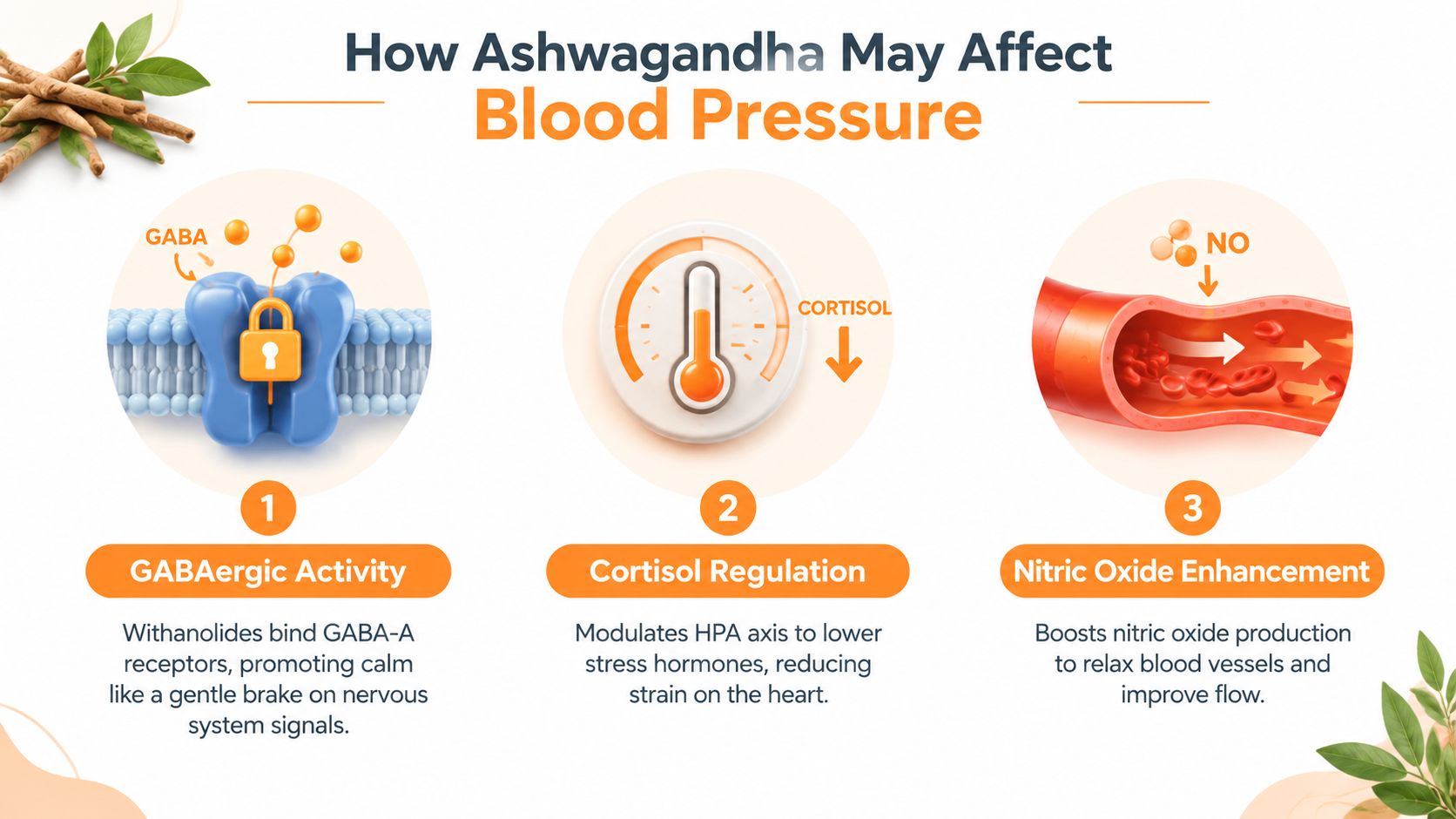
The proposed mechanisms are easier to understand as three control systems rather than as proof of a finished treatment. Each pathway offers a plausible explanation for why stressed people might respond differently from healthy normotensive adults.
GABAergic activity as a nervous-system brake
GABA is a calming neurotransmitter. Some research suggests that withanolides may interact with GABA-related signaling, including GABA-A receptors. The easiest analogy is a dimmer switch. Instead of shutting the nervous system off, calming signals may reduce the intensity of activity.
If sympathetic output remains high, the heart and blood vessels can stay under greater pressure. A calmer nervous-system state could therefore support healthier regulation in some stressed individuals. That's an indirect route, not the same as a medicine that targets a specific vascular pathway.
Nitric oxide and vessel flexibility
The inner lining of blood vessels, called the endothelium, helps regulate vessel tone. Nitric oxide is one of the signaling molecules involved in relaxation. It can be compared with a lubricant inside a pipe. When vessels respond appropriately, blood can move with less resistance.
Preclinical work has explored whether ashwagandha extracts influence nitric oxide availability and vascular relaxation. These findings help explain the biological interest, but laboratory and animal observations aren't direct evidence that a supplement lowers human blood pressure reliably.
Cortisol and the HPA axis
The HPA axis coordinates hormonal responses to stress. When the system remains activated, cortisol and related signals may contribute to cardiovascular strain. Ashwagandha appears to influence this stress axis in some human studies, which could help explain why blood-pressure effects, when present, seem more plausible in stressed populations.
The important limitation is that these mechanisms are partly preclinical. GABA-related activity, nitric oxide signaling, and cortisol modulation create a coherent hypothesis, but they don't demonstrate antihypertensive drug action. Clinical outcomes still have to come from well-designed human trials with blood pressure as a defined endpoint.
Dosing Forms and Practical Considerations
The label matters because “ashwagandha” isn't one uniform preparation. Most blood-pressure research has used standardized root extracts, while commercial products may use root, leaf, or a combination. A loose powder can contain a different concentration of active compounds from a tested extract, so the name on the front of the package doesn't establish equivalence.
Two widely discussed standardized preparations are KSM-66 and Sensoril. KSM-66 is root-only and commonly described as containing about 5% withanolides. Sensoril combines root and leaf and is commonly described as containing about 10% withanolides. These product-specific details and dose ranges should be confirmed against the individual label and clinical protocol, rather than assumed across brands.
| Attribute | KSM-66 | Sensoril |
|---|---|---|
| Plant material | Root-only extract | Root-plus-leaf extract |
| Commonly described withanolide concentration | About 5% | About 10% |
| Trial-relevant daily amount in the provided evidence | 600 mg daily in the 2019 trial, split into two doses (trial summary) | The verified blood-pressure data provided here don't establish a specific Sensoril dose |
| Main interpretation | A standardized root preparation with a blood-pressure trial signal | A different extract profile that shouldn't automatically be treated as equivalent |
How readers should interpret dose
The verified trials used different amounts. The 2019 KSM-66 trial used 300 mg twice daily for eight weeks, while the 2023 high-stress trial used 200 mg twice daily for 12 weeks (2019 trial summary; 2023 trial report). Those protocols show why dose and duration should be treated as research variables, not universal instructions.
Capsules, tablets, gummies, and powders are common formats. Comparative bioavailability evidence between these forms is limited, so a gummy shouldn't automatically be assumed to match a capsule used in a trial. Taking a product with food may improve tolerability, while timing can be adjusted around drowsiness or alertness.
Readers considering daily use can review this ashwagandha dosage guide, then discuss the product and schedule with a clinician. Blood-pressure effects, if they occur, should be viewed as gradual rather than as an immediate drop after a single serving.
Safety Interactions and Who Should Be Careful
A supplement can be well tolerated in a controlled study and still create problems in a medicine cabinet. Ashwagandha has been associated with drowsiness, gastrointestinal upset, nausea, and loose stools, while longer-term safety remains less certain. Rare reports of liver injury also mean new symptoms such as dark urine, yellowing of the skin or eyes, or unusual itching deserve prompt medical attention.
The antihypertensive interaction deserves attention
Ashwagandha may add to the blood-pressure-lowering effect of antihypertensive medicines. That concern applies to medicines such as ACE inhibitors, ARBs, beta-blockers, and diuretics. The combined effect could produce dizziness, lightheadedness, fainting, or hypotension, especially in someone whose baseline pressure is already low (medical dosing and interaction guidance).
Medication check: Anyone taking blood-pressure treatment should ask a prescriber or pharmacist about ashwagandha before adding it, rather than waiting for symptoms to appear.
The same principle applies to sedatives, benzodiazepines, sleep medicines, and alcohol because calming effects may stack. People taking thyroid hormone replacement need particular caution because ashwagandha may influence thyroid hormone levels. A supplement that feels relaxing can still have endocrine effects.
Groups that should avoid self-directed use
Pregnant and breastfeeding people shouldn't use ashwagandha without explicit medical guidance because safety concerns remain. People with autoimmune conditions, including lupus or rheumatoid arthritis, should also seek specialist advice because immune-stimulating activity could conflict with the condition or its treatment.
People with hyperthyroidism, thyroid disease, liver problems, hormone-sensitive prostate cancer, or upcoming surgery require the same careful screening. Anesthesia interactions are a practical concern, and product quality can vary because marketplace products may differ in plant material, standardization, and contamination controls. Information relevant to men considering the ingredient is also available in this guide to male ashwagandha use.
Long-term use beyond three months remains understudied in the evidence supplied here. That uncertainty makes periodic review with a healthcare professional more sensible than taking the product indefinitely by habit.
Putting the Evidence Together
The full evidence picture supports a cautious conclusion. Ashwagandha may produce modest blood-pressure reductions in some stressed or hypertensive adults, but controlled studies have also found no significant change, including in healthy adults and adults with high stress. The herb's more coherent role is as a stress-modulating adaptogen, not as a direct blood-pressure drug.
The practical decision can follow three questions:
- What is the starting blood pressure? Healthy normotensive users shouldn't expect a predictable reduction.
- What medicines are already being taken? Additive effects can cause dizziness or excessive lowering.
- What outcome is the supplement meant to support? Stress regulation is a more defensible aim than replacing prescribed treatment.
Lifestyle foundations still matter. Sleep, regular physical activity, and sensible sodium moderation support a broader cardiovascular plan, while home readings can help a clinician assess whether pressure is changing. Ashwagandha shouldn't replace medication, medical monitoring, or evaluation of persistent hypertension.
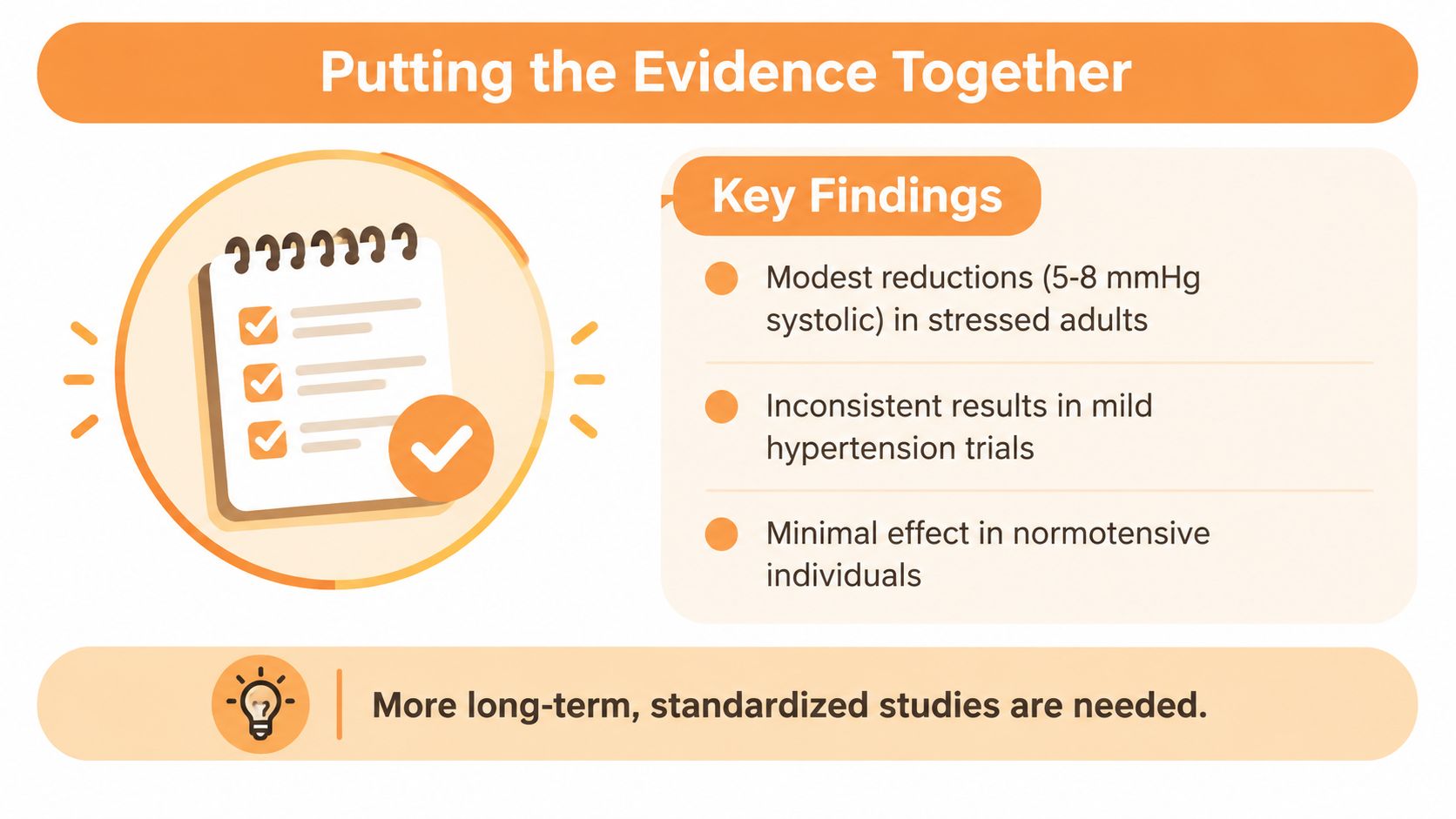
The most accurate takeaway is simple: ashwagandha may be one stress-support tool inside a broader health plan, but it isn't a standalone fix for blood pressure.
SEMEX offers a daily, vegan, non-GMO men's wellness supplement featuring ingredients such as zinc, L-arginine, sunflower lecithin, bromelain, and an ashwagandha-containing vitality blend. Men evaluating how ashwagandha fits alongside broader wellness goals can visit SEMEX to review the formula and testing information.
These statements have not been evaluated by the Food and Drug Administration. This product is not intended to diagnose, treat, cure, or prevent any disease.