

Acid in Sperm Explained What Semen pH Means
Could "acid in sperm" describe the sperm cells, or is the issue the fluid surrounding them? That distinction changes how semen pH should be understood. A mildly sour taste, an unusual semen analysis result, or a search for ways to support reproductive health can all lead to the same worry, but pH is not a simple label for sperm quality.
Semen is a mixture of fluids from several reproductive organs, with sperm suspended inside it. The pH reading describes that fluid environment, much like the water around fish describes the conditions they live in rather than the chemistry of each fish. Normal semen is usually slightly alkaline, and that environment helps sperm cope with the more acidic conditions of the vagina.
The useful questions are therefore more specific. Is the semen pH within the expected range? If it's outside that range, does the result appear alongside low volume, absent fructose, or signs of infection? Does a taste change reflect pH, diet, irritation, or something else? This guide follows those questions from basic chemistry through reproductive physiology, fertility interpretation, taste myths, and sensible medical next steps.
Table of Contents
- Introduction to Acid in Sperm and Why pH Matters
- What Semen pH Really Measures and the Normal Range
- How Your Body Sets Semen pH Between Acidic and Alkaline
- What Makes Semen More Acidic or More Alkaline
- Acid in Sperm and What It Means for Fertility Taste and Comfort
- Common Myths About Acidic Semen You Can Stop Worrying About
- When to Seek Medical Advice and How Semen pH Is Evaluated
Introduction to Acid in Sperm and Why pH Matters
Could “acid in sperm” describe the sperm cells, or does it describe the fluid carrying them? That distinction turns a worrying phrase into a more useful question about semen's fluid environment.
Semen is a mixture of sperm and secretions from the prostate and seminal vesicles. Each source contributes different substances, and their combined chemistry determines the final semen pH. Checking that pH is like measuring the water in a swimming pool, not the temperature or chemistry of every swimmer. The result describes the shared fluid around the sperm cells.
Why acidity raises concern
The vagina is naturally more acidic than semen. Semen is usually slightly alkaline, which can provide a more suitable surrounding environment after ejaculation. pH still represents only one part of reproductive biology. It does not, by itself, determine whether sperm move normally, fertilize an egg, or result in pregnancy.
Taste can add confusion. A mildly sour or otherwise unusual taste may reflect the fluid's chemistry, diet, irritation, or another factor, but taste cannot measure semen pH or diagnose a fertility problem. Online claims that “acidic semen” automatically means bad sperm, weak sperm, or poor fertility turn one observation into a conclusion the evidence does not support.
A low semen pH can matter clinically, especially alongside other findings. It is not a standalone fertility diagnosis. In a study of 1,199 patients, researchers found no meaningful difference in mean pH between men with normal and abnormal sperm concentration or motility. The finding supports treating pH as a reference marker, rather than an isolated judgment about fertility (the patient study in PMC).
A calmer way to read the question
A single taste experience rarely answers a medical question. A single pH result also needs context, including how the sample was collected and what the rest of the semen analysis showed. Persistent pain, unusual discharge, repeated abnormal results, or difficulty conceiving are better reasons to speak with a clinician than to diagnose yourself from taste or one laboratory value.
The central distinction: “Acid in sperm” usually means acidity in the semen fluid, not that sperm cells themselves are acidic.
Understanding that difference makes pH easier to interpret. The focus then becomes the measurement, the expected range, and the findings that give an unusual result real clinical meaning.
What Semen pH Really Measures and the Normal Range
What does “acid in sperm” describe? In most cases, it refers to the chemical environment of semen, the fluid that surrounds sperm, rather than an acidic property of the sperm cells themselves.
The pH scale runs from 0 to 14. Lower values are more acidic, higher values are more alkaline, and the midpoint is neutral. Lemon juice is strongly acidic, while semen normally measures just above neutral.
Clinical references commonly place liquefied semen around pH 7.2 to 7.8 or 7.2 to 8.0. The World Health Organization semen laboratory manual uses 7.2 as the lower threshold for a normal sample. A clinical reference from Stony Brook Medicine describes liquefied semen as normally about 7.2 to 7.8.
Why the range isn't a perfect line
A reference range describes the values clinicians commonly expect. It does not mean every healthy sample will produce the same reading. In one study, measured semen pH varied from 7.3 to 9.5, and 32% of samples were below pH 8.0 (study data). These results show why a value needs context before anyone labels it abnormal.
Timing and testing methods also affect interpretation. Semen changes after ejaculation as it liquefies, so the laboratory's collection instructions, timing, and measurement process matter. Clinicians usually review pH with volume, sperm concentration, motility, morphology, fructose, and signs of inflammation or infection.
What a number can and can't say
A pH within the expected range does not guarantee normal fertility, and a result outside it does not prove infertility. The number offers a clue about the ejaculate's fluid composition and whether one contributing gland or fluid may warrant closer evaluation.
Key takeaway: semen pH describes the fluid surrounding sperm. It is not a direct measurement of sperm motility, sperm DNA, or overall fertility.
That distinction turns “acid in sperm” into a fluid-environment question. Taste may vary, but only laboratory testing and the wider semen analysis can show whether the result has clinical meaning.
How Your Body Sets Semen pH Between Acidic and Alkaline
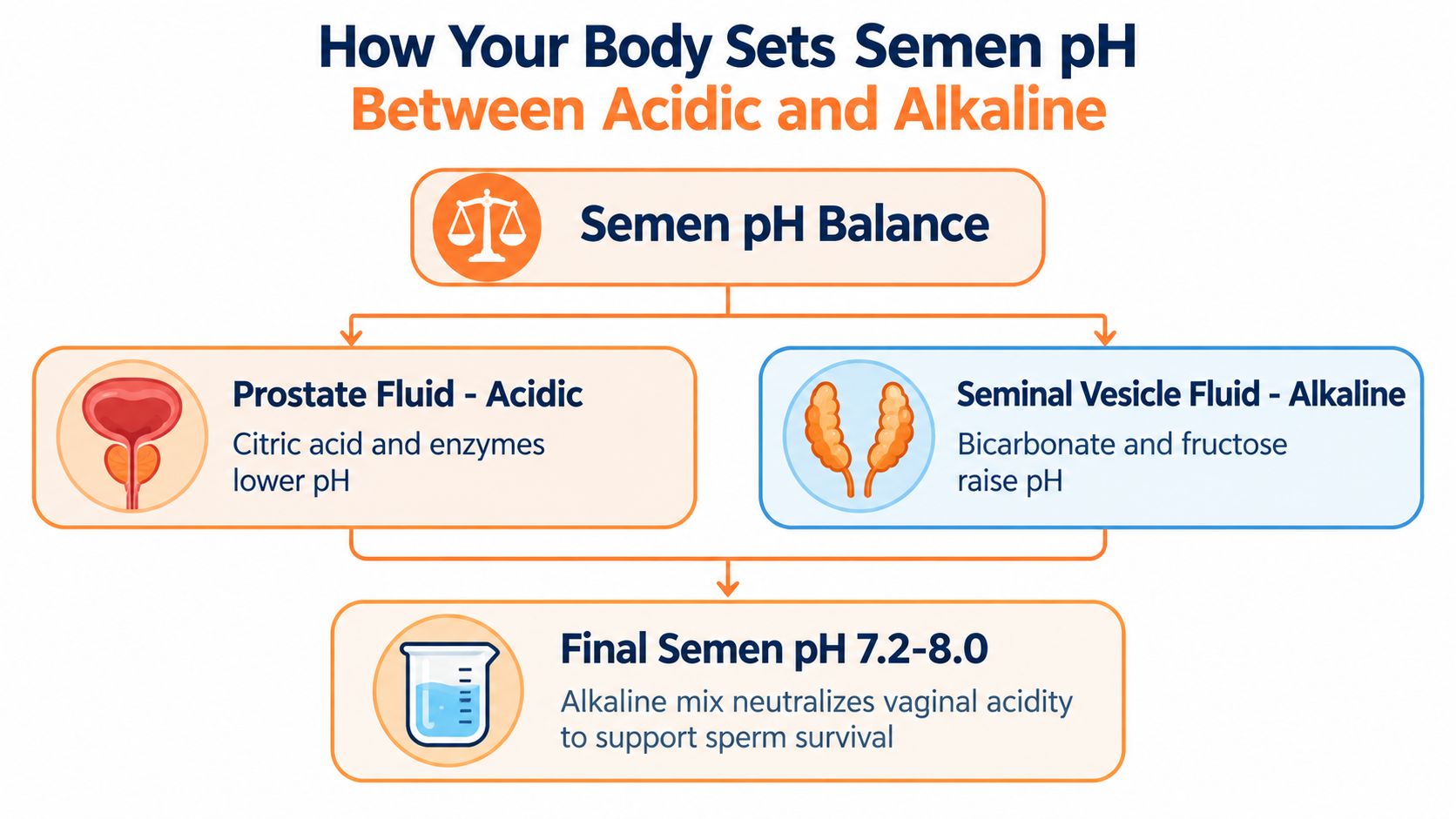
What makes semen mildly alkaline if one of its main contributors is acidic? The answer is the combined fluid environment created by several reproductive glands. Prostatic secretions are relatively acidic, while seminal vesicle fluid is alkaline. Their proportions help produce the slightly alkaline pH normally measured in semen.
Two streams flowing into one channel provide a useful comparison. One carries more acidic material, and the other carries more alkaline material. The final chemistry depends on how much each contributes, so semen pH is regulated by the mixture rather than by one organ working alone.
The prostate contribution
The prostate adds fluid containing substances such as citric acid and enzymes. Citric acid is a normal part of this secretion. Its presence does not mean that the entire ejaculate is abnormally acidic, because the final reading reflects the fluids combined after ejaculation.
The prostate and seminal vesicles contribute different chemical influences. Seminal vesicle fluid contains alkaline components, including bicarbonate, as well as fructose. Bicarbonate helps buffer acidity, while fructose serves as an energy-related component of seminal fluid.
Transport keeps the fluid environment stable
A recent academic review describes seminal plasma as maintained around pH 7.2 to 8.4 through the movement of hydrogen and bicarbonate (review of seminal plasma physiology). In practical terms, the reproductive tract controls chemical transport that affects acidity and alkalinity.
This buffering gives sperm a more suitable environment during and after ejaculation. Semen is not meant to be strongly alkaline. Instead, the mixture remains mildly alkaline, balancing the acidic prostate contribution and supporting sperm function as surrounding conditions change.
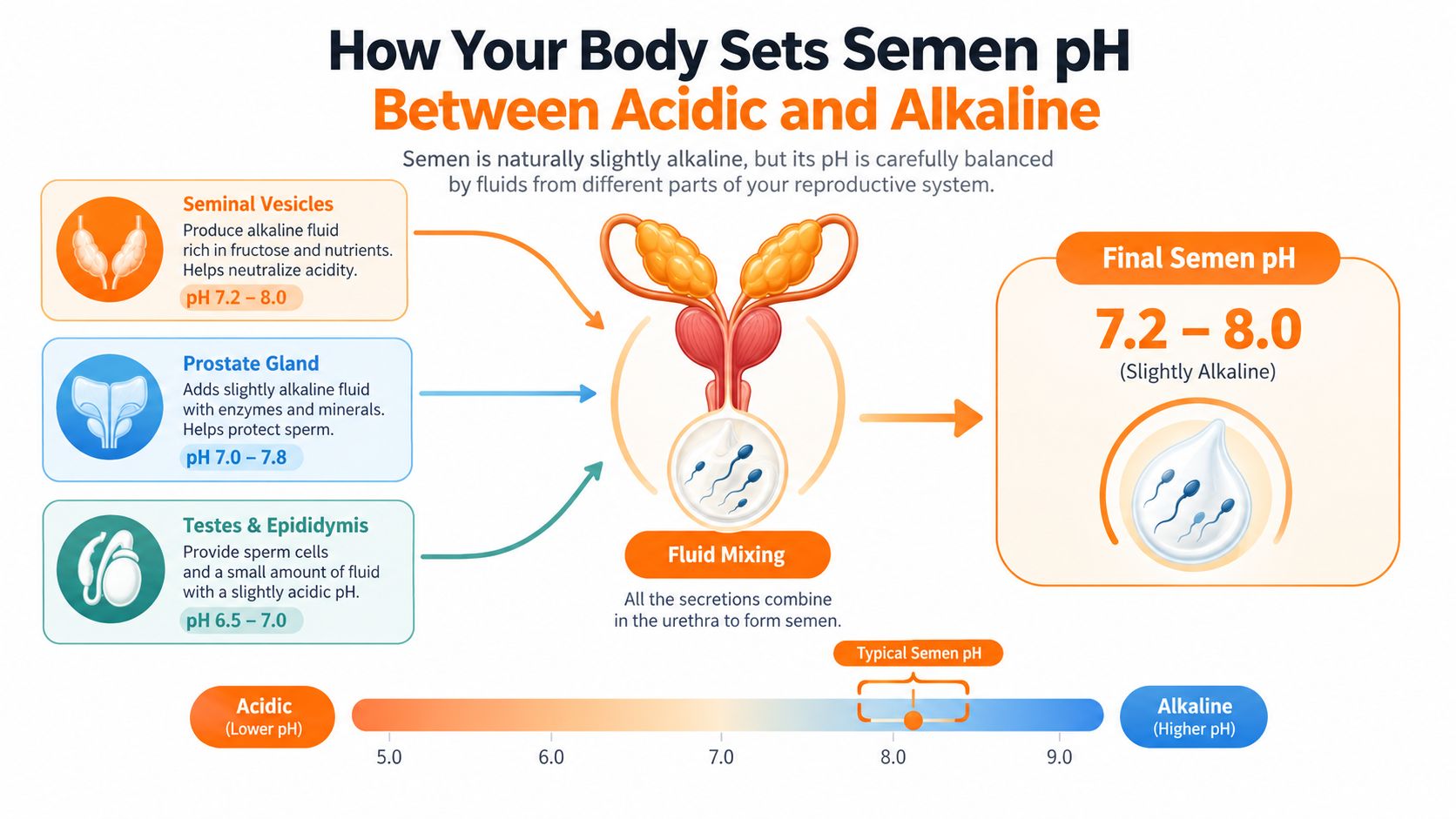
A low pH may indicate less alkaline seminal vesicle fluid or restricted movement through the reproductive tract. A higher pH may fit another pattern, including possible infection. Neither result identifies a cause by itself, so interpretation depends on the wider semen analysis and any related symptoms.
What Makes Semen More Acidic or More Alkaline
Could a semen pH result point to where the fluid mixture changed? It can offer a clue, but pH describes the semen environment, not an “acidic sperm” trait. A lower result may raise questions about seminal-vesicle fluid or passage through the ejaculatory ducts. A higher result may fit inflammation or infection. Neither result identifies one cause alone.
For clinical interpretation, pH below 7.2 can be more concerning when it appears with low semen volume and absent fructose. That pattern may reflect reduced seminal-vesicle contribution or a blockage involving the seminal vesicles or ejaculatory ducts. A clinical reference on semen pH also emphasizes that the surrounding findings matter more than an isolated reading.
Factors Linked to Lower vs Higher Semen pH
| pH Direction | Commonly Associated Pattern | Context to Check With Clinician |
|---|---|---|
| Lower than expected | Reduced seminal-vesicle contribution or possible blockage of the seminal vesicles or ejaculatory ducts | Semen volume, fructose, sperm presence, medical history, and reproductive anatomy |
| Higher than expected | Possible infection or inflammatory change | Symptoms, infection markers, leukocytes, examination findings, and repeat testing |
| Variable result | Collection, timing, handling, or biological variation | Laboratory method, abstinence instructions, sample completeness, and whether the pattern repeats |
Why the surrounding results matter
A low pH combined with low volume and absent fructose suggests a different pattern from a mildly unusual pH with otherwise unremarkable findings. Fructose helps clinicians trace seminal-vesicle fluid, so its absence may support the possibility that this contribution is not reaching the sample normally.
A higher pH also needs context. Values above 8 may suggest infection, while values below 7 may suggest seminal-vesicle blockage. These thresholds are prompts for clinical review, not instructions for self-diagnosis. The clinician may compare the pH with sperm presence, leukocytes, symptoms, examination findings, and the rest of the semen analysis.
Diet, hydration, illness, ejaculation timing, and sample handling can influence a sample's appearance or test result. Taste and appearance cannot replace laboratory testing. A repeated abnormal result carries more weight than a single impression, especially with pain, blood, burning, discharge, or difficulty conceiving.
Acid in Sperm and What It Means for Fertility Taste and Comfort
Does “acid in sperm” describe the sperm itself, or the fluid carrying it? In most discussions, pH refers to semen, the mixture surrounding sperm cells. That distinction connects three common questions: whether pH affects fertility, why semen may taste salty or sour, and which changes deserve medical attention.
Slightly alkaline semen can help sperm pass through the vagina's more acidic environment. This protective function describes the fluid environment, not a guarantee of healthy sperm. Semen pH alone also cannot measure sperm concentration, movement, or the ability to conceive. A complete semen analysis is needed for those questions.
Taste is more complicated than “acidic” or “alkaline”
Semen contains citric acid, amino acids, fructose, and zinc, among other substances. The News-Medical's semen physiology overview explains why normal semen may be described as mildly bitter, salty, or metallic rather than distinctly sour. For a plain-language explanation of why semen tastes salty, composition is more useful than treating taste as a pH test.
Taste remains subjective and is not a standardized medical measurement. A sour impression may relate to fluid composition, diet, contamination from another substance, or a change that needs assessment. One isolated flavor usually cannot identify the cause.
A persistent new change, especially with burning, pain, unusual discharge, blood, or a strong unpleasant odor, warrants clinical advice. The symptom pattern matters more than taste alone.
What ingredients can and can't mean
Zinc is a major semen constituent and a marker used in assessing male reproductive status. WHO-linked references list seminal zinc above 2.4 micromol per ejaculate as a normal reference limit, while the review of seminal zinc describes its relevance to sperm function and fertilization. These findings explain zinc's biological role. They do not show that taking zinc will change every man's semen or fertility.
L-arginine is used by nitric oxide synthase to produce nitric oxide. Researchers have measured nitric oxide synthase activity in human seminal plasma, as described in this research on nitric oxide synthase in semen. That connection describes reproductive-fluid physiology, not proof that a supplement treats a fertility problem.
For men reviewing ingredient-based products, SEMEX is a dietary supplement discussed in relation to semen volume and taste. It does not diagnose, treat, cure, or prevent a medical condition.
Common Myths About Acidic Semen You Can Stop Worrying About
Is “acidic sperm” describing the sperm cells themselves, or the fluid that carries them? That distinction makes several common myths easier to resolve. Semen is a mixture of secretions, and taste is not a substitute for laboratory testing.
Myth one, sperm cells become acidic
Reality: semen pH describes the fluid surrounding sperm. Sperm travel through contributions from the prostate and seminal vesicles, so the result represents the shared fluid environment, not a chemical label attached to each sperm cell. A pH result therefore needs to be read alongside the rest of the semen analysis.
Myth two, normal semen is acidic
Reality: normal semen is usually slightly alkaline. Clinical references place the expected lower boundary around 7.2, with typical values around 7.2 to 8.0, based on WHO reference material. A result below that range calls for context, such as collection conditions, other semen findings, and symptoms. It does not mean every ejaculate is naturally acidic.
Myth three, pH directly equals sperm motility
Reality: pH and motility answer different questions. A large patient study found no meaningful difference in mean pH between men with normal and abnormal sperm concentration or motility (population study of semen pH). Motility must be measured directly. One pH value cannot stand in for the movement or function of sperm.

Myth four, sour taste proves a medical problem
Reality: taste reflects semen composition and exposure. Citric acid is a normal semen constituent, and salty, bitter, or metallic descriptions can occur. Sourness alone is not a validated diagnostic test. Diet, infection, and contamination may also affect taste.
A practical rule: flavor can prompt a conversation, but a properly collected semen analysis and clinical assessment are needed to evaluate pH and reproductive function.
The useful question is not whether “acid in sperm” is good or bad. Ask whether a laboratory finding repeats, whether other markers are abnormal, and whether symptoms suggest infection or obstruction. This fluid-environment view replaces alarm with a clearer decision framework.
When to Seek Medical Advice and How Semen pH Is Evaluated
A clinician's evaluation starts with the entire semen analysis, not one isolated pH value. The review usually considers volume, sperm concentration, motility, morphology, fructose, infection indicators, and reproductive anatomy. A pH below 7.2 becomes more concerning when it appears with low volume and absent fructose, while a higher pH may prompt assessment for infection.
A simple appointment checklist
Before an appointment, a man can record the details that give a laboratory result context:
- The test result: Bring the exact pH, volume, sperm findings, fructose result, and laboratory reference range.
- Associated symptoms: Note pain, burning, blood, discharge, fever, discomfort with ejaculation, or a persistent change in odor.
- The pattern: Record whether the finding came from one sample or repeated testing.
- Fertility history: Include how long conception has been attempted, if relevant, and whether either partner has already had an evaluation.
- Collection details: Mention whether the sample may have been incomplete, delayed, or collected outside the laboratory.
A low pH with low volume and absent fructose may lead a clinician to consider reduced seminal vesicle contribution or blockage of the ejaculatory ducts. A high pH with symptoms may lead to infection testing. The anatomy and medical history help determine which explanation fits.
When prompt care makes sense
Persistent genital pain, painful ejaculation, blood in semen, urinary burning, unusual discharge, fever, or a repeated abnormal semen analysis shouldn't be handled through taste experiments or unverified online remedies. A urologist, primary-care clinician, or fertility specialist can decide whether repeat semen analysis, infection testing, imaging, or additional reproductive evaluation is appropriate.
The male fertility overview can help organize general questions, but it can't replace an examination or laboratory interpretation. General wellness habits may support normal reproductive function, yet supplements should be viewed as supportive tools, not substitutes for medical care.
For any dietary supplement, the label disclaimer is important: These statements have not been evaluated by the Food and Drug Administration. This product is not intended to diagnose, treat, cure, or prevent any disease.
SEMEX offers a men's dietary supplement formulated around ingredients such as zinc and L-arginine, which can be considered in a broader wellness routine related to semen volume and taste. Men interested in that option can visit SEMEX to review the product information and decide whether it fits alongside appropriate medical guidance.